
Forecasting the Silver Tsunami: A System Dynamics Approach to Alzheimer’s in the Czech Republic
Dynamic Modeling of the Czech Republic Population with a Focus on Alzheimer’s Disease Patients
This paper presents a predictive system dynamics model to forecast the Czech Republic's population and the number of Alzheimer’s Disease (AD) patients through the year 2100. By leveraging statistical data from the Czech Statistical Office (CZSO), the study utilizes sex-disaggregated cohorts to simulate the demographic shift toward an aging society and the subsequent rise in AD prevalence.
Executive Summary
TL;DR: This study develops a sophisticated simulation model to predict the trajectory of Alzheimer’s Disease (AD) in the Czech Republic up to the year 2100. By applying System Dynamics (SD), the researchers demonstrate that while the overall population is shrinking, the number of AD patients will skyrocket due to increased longevity, particularly among women.
Academic Positioning: This work bridges the gap between demographic forecasting and clinical epidemiology. It moves beyond static statistical projections by using a feedback-driven mathematical framework to visualize the looming healthcare crisis in Central Europe.
Motivation: The Hidden Burden of Longevity
The primary challenge in managing Alzheimer’s Disease is its "slow-burn" nature. It is an irreversible, neurodegenerative condition where symptoms often lag years behind biological onset. In the Czech Republic, current data shows a staggering trend: between 2013 and 2015, the cost of care rose by 30.1%, significantly outpacing the increase in the number of patients.
The authors argue that traditional linear models are insufficient. Why? Because the "risk" of AD is non-linearly coupled with age and gender. As the population "ages in place," the feedback loops between birth rates, migration, and medical advancement create a demographic profile that the current healthcare infrastructure is unprepared for.
Methodology: Stocks, Flows, and Feedback Loops
The researchers utilized System Dynamics (SD), a methodology founded on the principle that the behavior of a system is as much a result of its structure (the interactions between parts) as the parts themselves.
The Model Architecture
The model was built using the STELLA environment and divided into two core subsystems:
- General Population Subsystem: Modeled as 101 "Stocks" (age cohorts from 0 to 100).
- AD Patient Subsystem: Specifically tracks cohorts from age 60+, where the risk becomes statistically significant.
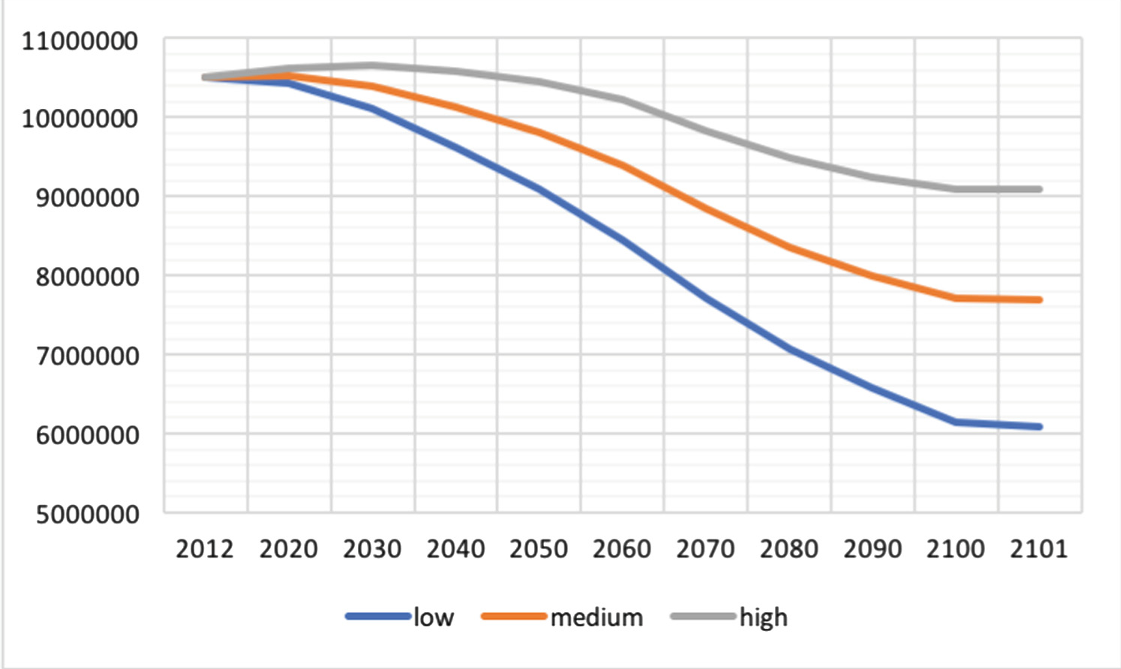 Figure 1: The non-sex disaggregated view of the population stock and flow structure.
The model accounts for gender dimorphism: women generally live longer but face a significantly higher risk of AD. This required two separate parallel simulations to ensure the final tally wasn't skewed by average life expectancy alone.
Deep Dive into Prediction Results
The simulation results provide a sobering look at the 21st century.
- The Gender Gap: The prognosis shows a dramatic divergence. Female AD patients are expected to peak near 200,000, nearly double the peak of their male counterparts (approx. 115,000).
- The Age Paradox: Even as the total population of the Czech Republic decreases due to low birth rates, the "Over 85" cohort—the highest risk group—is expected to expand significantly.
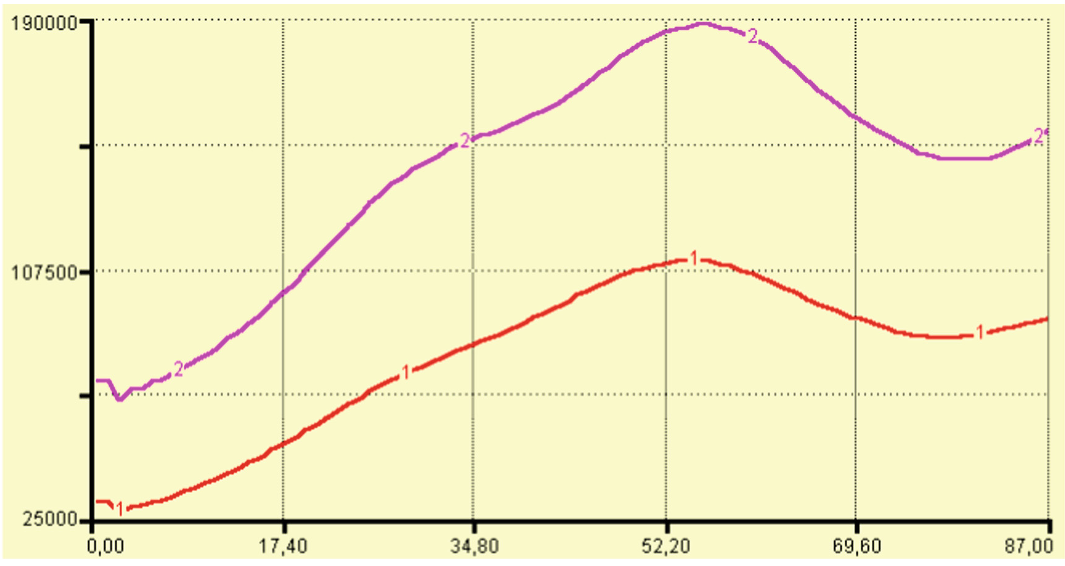 Figure 2: Forecasted growth of AD patients (Line 1: Men, Line 2: Women) showing the heavy burden on the female demographic.
The model’s validity was confirmed by comparing its baseline population results with the official Czech Statistical Office (CZSO) projections. The differences were "negligible," caused only by internal algorithm rounding, thereby solidifying the reliability of the AD-specific forecasts.
Critical Insight & Conclusion
Takeaway
The value of this paper lies in its predictive utility. It transforms abstract clinical data into a dynamic roadmap for policymakers. The "Silver Tsunami" isn't just about more elderly people; it is about a specifically diseased cohort that requires intensive, non-automated care.
Limitations & Future Work
While the model is robust, it primarily relies on historical prevalence rates. It does not currently account for:
- Medical Breakthroughs: Potential disease-modifying therapies that could slow AD progression.
- Migration Fluctuations: Drastic shifts in migrant demographics could alter the age-stock balance.
Future research should integrate Socio-economic feedback loops, where the cost of care itself impacts the quality of life and mortality rates within the model, creating an even more comprehensive "whole-system" understanding.
Keywords: System Dynamics, Alzheimer’s Disease, Population Modeling, Simulation, Czech Republic.