
Social Atoms: Predicting Network Evolution via Dynamic Molecular Modelling
Utilizing Dynamic Molecular Modelling Technique for Predicting Changes in Complex Social Networks
This paper introduces a novel framework for predicting the evolution of complex social networks by repurposing Dynamic Molecular Modelling (DMM). By treating social network nodes as interacting particles governed by modified Lennard-Jones potentials and using Minimum Volume Embedding (MVE) for 2D spatial mapping, the authors successfully simulated and predicted communication patterns within the Enron email dataset.
Executive Summary
TL;DR: This research bridges the gap between statistical physics and sociology by treating email-exchanging employees as "particles" in a potential field. By applying Dynamic Molecular Modelling (DMM) and the Lennard-Jones potential to the Enron dataset, the authors demonstrate that social network changes can be predicted with surprising accuracy using classical equations of motion.
Positioning: This work represents a sophisticated "Sociodynamics" approach, moving beyond simple graph metrics toward a continuous-space simulation of human interaction.
The Problem: The Static Nature of Social Graphs
Most social network models treat connections as binary or weighted edges in a vacuum. However, human relationships are dynamic: an intense period of communication often leads to a "cooling-off" period (repulsion), while distant acquaintances may gradually gravitate toward one another (attraction).
Previous methods using Cellular Automata were limited by discrete grids. The authors argue that a particle-based approach allows for a more nuanced representation of "social space," where the distance between individuals captures the latent potential for future interaction.
Methodology: From Emails to Equations
The authors propose a four-stage pipeline to transform raw communication logs into a physical simulation:
1. Data Preparation & Sliding Windows
Using the Enron email corpus, they extracted relationships for 151 users over 48 months. They employed a sliding time frame (60-day windows with 20-day offsets) to create a series of "temporal snapshots" of the network.
2. Minimum Volume Embedding (MVE)
Because social networks are not inherently metric, the authors used MVE to project nodes into a 2D Euclidean space. MVE was chosen for its stability and ability to preserve local distances more effectively than Kernel PCA or SDE.
3. Tuning the Social Potential
The core innovation lies in the adaptation of the Lennard-Jones Potential. Traditionally used to describe the interaction between a pair of neutral atoms, the authors re-tuned the formula:
While physics uses , social data suggested much "softer" interactions (). This potential ensures that when people get "too close" (too many emails), a repulsive force prevents total saturation, mimicking real-world social fatigue.
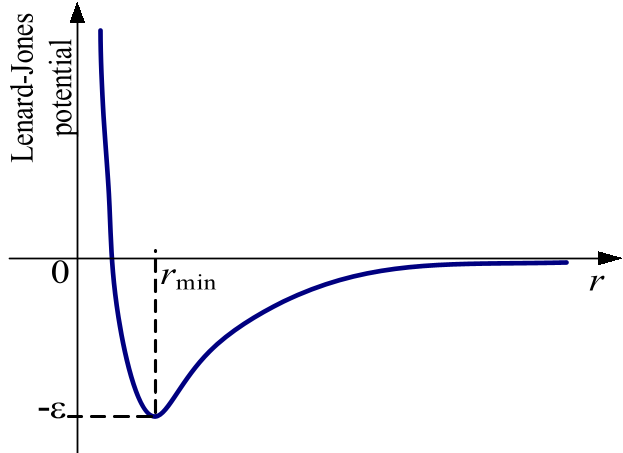 Figure 1: The potential function used to dictate node movement. The minimum represents the equilibrium point of social distance.
Experiments and Results
The simulation's performance was validated by comparing the predicted 2D positions of nodes against the actual MVE embeddings of future time windows.
- Short-term accuracy: At step , the correlation was a high 0.71.
- Long-term decay: By , the correlation dropped to 0.47.
The authors noted that roughly 10% of nodes—typically isolated or loosely connected users—behaved unpredictably. This suggests that the model is highly effective for the "core" of the network but struggles with "social outliers."
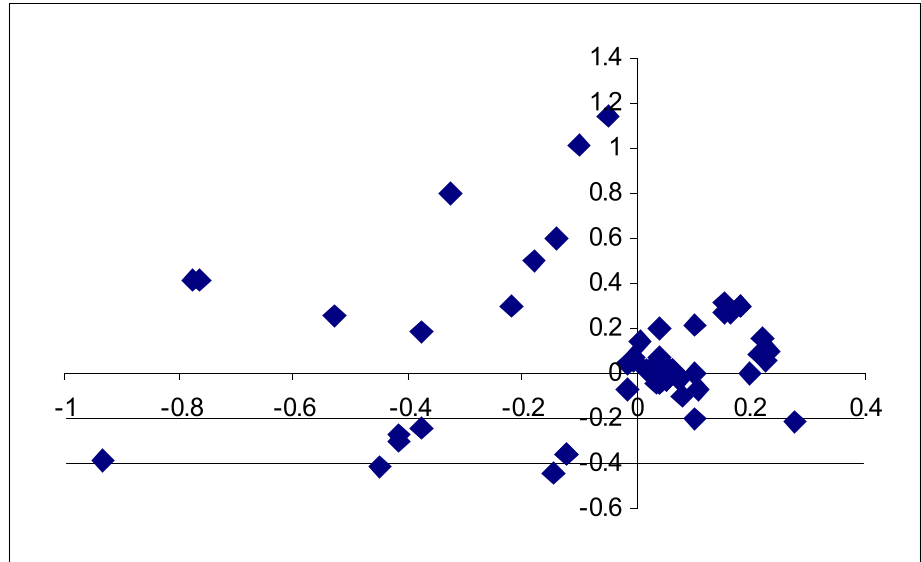 Figure 2: The predicted positions of 151 nodes after 25 simulation steps, showing the emergence of social clusters.
Critical Insight: Why Physics Works for People
The success of the DMM approach relies on the Social Force intuition. Figure 2 in the paper shows a trend: a massive spike in messages in one month almost always leads to a decrease in the next. This "regression to the mean" is perfectly captured by the repulsive part of the molecular potential, providing a more robust predictive framework than simple linear extrapolation.
Conclusion and Future Outlook
This paper proves that the "atoms of society" follow semi-predictable physical laws. However, the model currently assumes all users share the same "potential function." Future work should focus on heterogeneous potentials—acknowledging that an CEO’s "social gravity" is vastly different from that of a junior employee.
Takeaway for Practitioners: When modeling long-term trends in user interaction, look beyond graph theory; the laws of thermodynamics and motion might offer a more accurate lens for the "social heat" of your platform.