
[NeurIPS 2024] DPTS: Breaking the Efficiency Bottleneck of LLM Tree Reasoning
Dynamic parallel tree search for efficient llm reasoning
This paper introduces Dynamic Parallel Tree Search (DPTS), a novel parallelism framework designed to accelerate Tree of Thoughts (ToT) reasoning in Large Language Models. By implementing a Parallelism Streamline and a Search and Transition Mechanism, DPTS achieves a 2-4x speedup over standard MCTS while maintaining or improving reasoning accuracy across math and code benchmarks.
TL;DR
While OpenAI’s o1 has proven that "thinking" longer leads to better results, the computational cost of Tree of Thoughts (ToT) reasoning remains prohibitive. Dynamic Parallel Tree Search (DPTS) is a new framework that treats reasoning not as a sequential path, but as a dynamic parallel stream. It achieves a 2-4x speedup over Monte Carlo Tree Search (MCTS) by parallelizing arbitrary reasoning paths and aggressively pruning suboptimal "thought branches" before they waste GPU cycles.
The "Thinking" Tax: Why Tree Search is Slow
Current LLM reasoning algorithms like ToT and MCTS are essentially "System 2" thinkers—they explore multiple possibilities before committing to an answer. However, they face a massive "efficiency tax" due to two obstacles:
- Parallelism Incompatibility: Tree search involves backtracking and branching. different branches have different lengths. Standard GPUs hate this irregularity; they prefer uniform, batch-processed data.
- The Suboptimal Trap: Standard MCTS often spends 90%+ of its tokens exploring paths that have a near-zero probability of being correct simply because they haven't hit a "limit" yet.
Methodology: Engineering the Reasoning Stream
The authors propose DPTS, which re-engineers the search process to be "GPU-native" through two key modules.
1. The Parallelism Streamline
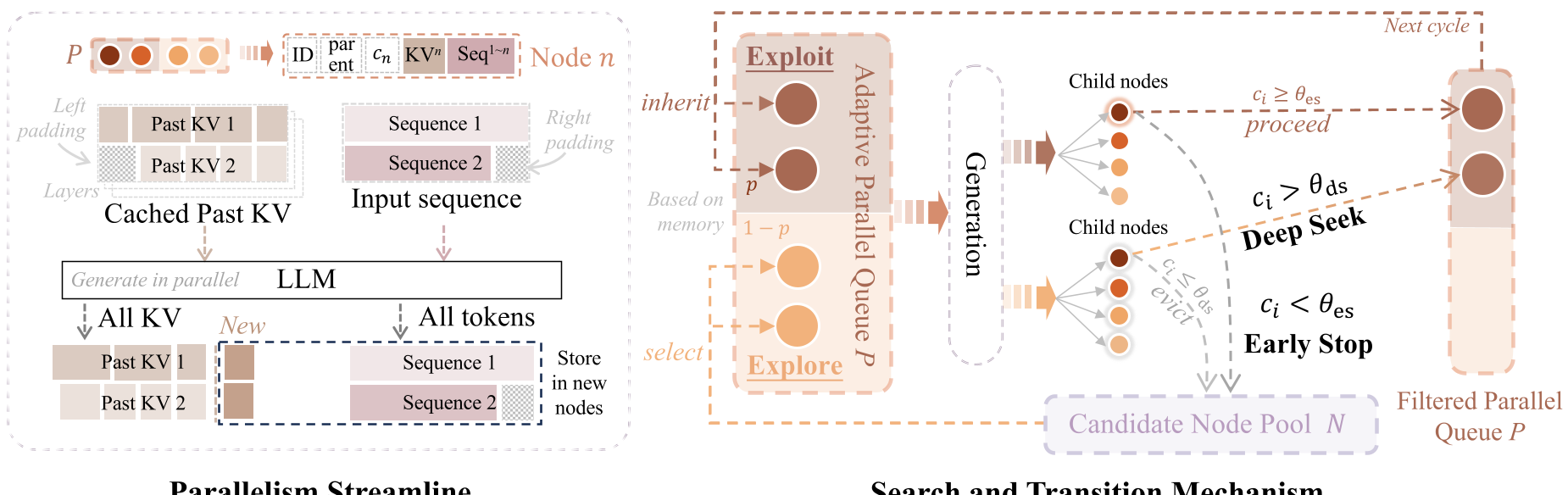
Traditional inference processes one sequence at a time. DPTS introduces a specialized Node Data Structure that isolates KV-caches for every node. By using a clever padding and concatenation strategy, DPTS can batch together nodes from completely different depths and different branches into a single GPU forward pass.
- Adaptive Queueing: DPTS monitors GPU memory in real-time. If there is spare VRAM, it increases the number of parallel "thoughts"; if memory hits a limit, it prunes the queue to prevent OOM (Out of Memory) crashes.
2. Search and Transition Mechanism
This is the "brain" of the operation. Instead of treating all paths equally, DPTS splits them into:
- Exploitation Nodes: High-confidence paths that are being pushed toward a final answer.
- Exploration Nodes: New branches being "tested" for potential.
The Transition part is critical:
- Early Stop (ES): If an exploitation path's confidence drops below a dynamic threshold (θes), it is immediately killed. No more wasted tokens.
- Deep Seek (DS): If an exploration node shows a sudden spike in confidence, it is "promoted" to the exploitation queue for deeper, faster processing.
Experiments: Faster Thinking, Better Results
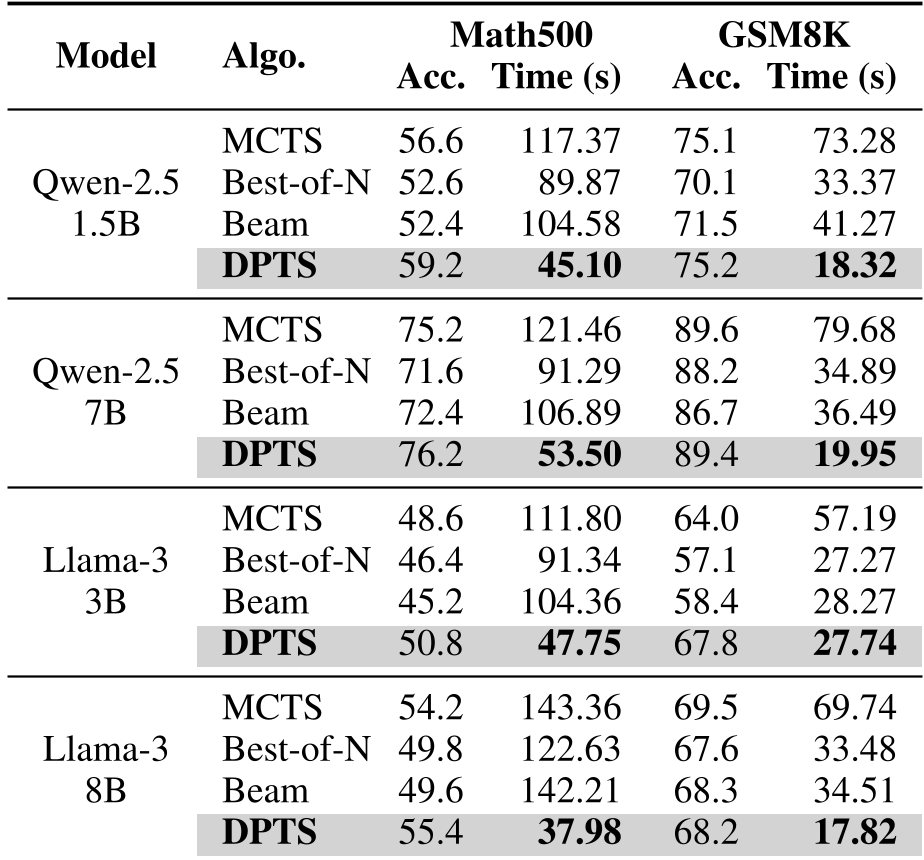
The authors tested DPTS on the Qwen-2.5 and Llama-3 families across Math500 and GSM8K.
Efficiency Gains
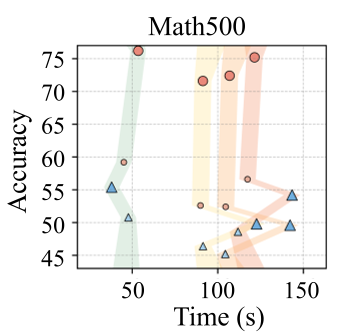
DPTS doesn't just shave off a few seconds; it fundamentally changes the scaling curve. On Qwen-2.5-7B, MCTS took ~121 seconds per math problem. DPTS did it in 53 seconds. On GSM8K, the speedup reached nearly 4x.
Accuracy Boost
Counter-intuitively, DPTS often achieves higher accuracy than the slower MCTS. Why? Because by pruning "dead-end" thoughts early, the model can spend its fixed time budget exploring more high-quality candidates. On Qwen-2.5-1.5B, accuracy jumped from 56.6% to 59.2%.
Critical Insights & Takeaways
The core value of DPTS is its recognition that inference-time scaling is a resource allocation problem.
- Pruning is as important as Generation: Most LLM reasoning work focuses on making nodes better. DPTS focuses on not making bad nodes at all.
- The Memory-Compute Trade-off: By utilizing more VRAM to store distinct KV-caches for parallel nodes, DPTS trades space for a massive reduction in wall-clock time.
- Scalability: The method scales exceptionally well to large models (72B+), where the cost of sequential reasoning is otherwise prohibitive.
Conclusion
DPTS provides a vital blueprint for the next generation of "Thinking Models." By moving away from sequential, MCTS-style search and toward a dynamic, parallel, and hardware-aware framework, we can achieve o1-level reasoning capabilities without the crippling latency.
Disclaimer: This blog is a technical summary based on the paper "Dynamic Parallel Tree Search for Efficient LLM Reasoning". For detailed implementation, visit the official repo.