
Decoding Affective Dynamics: A Fisher Kernel Approach to Emotion Regression
Dynamic physiological signal analysis based on Fisher kernels for emotion recognition
The paper introduces a dynamic physiological signal analysis framework for emotional regression, leveraging Autoregressive Hidden Markov Models (AR-HMM) and Fisher Kernels. By mapping multimodal biosignals—including EEG, EMG, and GSR—into a fixed-dimension Fisher score space, the researchers achieved superior regression accuracy on the DEAP dataset compared to traditional static characterization methods.
TL;DR
The research addresses the challenge of continuous emotion recognition by converting dynamic, variable-length physiological signals into a structured "Fisher Score" space. By integrating the temporal modeling of Hidden Markov Models (HMM) with the predictive power of Support Vector Regression (SVR), the authors significantly reduce error rates in predicting Valence and Arousal compared to traditional static feature sets.
Motivation: Why Static Features Are Not Enough
Human emotions are not snapshots; they are processes. Traditional affective computing often relies on "static characterization"—calculating the mean or variance of a signal over a window. This approach discards the vital temporal "signature" of how a signal evolves. Furthermore, physiological data often comes in variable lengths, creating a mismatch with modern machine learning algorithms that require fixed-dimension inputs. The authors sought a bridge between Generative Modeling (to capture signal life-cycles) and Discriminative Regression (for high-accuracy prediction).
Methodology: The AR-HMM-Fisher Pipeline
The framework operates in three distinct phases:
- Temporal Feature Extraction: The system uses Autoregressive (AR) models to represent the linear dependencies in time-series data, extracting coefficients that describe the signal's "momentum."
- Generative Modeling (AR-HMM): These coefficients are fed into a Left-to-Right HMM. The HMM identifies "states" of physiological activity, effectively modeling the latent transition of an emotional response.
- Fisher Kernel Mapping: This is the "secret sauce." Instead of using the HMM outcome directly, the authors calculate the gradient of the model's parameters. This maps a sequence of any length into a fixed-dimensional Fisher Score space, representing how much the model parameters would need to change to perfectly fit that specific data point.
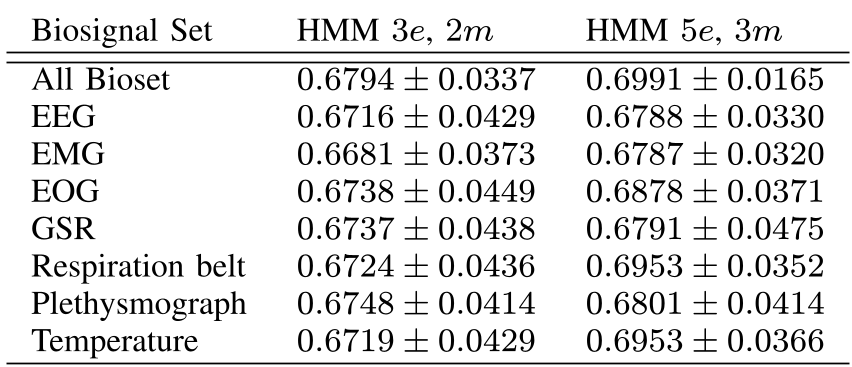 Table 1: Comparison of HMM configurations (States vs. Gaussians) showing the stability of the 3e, 2m setup.
Experiments and Key Results
The authors validated their approach on the DEAP dataset, a gold standard in affective computing featuring 32 participants and a wide array of signals (EEG, EMG, GSR, etc.).
- Dynamic vs. Static: The results clearly favored the dynamic framework. For instance, in "Passive Arousal" tasks, the dynamic model achieved an RMSE of 0.6117, compared to 0.6539 for static features.
- The Power of Multimodality: While EEG is the most sensitive to valence, combining all biosignals (GSR, Respiration, Temperature, etc.) yielded the most robust performance across the Valence/Arousal spectrum.
- Kernel Selection: The choice of SVR kernel matters; the study shows that RBF (Radial Basis Function) kernels generally outperform polynomial kernels in mapping these complex Fisher scores.
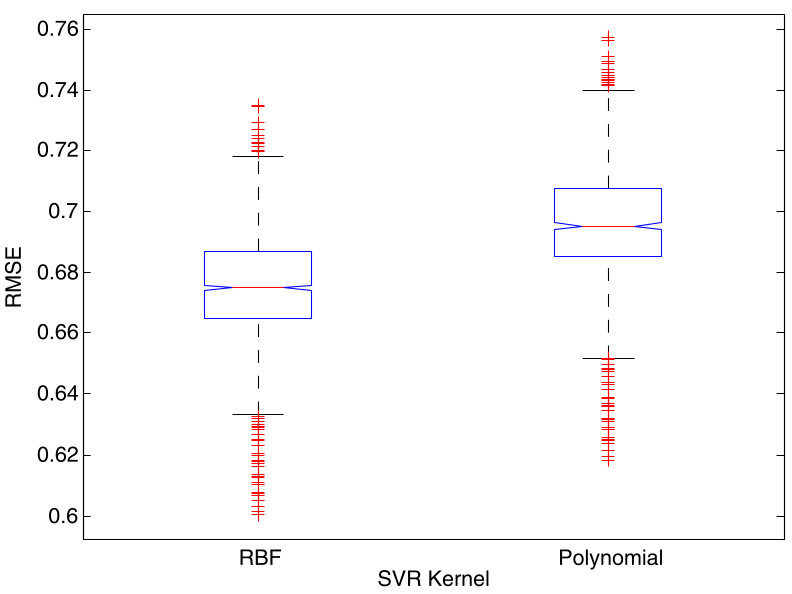 Figure 1: RMSE performance across different kernels, highlighting the efficacy of RBF in handling Fisher scores.
Critical Insight: The Value of "Model Distillation"
The core achievement here is the realization that the sensitivity of a model to its data (the Fisher Score) is often a more powerful feature than the data itself. By using the HMM as a "feature extractor" rather than a final classifier, the authors circumvented the limitations of HMMs in high-dimensional regression.
Conclusion & Future Outlook
This work demonstrates that the temporal dynamics of the body—the way our heart rate fluctuates or our brain waves shift over a one-minute music video—contain critical information often missed by static averaging.
Future Work: The authors suggest that the "curse of dimensionality" remains an issue for Fisher scores. Future research would benefit from applying Dimensionality Reduction (PCA or LDA) to the Fisher Score space or expanding the framework to include video-based facial expression analysis for a truly holistic affective interface.