
[SIGIR 2025] Dynamic Pivot: Leveraging LLM-Generated Reference Documents for Ultra-Efficient Reranking
Dynamic Ranked List Truncation for Reranking Pipelines via LLM-generated Reference-Documents
The paper introduces a novel framework for efficient information retrieval by using Large Language Models (LLMs) to generate "reference documents" that act as semantic pivots. These pivots enable dynamic Ranked List Truncation (RLT) and accelerate listwise reranking (via methods like SNOW and VS-Sliding), achieving up to 66% reduction in inference latency while maintaining or improving SOTA effectiveness.
TL;DR
The computational "tax" of LLM-based reranking is a major bottleneck in production search. This paper proposes a paradigm shift: instead of just using LLMs to score documents, use them to generate a semantic "pivot" document. This pivot acts as a benchmark to instantly prune irrelevant candidates and enable parallelized listwise reranking, cutting latency by up to 66% without sacrificing accuracy.
Problem & Motivation: The Tyranny of the Fixed Cut-off
Standard retrieval pipelines follow a "Retrieve-then-Rerank" pattern. However, the reranker—often a heavy model like RankZephyr or GPT-4—usually processes a fixed number of documents (e.g., top 100). This is inherently flawed:
- Query Insensitivity: A simple query might only have 5 relevant documents; a complex one might have 50. Fixed truncation wastes cycles on noise or misses signal.
- Sequential Bottlenecks: Listwise LLM rerankers typically use "sliding windows" with fixed strides, which are painfully sequential and slow.
The authors' core insight is that LLMs possess an internal "relevance scale." By asking an LLM to generate a moderately relevant document for a query, we create a custom "yardstick" to measure the rest of the retrieved list.
Methodology: The Pivot as a Multi-Tool
The authors propose PSI-Rank, a framework that uses an LLM-generated reference document () as a semantic boundary.
1. Pivot Generation
The system prompts an LLM to generate a document that is "moderately relevant" (Grade 2 on the TREC scale). This document isn't a perfect answer but provides a stable semantic boundary between high-precision results and "tail" noise.
2. SNOW & VS-Sliding: Breaking the Sequential Chain
The paper introduces two breakthrough listwise strategies shown in the architecture below:
- SNOW (Shared Non-Overlapping Window): Unlike the traditional sliding window that requires overlaps for document propagation, SNOW injects the pivot into multiple parallel windows. This allows documents to be promoted relative to the pivot simultaneously.
- VS-Sliding (Variable Stride Sliding): In areas where document density is low (the "tail" of the list), the stride increases to skip irrelevant content. It slows down only when it detects a cluster of pivot-beating candidates.
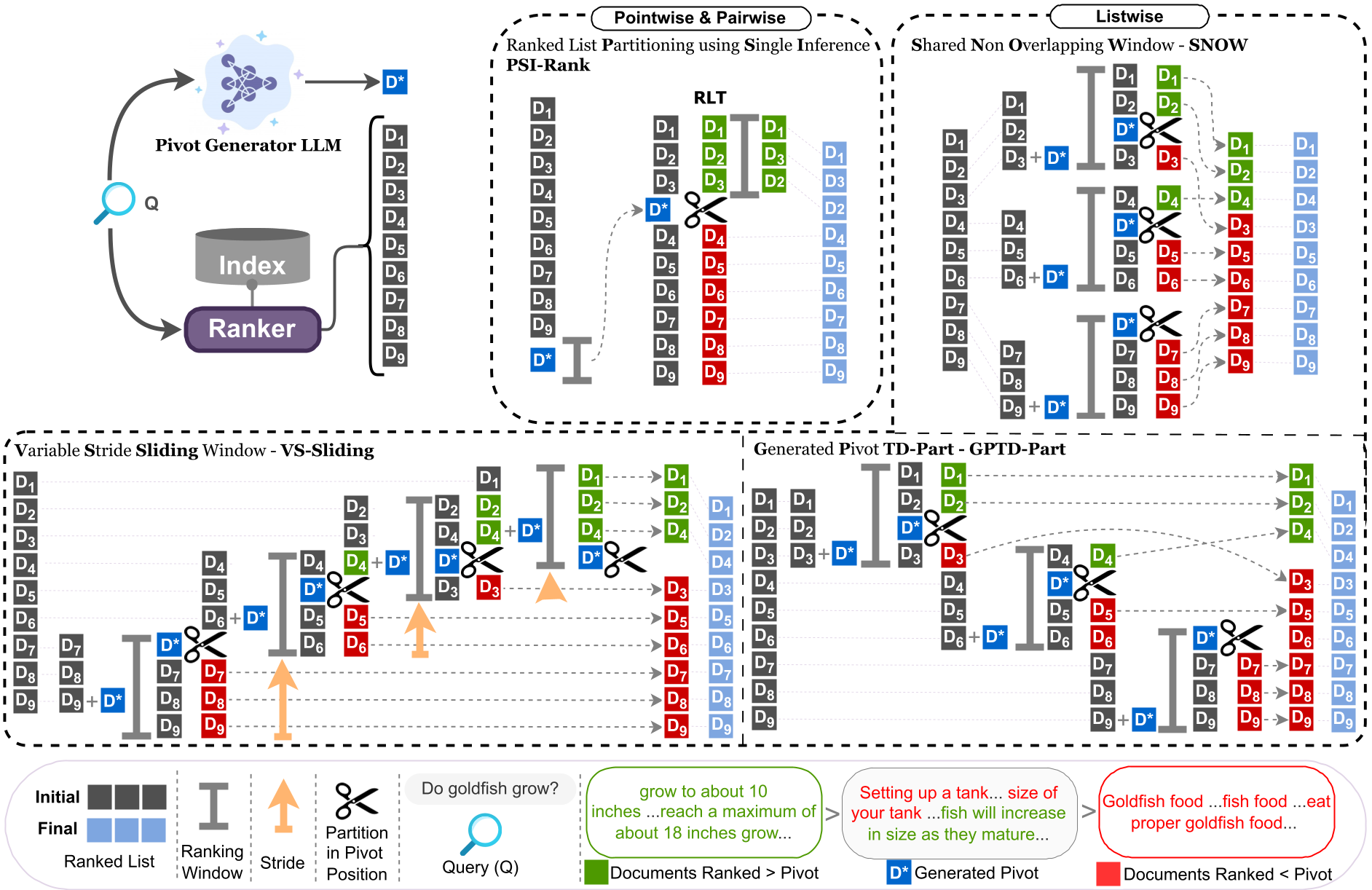 Figure 1: Comparison of PSI-Rank (Pointwise/Pairwise) and parallelized listwise strategies (SNOW, VS-Sliding).
Experiments & Results: Efficiency without Compromise
The researchers benchmarked their approach against standard RLT models (Choppy, AttnCut) and listwise baselines.
Truncation Performance
PSI-Rank effectively "shrank" the reranking workload. In out-of-domain tasks like SciFact, the method achieved peak performance by reranking only 25% of the original list.
Reranking Speed-up
The efficiency gains in listwise setups are the highlight. By utilizing the pivot to enable parallel processing, the SNOW method achieved a speed-up of 2.95x on the DBPedia dataset while maintaining competitive nDCG scores.
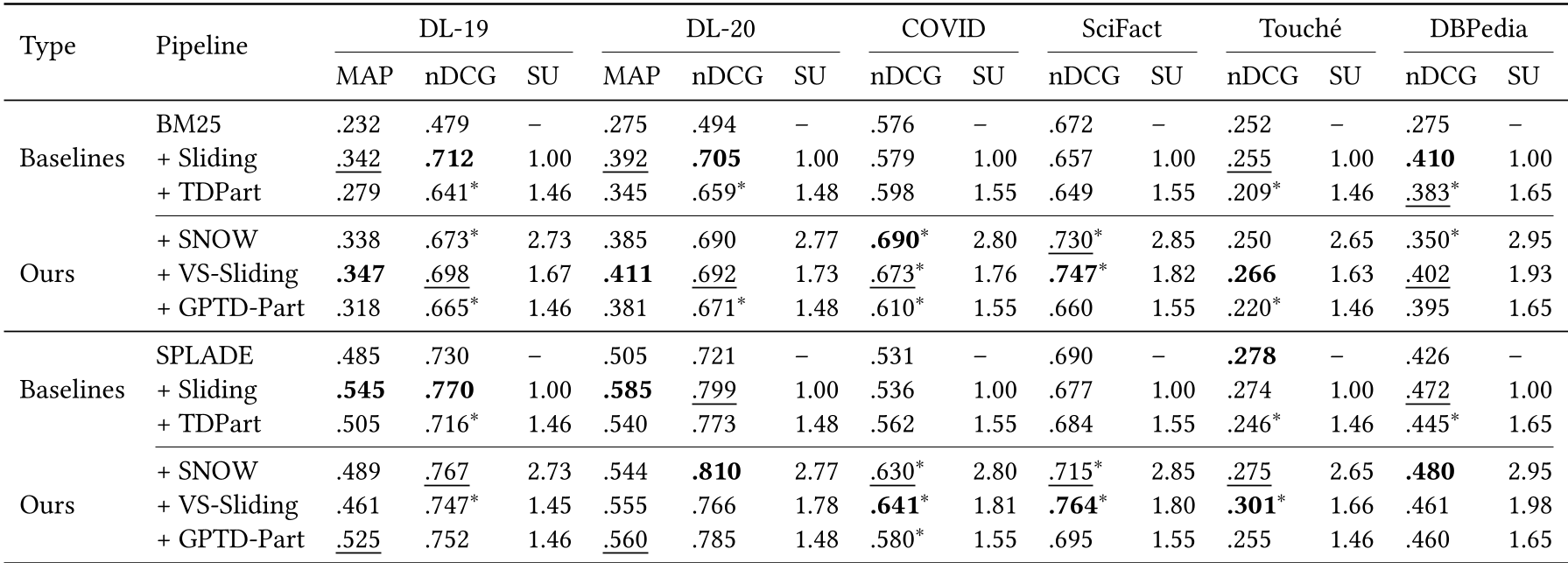 Table 1: Performance comparison showing significant Speed-Up (SU) across various BEIR datasets.
Deep Insight: Is the Pivot Model-Dependent?
A critical question (RQ3) was whether the quality of the pivot depends on using a massive model like GPT-4o. Interestingly, the study found that Llama-3-8B produced pivots that were just as effective—and sometimes more stable—than those from larger models. This suggests the "semantic boundary" property is a robust emergent feature of instruction-tuned LLMs, not just a brute-force scaling effect.
Conclusion & Future Outlook
This work moves beyond the view of LLMs as mere "calculators" of relevance scores and positions them as "content architects" for search infrastructure. By generating a single pivot, we can:
- Unblock Parallelism: Move from sequential sliding windows to parallel batch processing.
- Adaptive Pruning: Stop wasting GPU hours on the irrelevant tail of ranked lists.
Limitations: The latency of the initial pivot generation itself must be low. If the generation takes longer than the reranking of 10 documents, the efficiency gains only materialize for longer ranked lists (e.g., ). Takeaway: Effective IR is increasingly about "semantic signal processing" rather than just keyword matching.