
Hybrid Intelligence: Bridging Impromptu Socializing and Dynamic Scene Recognition
A Dynamic Scene Recognition Method for Event-Based Social Network
The paper introduces a dynamic scene recognition method tailored for Impromptu Event-based Social Networks (IEBSN) by combining a supervised Convolutional Neural Network (CNN) with unsupervised K-means clustering. The system aims to automate event scene labeling and recommendation using a custom Convolutional Feature Encoder and a threshold-based fallback mechanism.
TL;DR
To solve the inefficiency of manual event tagging in Impromptu Event-based Social Networks (IEBSN), this paper proposes a dual-mode recognition system. By combining a Convolutional Feature Encoder (supervised) with a K-means clustering fallback (unsupervised), the system achieves robust scene classification even when faced with the noisy, blurred, and context-dependent images typical of spontaneous social gatherings.
Background: The "Impromptu" Challenge
Event-based Social Networks (EBSN) like Meetup usually involve planned activities. However, IEBSNs focus on the "now"—spontaneous events where users upload photos on the fly. In these moments:
- Manual tagging is slow: Users don't want to type descriptions during a party.
- Scene Ambiguity: A "coffee shop" and an "airplane cabin" might both contain seats and tables, but their spatial layouts (the "scene") are distinct.
- Noisy Data: User-uploaded photos are often blurred or poorly framed, confusing standard object-centric classifiers like ResNet.
Why Object Recognition Isn't Enough
The authors argue that scene recognition is more abstract than object recognition. While recognizing a "cup" is about local features, recognizing a "cafe" is about the spatial relationship between the cup, the counter, and the lighting. Traditional CNNs use Fully Connected (FC) layers at the end, which collapse spatial information into a global vector. This is detrimental for scenes where local context and layout are key.
Methodology: The Convolutional Encoder & Dynamic Clustering
1. The Convolutional Feature Encoder
Taking inspiration from Fully Convolutional Networks (FCN), the authors replace the FC layers with convolutional filters. This allows the model to act as a sliding window over the image, preserving the spatial structure of the features.
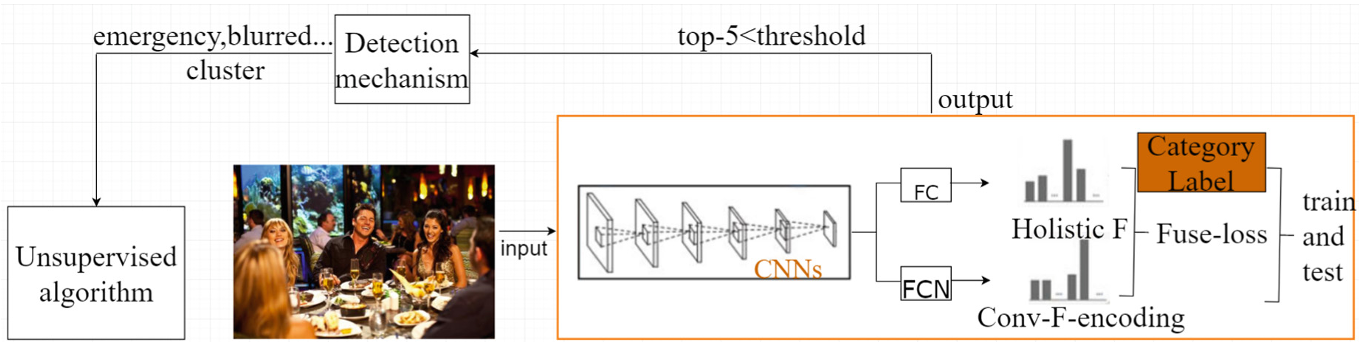
The mathematical intuition involves transforming the weight matrix of a connected layer into a convolutional kernel, allowing the model to compute dot products across local regions while sharing parameters:
2. The Unsupervised Fallback
Not every image can be classified with high confidence. The system uses a "Detection-Mechanism": if the Top-5 probability of the supervised model is below a specific threshold, the image is passed to a K-means clustering module. This ensures that even "unknown" or highly blurred scenes are grouped logically for future recommendation, rather than being misclassified into a wrong category.
Experimental Insights
The model was validated using Places2, the world's largest scene dataset (10M+ images). The analysis focused on "blurred samples"—classes like airplane_cabin where variety is high.
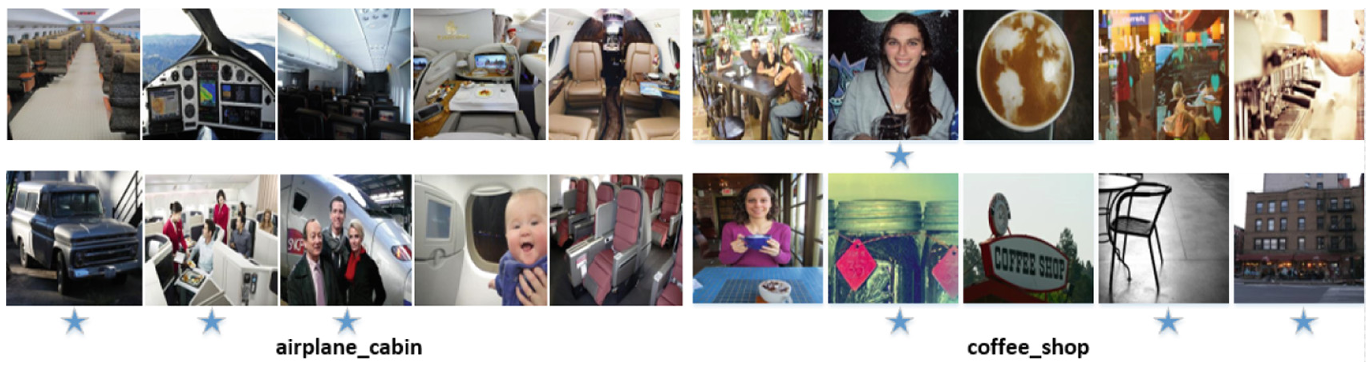
The experiments confirmed:
- Context Matters: Capturing local visual patches via the Convolutional Encoder outperformed global FC features in complex architectural environments.
- Real-time Ready: The K-means module, evaluated via the Silhouette Coefficient, proved fast enough for mobile social applications.
Critical Analysis & Future Outlook
While the hybrid approach effectively handles the "noise" of impromptu socializing, the paper acknowledges a significant hurdle: Dataset Bias. Current models still rely heavily on the specific objects present in a scene.
The true "holy grail" of scene recognition lies in Reasoning Ability—teaching a model to understand why a certain layout constitutes a "party" vs. a "meeting," beyond just spotting a cake or a whiteboard. Future work will likely look toward Vision Transformers (ViTs) or Graph Neural Networks to better model these abstract dependencies.
Conclusion
This work represents a practical leap for IEBSNs. By moving away from rigid manual tagging and leveraging the spatial-preserving power of convolutional encoders, social platforms can become significantly smarter, offering "silent" but accurate event recommendations in real-time.