
Dynamic Social-Aware Computation Offloading: Beyond Latency and Energy in IoT
Dynamic Social-Aware Computation Offloading for Low-Latency Communications in IoT
This paper proposes a dynamic social-aware computation offloading scheme for D2D-assisted Mobile Edge Computing (MEC) in IoT. It introduces a Lyapunov-based Drift-Plus-Penalty (DPP) algorithm to jointly optimize task execution latency and energy consumption by leveraging social trust levels between devices.
TL;DR
In the face of the resource-constrained nature of IoT devices, this paper introduces a social-aware computation offloading framework for D2D-assisted Mobile Edge Computing (MEC). By leveraging social trust levels to guide the partitioning of computing and transmission power, and utilizing a Lyapunov-based Drift-Plus-Penalty (DPP) algorithm, the authors successfully minimize the trade-off between energy consumption and latency while ensuring system stability in dynamic environments.
1. The Conflict: Resource vs. Demand
The Internet of Things (IoT) landscape is defined by a paradox: applications require increasingly extreme low latency (Real-time sensing, AR/VR), yet the smart devices themselves remain battery-constrained and computationally weak.
While Mobile Edge Computing (MEC) brings servers closer to the edge, the bottleneck often shifts to the wireless uplink. Device-to-Device (D2D) communication offers a solution by using neighbors as relays or processing units. However, previous works ignored a vital human factor: Trust. Why would a user allow their device to process another's data without a social relationship or incentive? This paper fills that gap by integrating social awareness into the offloading decision matrix.
2. Social Trust Meets Physical Resources
The core innovation lies in the Social Layer Model. The authors define a time-varying social trust matrix , where represents the trust level between users.
The Methodology Architecture
The paper defines four offloading modes:
- Local Offloading: Processing on the device itself.
- Direct Cloud Offloading: Sending data directly to the MEC server via a cellular link.
- Direct Cooperative Mobile Peer Offloading: Using an idle neighbor's CPU. The neighbor's allocated frequency is scaled by their trust level: .
- D2D-Assisted Cloud Offloading: Using a neighbor as a relay to reach the cloud, with transmit power scaled by trust.
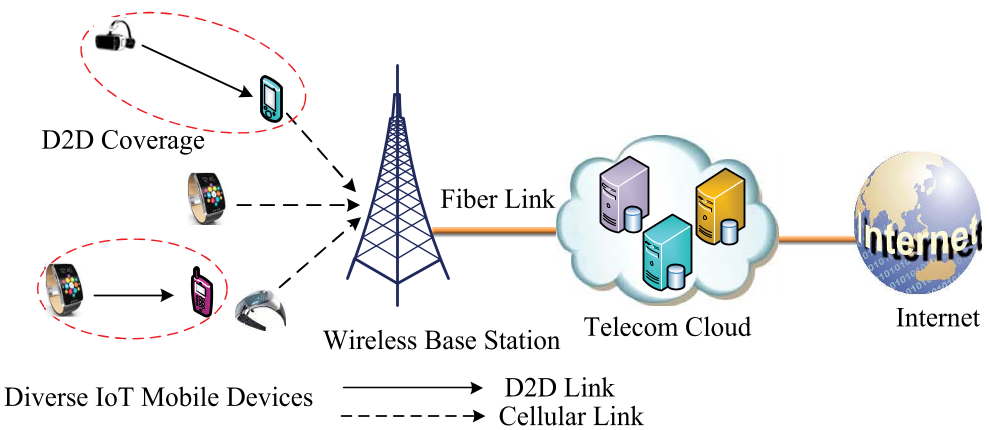 Fig. 1: Illustration of MEC for diverse IoT mobile devices involving direct and D2D-relay paths.
3. Optimization via Lyapunov Framework
To handle the dynamic nature of tasks and mobility, the problem is formulated as an infinite-horizon time-average renewal-reward problem. The goal is to minimize a weighted utility of latency and energy:
The authors use the Drift-Plus-Penalty (DPP) algorithm. By creating a Virtual Queue for latency constraints, they ensure that if the queue remains stable, the long-term latency constraints are met. At each time slot, the system simply minimizes:
This approach effectively turns a complex long-term optimization into a series of greedy, short-term decisions that are computationally efficient.
4. Experimental Results and Insight
The study utilized the Infocom06 user mobility trace and the Gauss-Markov mobility model to simulate realistic IoT environments.
Key Performance metrics:
- The V-Tradeoff: Increasing the parameter allows the system to push the utility (energy/latency) lower, but at the cost of longer convergence time for the latency constraints.
- Bandwidth Sensitivity: As subchannel bandwidth increases, the system shifts preference from local/peer processing to D2D-assisted cloud offloading.
- Competitiveness: The DPP algorithm performs nearly as well as the Branch and Bound (BnB) method but with significantly lower computational overhead.
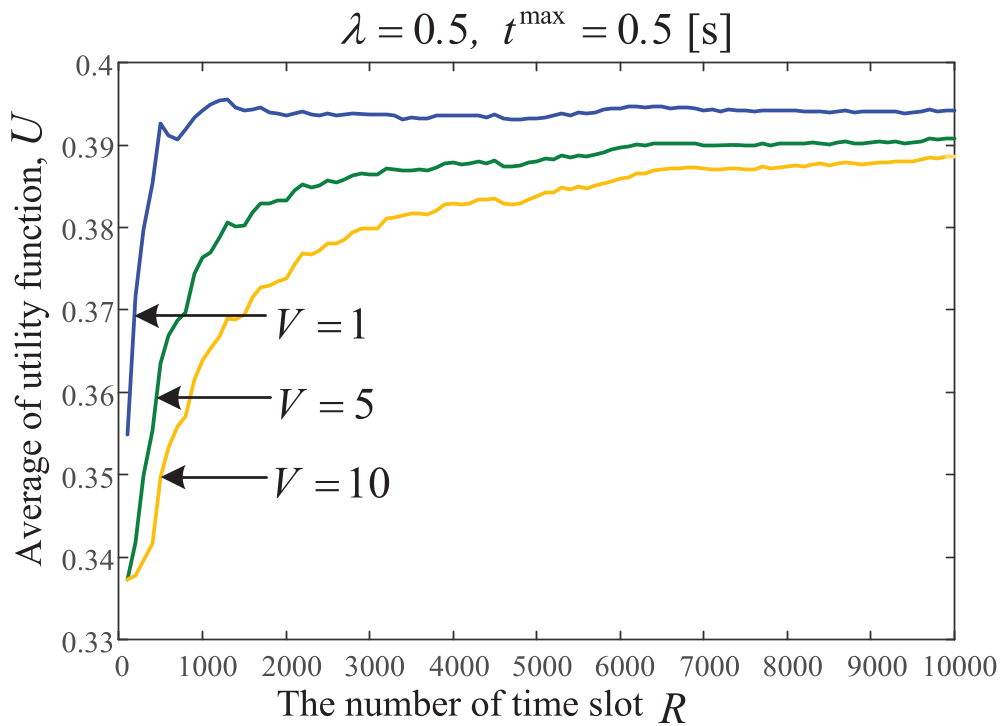 Fig. 2: (a) Utility vs. V, showing the 1/V convergence; (b) Sample path of average latency showing stability.
5. Critical Analysis & Future Outlook
The "Social-Aware" approach is a significant step toward making D2D offloading practical. By making the resources (CPU, Power) dependent on trust (), the model inherently incentivizes or restricts cooperation based on relationship quality.
Limitations:
- The model assumes the MEC server (Cloud) has fixed resource contracts, whereas in reality, these could be dynamic.
- The "Trust Score" is treated as an input; however, in a real system, the discovery and verification of these scores would create its own overhead.
Takeaway: This work proves that cross-layer design—combining social network theory with stochastic physical resource optimization—is the key to scaling the "Internet of Everything."