
Dynamic Social Caching: Predicting Content Demand through the Lens of User Mobility
A dynamic social content caching under user mobility pattern
This paper introduces a dynamic social content caching scheme that integrates user mobility patterns with social network propagation. By combining Collaborative Filtering (CF) for preference prediction and a Markovian Evolving Graph (MEG) model for mobility, it optimizes edge caching to significantly outperform traditional popularity-based methods.
TL;DR
Current content caching is often "blind" to the fact that people move. While social media trends are predictable, the physical location of the users consuming that media fluctuates wildly (e.g., during a holiday exodus). This paper presents a proactive caching scheme that anticipates where content should be staged by combining Collaborative Filtering for interest with Markovian Evolving Graphs for mobility. The result? A 20% boost in cache hit ratios compared to traditional popularity-based methods.
The Motivation: Geography is the Missing Variable
Most Content Delivery Networks (CDNs) and edge servers use historical popularity—if a video was popular yesterday, it’s cached today. However, the authors point out a critical flaw: User Mobility.
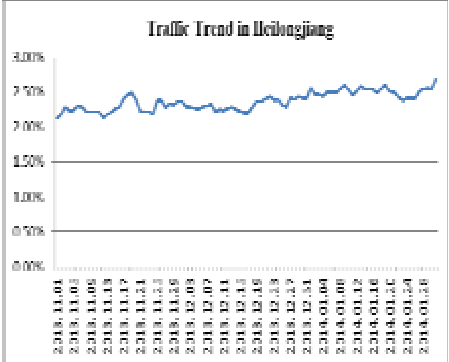
Using Baidu traffic data as a case study, the authors show that during events like the Chinese Spring Festival, traffic in Guangdong (an export province) plummets while traffic in Heilongjiang (an import province) spikes. If your cache doesn't move with the people, the network experiences massive "traffic jams" and latency. Existing strategies fail to observe this time-variant location mobility, treating the user base as a static distribution.
Methodology: The Fusion of Preference and Motion
The paper proposes a dual-engine approach to decide what to cache and where to update it.
1. Preference Prediction (The "What")
The authors utilize Collaborative Filtering (CF) to compute a utility probability. By analyzing a score matrix (representing whether user watched content ), they rank potential candidates for the cache.
- Insight: Content recommendation isn't just about global popularity; it's about the latent rating of a specific community within a certain geographic cell.
2. Time Order Memory & Dynamic Graphs (The "Where")
This is the core innovation. The authors adopt a Time Order Memory (TOM) model to describe human mobility.
- Logic: People return to places they visited recently with high probability, following a power-law distribution .
- The Model: They identify the network as a Markovian Evolving Graph (MEG). Instead of a static social graph, the edges exist only when users are in proximity or actively sharing, allowing the model to calculate "Flooding Time" () in a dynamic environment.
3. Integrated Decision Metric
The final caching priority for a content is a product of three factors: (Preference Mobility Probability Spreading Efficiency)
Experiments & Results
The authors validated their model using 120 hours of YouTube network traces (over 10,000 users and 120,000 videos).
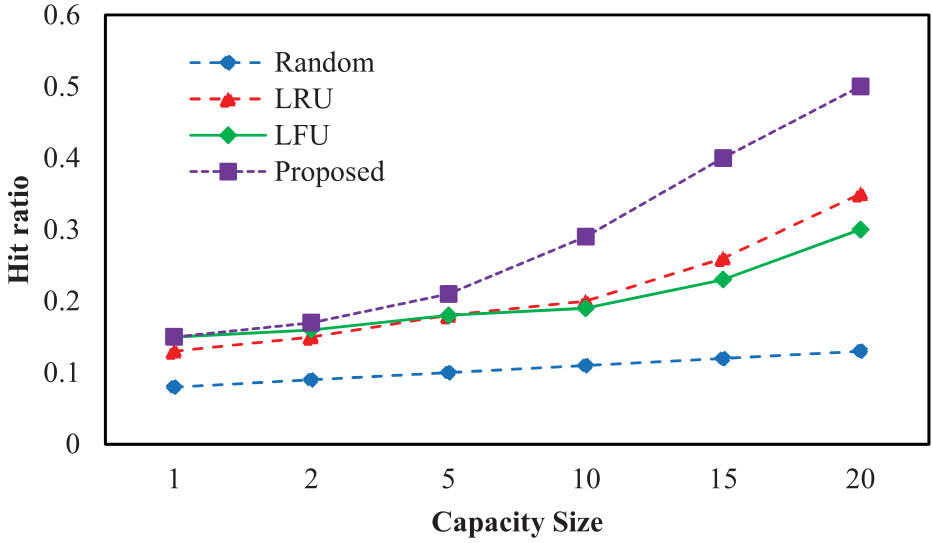
Cache Hit Ratio
Compared to "Popularity-based" and "Random" caching, the proactive mobility-aware approach maintained a significantly higher hit ratio across varying cache capacities.
- SOTA Comparison: A 20% improvement over reactive methods.
Update Delay
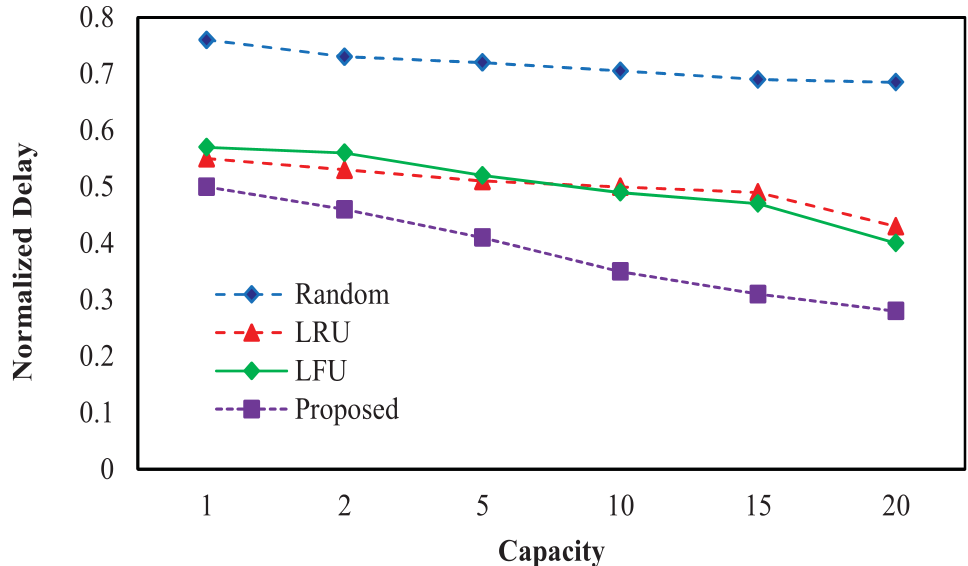
When looking at cache replacement (LRU vs. LFU vs. Proposed), the proactive method reduced normalized average delay significantly. As the cache size increases, the gap between the proposed method and traditional algorithms like LRU/LFU widens, proving that "smart" updates are more valuable than simple "recent" updates in mobile environments.
Critical Analysis & Conclusion
The value of this work lies in its Inductive Bias: it assumes that content demand is physically mobile.
Takeaways:
- Proactive > Reactive: Predicting where a user will be next week is more effective for edge resource allocation than looking at what they watched last week.
- Dynamic Graphs: Treating social networks as Markovian Evolving Graphs provides a more realistic mathematical framework for 5G/6G edge computing than static graph theory.
Limitations: The paper focuses on "new content" recommendation and leaves "periodic/subscribed" content for future work. Furthermore, the computational overhead of maintaining a Dynamic Random Graph at scale needs further investigation to ensure it doesn't offset the latency gains from caching.
Future Outlook: This research paves the way for "Self-Organizing CDNs" that can physically flow through the network backbone in sync with human migration patterns, a necessity for truly low-latency mobile multimedia services.