
Dynamic Social Features: Speeding Up the "Word-of-Mouth" in Mobile Networks
Dynamic social feature-based diffusion in mobile social networks
This paper introduces a novel information diffusion strategy in Mobile Social Networks (MSNs) by defining "Dynamic Social Features" to minimize diffusion time. The core method utilizes k-means clustering based on social similarity metrics to select optimal initial seed nodes, achieving significantly faster network-wide dissemination compared to traditional network analysis or static profile-based methods.
TL;DR
Information diffusion in Mobile Social Networks (MSNs) often relies on opportunistic contacts—what we call "word-of-mouth" marketing. This paper argues that who you are (static profile) is less important than how you behave (dynamic contact history). By introducing Dynamic Social Features (DSF), the authors propose a clustering-based algorithm that selects the most "socially active" nodes to minimize the time it takes for a message to reach an entire network.
Context & Motivation: The Static Profile Trap
In an MSN, devices interact like Delay Tolerant Networks (DTNs): move, store, carry, and forward. Most existing strategies pick "influential" nodes based on static profiles (e.g., "I live in New York"). However, if that user is currently at a conference in Miami, their static profile is useless for predicting local contacts.
The authors identify a massive gap: Prior work fails to capture the dynamic reality of human movement. They propose that by looking at how frequently you meet people with specific traits, we can predict your future utility as an information carrier more accurately than any static CV could.
Methodology: The "Enhanced" Logic
The authors don't just look at how many people you met; they look at the probability of your next encounter.
1. Defining Dynamic Features
While basic frequency () is a start, it doesn't distinguish between a node that met 1/2 people and one that met 50/100. Both have a 0.5 frequency, but the latter is clearly more reliable. The authors' Enhanced Dynamic Social Feature uses a geometric mean to reward nodes that are more active, effectively "breaking the tie" in favor of high-activity nodes.
2. Community Selection via K-Means
Instead of treating the network as a flat graph, the paper uses a social similarity metric (like Euclidean distance) to group nodes into communities.
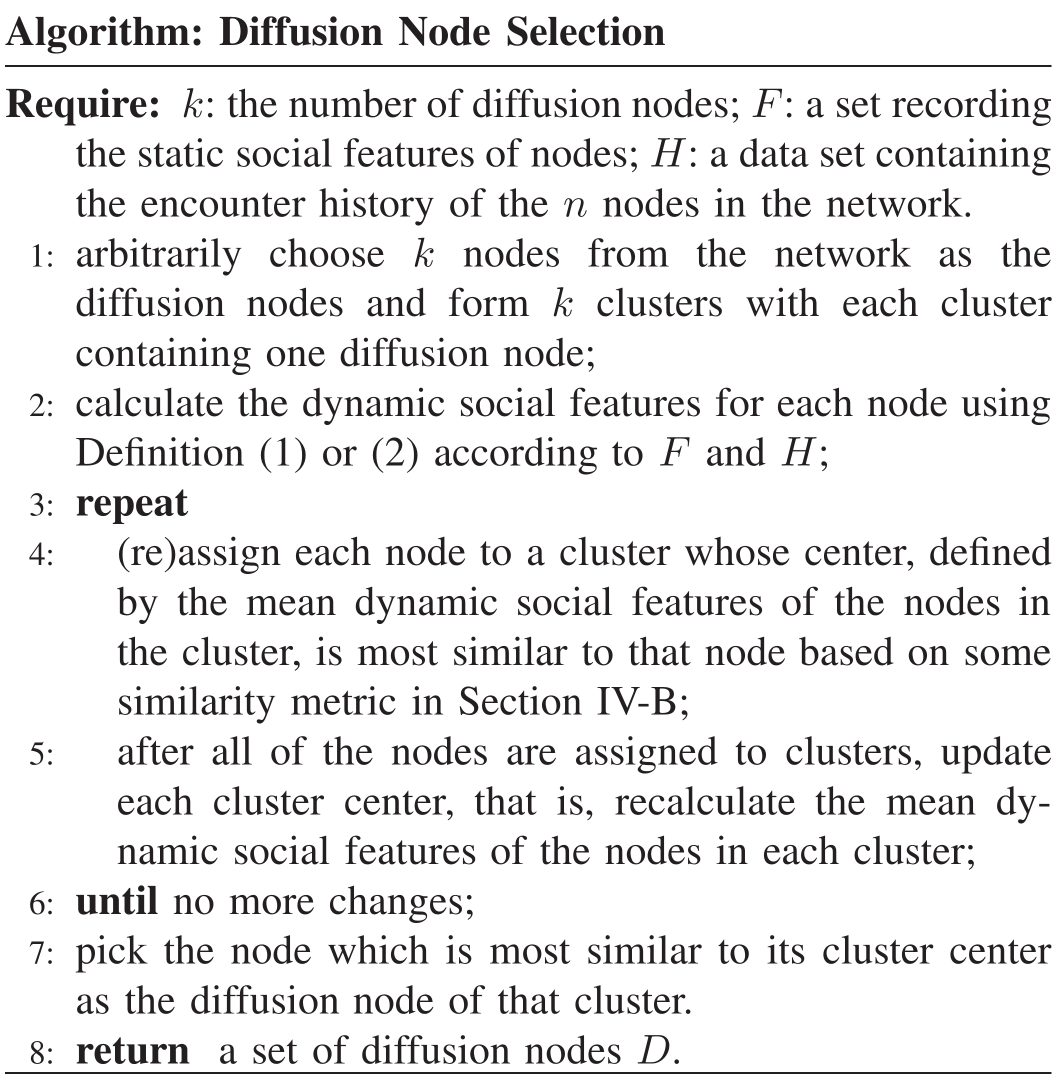
The algorithm iterates through two steps:
- Assignment: Assign each node to the "social cluster" whose center (mean features) is most similar.
- Selection: Once communities are stable, the node closest to the center of each cluster is picked as the initial "seed" for information diffusion.
Experiments: Real-World Evidence
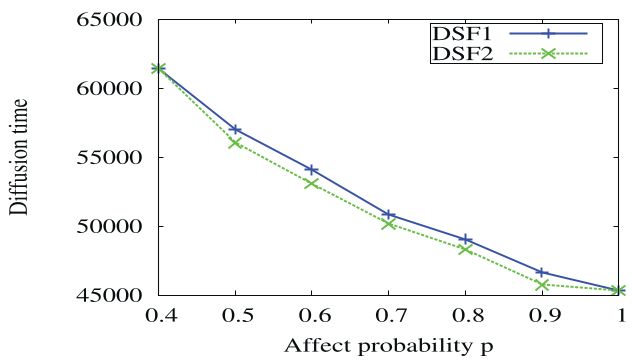
Using the Infocom06 trace (Bluetooth contacts from an actual IEEE conference), the researchers compared their DSF algorithms against:
- Analy: Traditional network analysis.
- Static: Profile-based selection.
- Rand: Random selection.
Key Findings
- DSF2 > DSF1: The predictive model for dynamic features outperforms simple frequency.
- Dynamic > Static: As expected, static profiles performed poorly (sometimes worse than random selection) because they didn't reflect the actual environment of the conference.
- Lower Diffusion Time: Across the board, the DSF approach reached 100% of the network faster than all competitors.
Critical Insight & Conclusion
The brilliance of this work lies in its transition from Graph Theory to Feature Analysis. By treating social closeness as a multi-dimensional feature vector rather than a simple edge in a graph, the authors allow for more nuanced "similarity" calculations (like Shannon entropy for feature weighting).
Limitations: The algorithm assumes nodes are willing to share their contact history (privacy concerns) and requires an initial observation period (cold-start problem) to accurately map dynamic features.
Future Outlook: This approach is ripe for integration with State Space Models (SSM) or Federated Learning, where local feature vectors could be updated privately to optimize diffusion without exposing raw contact logs.