
Dynamic Social Networks: Capturing the Pulse of Cinematic Evolution
15416_Dynamic social network for narrative video analysis.
This paper introduces a Dynamic Social Network (DSN) framework for narrative video segmentation. By modeling the evolution of character interactions through a chain of local social networks using sliding windows, the method automatically partitions movies into meaningful narrative scenes, significantly outperforming static social network models.
TL;DR
Analyzing the narrative structure of a movie is often hindered by the "semantic gap" between raw pixels and story logic. This paper presents a Dynamic Social Network (DSN) framework that treats a movie not as a static graph of characters, but as an evolving chain of interactions. By detecting shifts in these social structures and calibrating them with web-based plot synopses, the researchers achieved a more accurate, context-aware segmentation of narrative scenes.
Background: Beyond Static Role-Playing
In the realm of computer vision, "seeing" a movie is easy, but "understanding" the story is hard. Early methods relied on Tempo (visual/audio pacing), while later works introduced RoleNet, which mapped out which characters talk to whom. However, RoleNet had a major flaw: it assumed the social structure was global. In reality, a movie follows "The Hero's Journey"—characters meet, leave, and interact differently as the plot progresses. A static network ignores this temporal flow.
The Core Insight: Social Change as a Scene Boundary
The authors argue that a narrative scene is essentially a temporal cluster where the social network structure remains consistent. When the "dynamic social network" changes significantly—say, the protagonist moves from a group of friends to a confrontation with a villain—a scene boundary is likely present.
Methodology: From Windows to Matrices
- Sliding Windows: Instead of one giant graph, the authors use overlapping windows across the video shots to build a sequence of local social networks ().
- The Social Descriptor: Each network is represented by two histograms—Co-occurrence (who is with whom) and Occurrence (who is on screen alone). This allows the system to handle monologues and dialogues separately.
- The Similarity Matrix: By calculating the similarity between every pair of local networks, they create a matrix that visualizes the "stability" of the social structure over time.
- External Heuristics: To solve the subjective problem of how many scenes a movie has, they simply count the paragraph breaks in IMDB or Wikipedia synopses—a clever use of human-generated metadata.
 Figure 1: The transition from video shots to a chain of local social networks (DSN).
Experimental Battleground
The researchers tested their model against 8 films, including Casino Royale and The Devil Wears Prada.
- DSN vs. RoleNet: While RoleNet is good at identifying the main characters, it often misses scene transitions within a consistent group. DSN’s sliding window approach accurately identifies these shifts.
- DSN vs. Tempo: In action movies like Casino Royale, visual tempo (fast cuts) is a strong signal. However, in drama or character-driven films like The Lake House, the DSN approach was significantly more reliable because the "story" is told through relationships, not just camera movement.
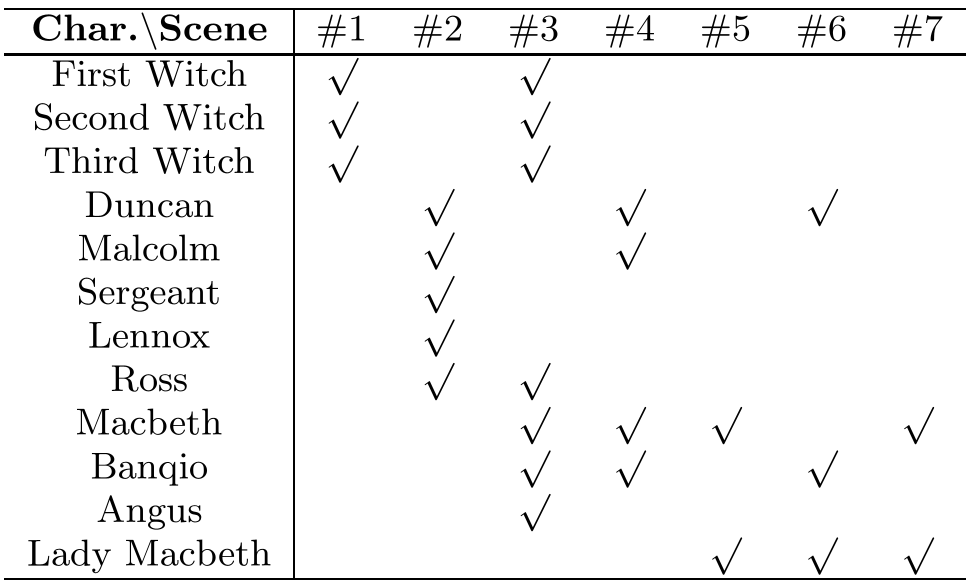 Table 1: The distribution of characters in Shakespeare's Macbeth, illustrating how social presence shifts between scenes.
Critical Analysis & Future Outlook
The beauty of this work lies in its simplicity: it acknowledges that humans have already segmented these stories in the form of written synopses.
Limitations:
- Genre Sensitivity: As noted, action movies depend more on visual cues than social ones.
- Face Recognition Dependence: The accuracy of the DSN is only as good as the underlying character identification system. If the system fails to recognize a face, the social graph breaks.
The Future: Integrating this social-temporal logic with modern Transformers or Large Multimodal Models (LMMs) could revolutionize how we index video. Imagine a search engine where you can ask, "Find the scene where the protagonist's relationship with the mentor starts to sour"—this paper laid the foundational logic for exactly that kind of high-level semantic retrieval.
Summary Table of Results
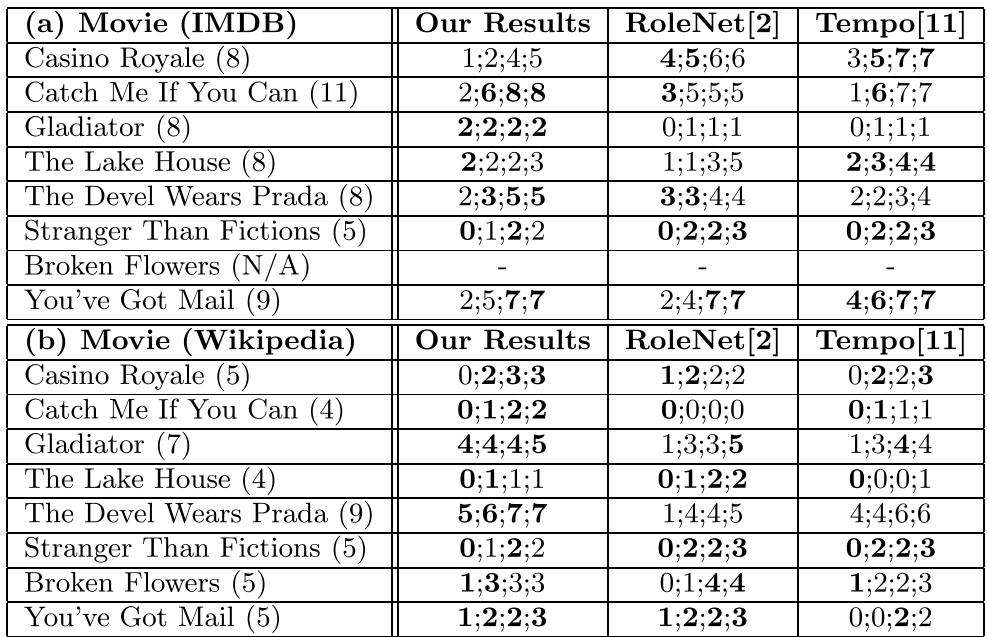 Table 2: Performance comparison across different tolerance ranges (0-3 shots). DSN (Our Results) consistently shows the most 'hits' in the ground truth boundaries.