
DynNetSim: Decoding the Evolution of Terror Networks through Dynamic Simulation
A Dynamic Social Network Software Platform for Counter-Terrorism Decision Support
This paper introduces DynNetSim, a dynamic social network software platform designed for counter-terrorism decision support. It uniquely combines stochastic modeling with a multi-modal behavioral simulation framework to analyze how networks (e.g., terrorist cells or critical infrastructure) evolve and adapt over time in response to environmental forces and disruptive events.
TL;DR
Static snapshots of social networks are no longer sufficient to counter dynamic, adaptive threats. DynNetSim is a sophisticated simulation platform that fuses stochastic network growth with agent-based behavioral modeling. By incorporating environmental contexts—like socio-political trends and disruptive events—it allows decision-makers to run "what-if" scenarios to test the effectiveness of counter-terrorism strategies against evolving adversaries.
Background: Beyond the Static Graph
In the early 2000s, Social Network Analysis (SNA) was a breakthrough for intelligence, famously aiding in the capture of Saddam Hussein by tracing family and tribal links. However, most SNA tools of that era were static. They could tell you who was important yesterday, but they couldn't predict how a cell might reorganize after a leader is removed, or how a radical ideology might spread through an environment over time.
The Problem: The Missing Environment and Intent
The author identifies a critical gap in existing research:
- Context-Blindness: Networks don't exist in a vacuum. They are influenced by economic shifts, political events, and social sentiments.
- Lack of Adaptation: Static models don't account for "Intentional Entities"—people who change their behavior when they feel watched or attacked.
- Inability to "What-If": Without a dynamic model, planners cannot simulate "Effects-Based Operations" (EBO) to see how a specific intervention (e.g., freezing funds) propagates through the network long-term.
Methodology: The Multi-Modal Architecture
DynNetSim's power lies in its layered architecture, built upon the ForeTell platform. It doesn't rely on a single mathematical approach but rather a "toolbox" of dynamics:
1. The Ontology
The system defines a hierarchy: Scenario > Environment > Network > Node/Link.
- Nodes: Can be People, Groups, Threat Activities, or Targets.
- Links: Sophisticated "Composite Links" that track multiple relationship types (trust, control, funding) and their intensities over time.
2. The Simulation Engine (The "How It Works")
The engine integrates three core dynamic types:
- Stochastic Dynamics: Statistical rules governing the "natural" birth and death of nodes/links (e.g., the "rich-get-richer" attachment rule).
- System Dynamics: Hard-coded and "soft-coded" causality. For example, an increase in Anti-Western Sentiment (a Force) triggers a causal rule that increases Recruitment Rates in a Terrorist Group.
- Agent Decision-Rules: Computational agents sense their environment and peers, executing "If-Then" logic to switch tactics or targets.
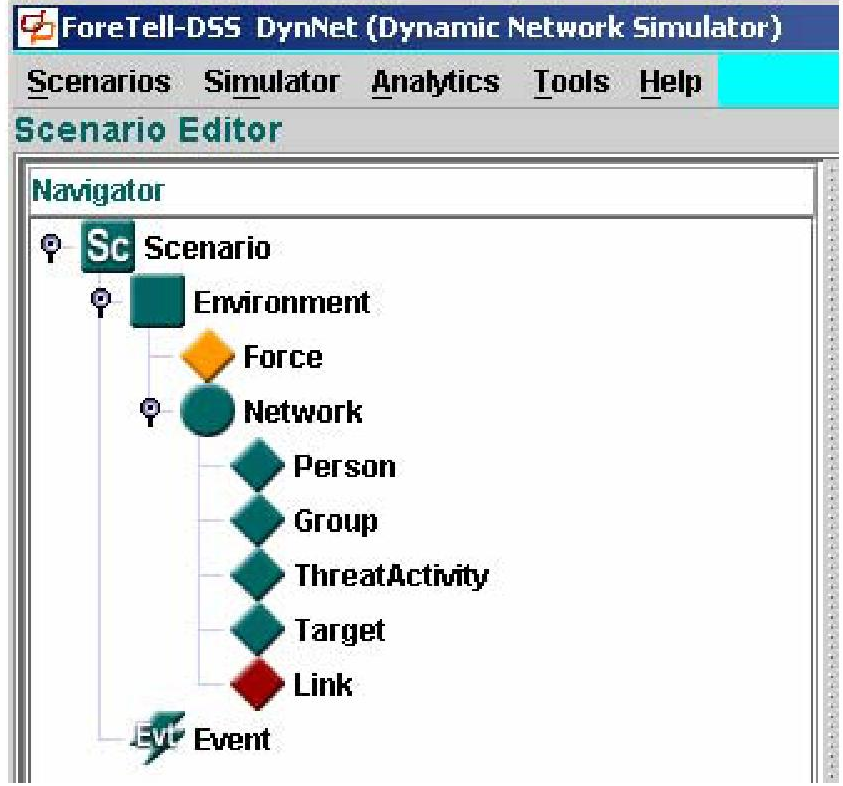 Fig. 1: The entity hierarchy of DynNetSim, showing how environmental forces interact with specific network nodes.
Experiments and Decision Support
The platform allows for Monte Carlo trials, running a scenario thousands of times with slight variations in inputs to see the range of likely outcomes.
Key Application Areas:
- Intelligence Analysis: Fusing data to identify anomalous patterns.
- Critical Infrastructure Protection: Modeling how an attack on a port (like New Orleans post-Katrina) creates cascading economic failures.
- Preparedness Planning: Comparing the cost vs. risk-reduction of defensive strategies.
 Fig. 2: The ForeTell simulation cycle, ensuring environmental forces are calculated before agent behaviors.
Critical Insight & Conclusion
DynNetSim represents a shift toward System-of-Systems thinking. By mapping DIME (Diplomatic, Information, Military, Economic) actions to PMESII (Political, Military, Economic, Social, Information, Infrastructure) outcomes, it acknowledges that counter-terrorism is a multi-dimensional chess game.
Takeaway: The true value of this work is not in predicting the "exact" future, but in uncertainty management. It provides a "safe" virtual space for planners to discover unintended consequences of their actions—potentially preventing "brittle" strategies from failing in the field.
Limitations: The framework is heavily dependent on the quality of the "soft-coded" causal rules. If the underlying social science regarding recruitment is flawed, the simulation's results will be equally skewed. Future work must focus on "closing the loop" by feeding real-time intelligence back into the model to refine these behavioral rules.