
Mastering Social Dynamics: How Timeframe Type Reshapes Group Evolution Discovery
Influence of the Dynamic Social Network Timeframe Type and Size on the Group Evolution Discovery
This paper investigates the Group Evolution Discovery (GED) method by analyzing how different temporal segmentation strategies impact the identification of social community dynamics. Using data from a Polish social portal, the study evaluates the performance of GED across disjoint, overlapping, and increasing timeframe types to determine their effectiveness in capturing group events like merging, splitting, and shrinking.
TL;DR
Analyzing how groups change over time in social networks is notoriously difficult due to "temporal noise." This paper demonstrates that the way you slice your timeline—whether using disjoint, overlapping, or increasing windows—is just as important as the detection algorithm itself. By testing the GED (Group Evolution Discovery) method on a real-world dataset, the research proves that overlapping timeframes are the key to unlocking hidden evolution patterns that disjoint windows completely miss.
Context & Motivation
Most social network data is a stream of discrete events (e.g., an email sent at 10:05 PM). To analyze these as a "network," we usually group them into timeframes (slices). However, previous research indicates a painful reality: if you slice the data into separate, non-overlapping chunks, the correlation between the network structure of one chunk and the next is often near zero.
The authors argue that the failure to track community evolution isn't necessarily a failure of the tracking algorithm (like GED), but a failure of the temporal segmentation strategy.
Methodology: The GED Framework
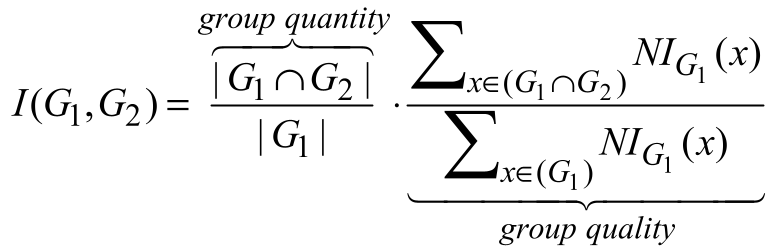
The core of the study revolves around the GED method. Unlike simpler methods that only count heads, GED looks at both Quantity (how many members stayed?) and Quality (did the influential members stay?).
The Inclusion Formula
At the heart of GED is the inclusion measure , which determines how much of Group 1 is "present" in Group 2:
The method identifies seven distinct events: Continuing, Shrinking, Growing, Splitting, Merging, Dissolving, and Forming.
Experimental Setup: The Three Slicing Strategies
The authors tested these on data from extradom.pl, a social portal for home builders, using three strategies:
- Disjoint: Standard "Step 1, Step 2, Step 3" windows.
- Overlapping: A sliding window approach where consecutive timeframes share data.
- Increasing: A cumulative approach where each new timeframe includes all previous data.
The Core Discovery: Why Overlapping Wins
The results provided a stark contrast in how we perceive social dynamics based on our "temporal lens."
1. The Disjoint Failure
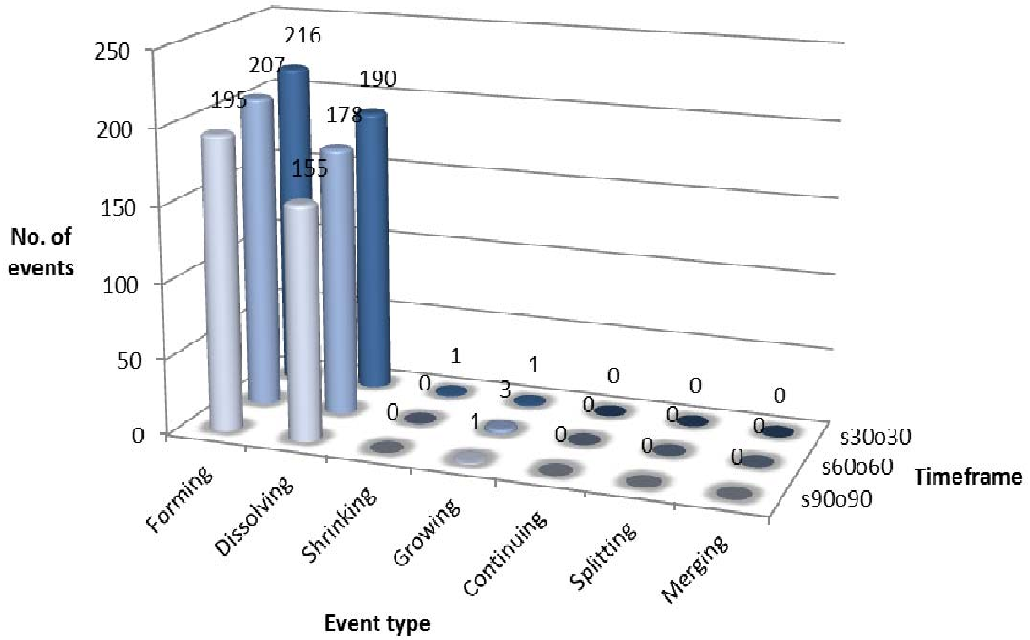
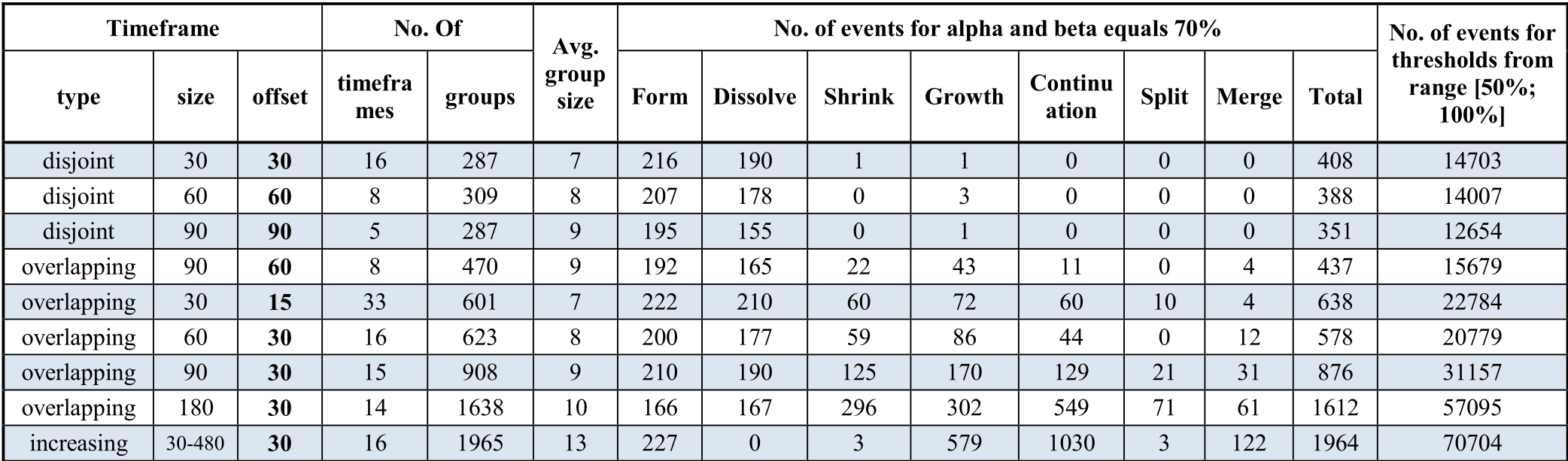
When using disjoint windows, the network changed too rapidly. The GED method reported almost exclusively "Forming" and "Dissolving" events. In short, groups appeared to vanish and reappear from scratch, leaving no trace of an actual "evolutionary" path.
2. The Overlapping Breakthrough
By introducing overlap, the "rapid noise" was smoothed out. Because adjacent timeframes shared interactions, the GED method could finally "bridge" groups across time.
- Insight: Extending the size of the overlap (while keeping the offset small) significantly increased the discovery of "Merging" and "Splitting" events—the hallmarks of complex social dynamics.
3. The "Persistent" View (Increasing Timeframes)
In the increasing timeframe model, groups almost never "dissolve" because the data is cumulative. This approach was found to be perfect for identifying persistent groups—core communities that remain stable over a 17-month period.
Critical Analysis & Conclusion
Takeaway
The research confirms that for any rapidly changing social network, overlapping timeframes are mandatory for meaningful evolution analysis. The size of the window and the offset are not just administrative settings—they are parameters that define the granularity of the "social story" you are telling.
Limitations & Future Work
The study relies on the CPM (Clique Percolation Method) for community detection. A potential limitation is that CPM itself can be sensitive to edge density, which fluctuates in different timeframe types. Future research could explore adaptive window sizes, where the timeframe length automatically adjusts based on the "velocity" of network changes, rather than using fixed day counts.
The GED method proves to be a flexible and robust framework, provided the researcher chooses the right temporal "glasses" to view the data.