
DSNG-M: Controlling the Pulse of Evolving Social Networks via Modularity
Dynamic Social Networks Generator Based on Modularity: DSNG-M
This paper introduces DSNG-M, a novel dynamic social network generator that produces time-evolving graphs by controlling modularity. Unlike traditional generators that rely on macro-operations like community splitting, DSNG-M utilizes an iterative edge-flipping mechanism guided by simulated annealing to reach precise structural targets while preserving the original community label integrity.
Executive Summary
TL;DR: DSNG-M (Dynamic Social Networks Generator based on Modularity) is a benchmarking tool that generates time-evolving social networks by iteratively "flipping" edges to match a specific modularity target. It ensures that while the topology changes, the underlying community backbone remains consistent with the original data.
Positioning: This work moves beyond simple "growth-based" models to a "metric-driven" generation paradigm, filling a gap in the creation of controlled benchmarks for dynamic community detection.
Motivation: The Missing Link in Dynamic Benchmarking
Capturing real-world dynamic social data is notoriously difficult due to privacy and longitudinal tracking costs. While generators exist, they usually fall into two traps:
- Lack of Community Context: Simple random graphs (Erdős–Rényi) or small-world models lack clear community structures.
- Uncontrolled Evolution: Current dynamic models use specific operations (add/delete nodes) but cannot guarantee a specific "strength" of community structure (Modularity ) at each time step.
The authors' insight is simple yet powerful: Modularity is the thermostat of social order. If we can tune this thermostat, we can simulate networks transitioning from high internal cohesion to noisy, inter-connected states.
Methodology: The Core Engine
DSNG-M treats network generation as an optimization problem. Given an initial network and an expected modularity , the system performs the following:
1. The Flipping Mechanism
The generator randomly selects two nodes . If an edge exists, it is removed; if not, it is added.
- Greedy Step: If the flip moves the current closer to , it is accepted.
- Probabilistic Step: To prevent getting stuck in local optima, moves that worsen the modularity are accepted with a probability , where is a "temperature" parameter that cools down (reduces noise) over time.
2. Architecture Visualization
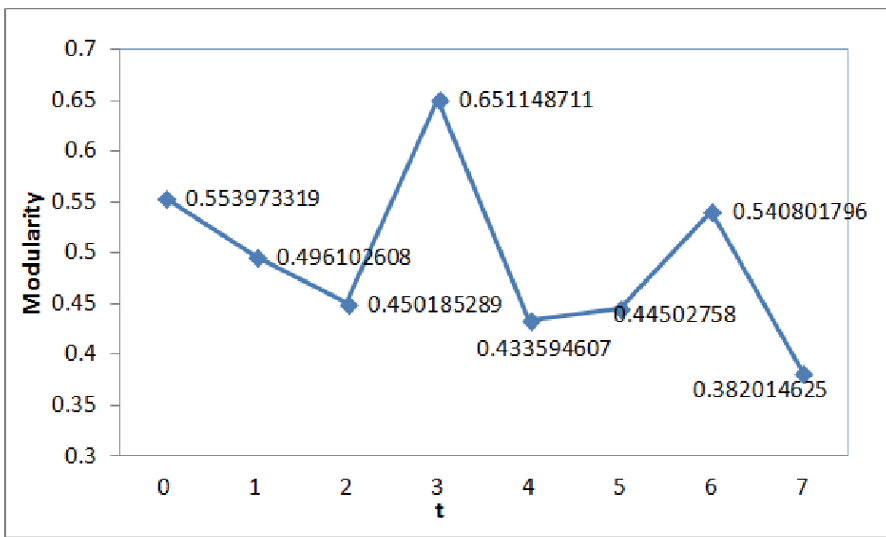 The figure above illustrates the snapshot generation at different time steps, moving from the original network (t0) through various evolutionary states.
Experiments & Results
The authors validated DSNG-M using the "American College Football" dataset.
SOTA Consistency
By aggregating 50 generated time-steps and applying a Label Propagation Algorithm (LPA), the researchers found that the "intrinsic structure" recovered was identical to the original network. This proves that DSNG-M doesn't just "scramble" the network; it evolves it while respecting its genetic community blueprint.
Structural Dynamics
The study revealed key correlations between and network metrics:
- Edge Count: Higher modularity often correlates with fewer inter-community edges.
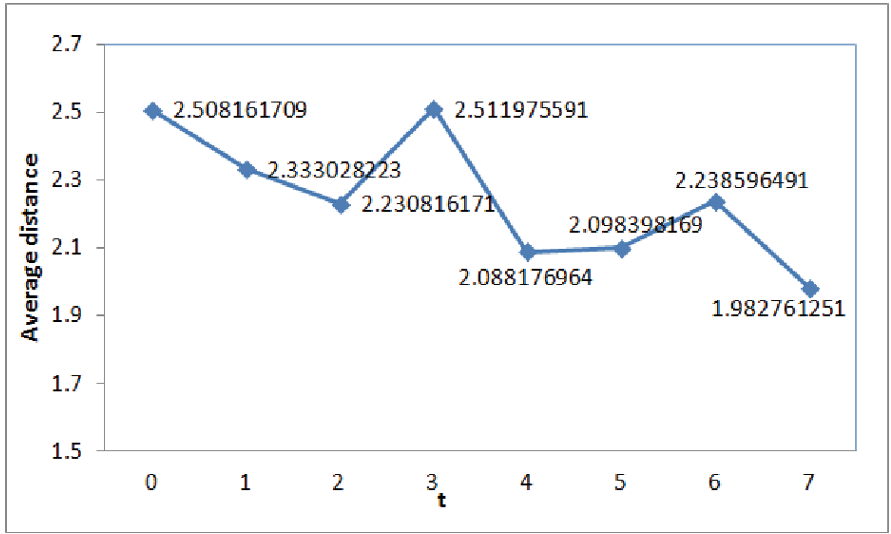
- Average Distance: As modularity increases (stronger clusters), the average path length between nodes typically increases as well, as shown in the experimental plots.
The Cost of Stability (Parameter T)
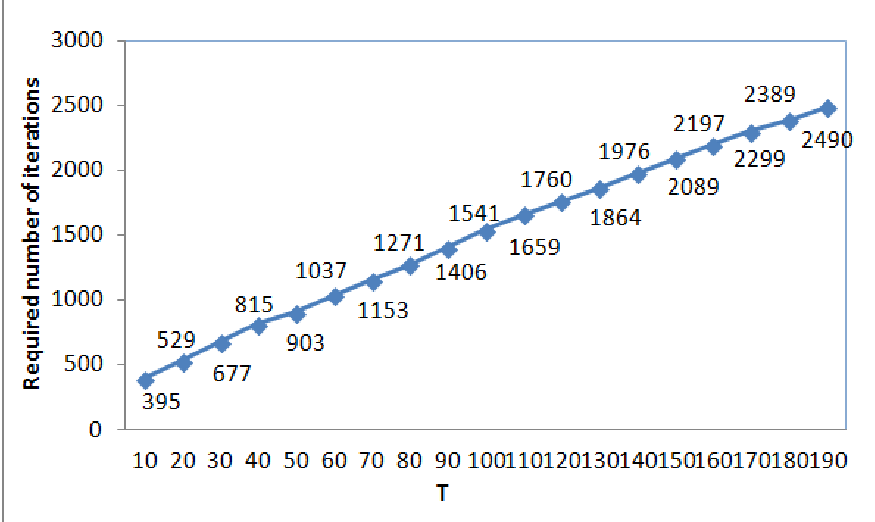
The "Temperature" parameter acts as a trade-off between speed and accuracy. A high allows the generator to explore more configurations, but significantly increases the number of iterations required to converge on .
Critical Analysis & Conclusion
Takeaway
DSNG-M is a significant step toward "programmable" social networks. It allows researchers to specify how structured a network should be at any given moment, making it an ideal candidate for testing evolutionary community detection algorithms.
Limitations
- Edge-Only Mutation: The current version does not handle the birth or death of nodes, which is a staple of real-world networks (e.g., users joining/leaving a platform).
- Computational Intensity: For massive graphs, the quadratic nature of selecting random node pairs for flipping might lead to high latency.
Future Work
The authors aim to expand the model to include node-level dynamics and investigate how local community memberships shift under these modularity-constrained perturbations.