
Beyond Static Profiles: Modeling User Interests as Dynamic Signals with Wavelets
Dynamic Social Recommendation
The paper introduces "Bag-of-Signals," a temporal user modeling framework that treats evolving user interests as non-stationary signals. By applying Haar Wavelet Transforms to concept-based user profiles, the authors developed a Twitter user recommender system that significantly outperforms traditional static and time-aware baselines.
TL;DR
In the fast-paced world of social media, our interests aren't just a list of keywords; they are a fluctuating pulse. This paper introduces the Bag-of-Signals model, which moves away from static "Bag-of-Words" profiles. By treating hashtags and topics as digital signals and analyzing them via Wavelet Transforms, the researchers from Roma Tre University have created a recommender system that understands when and how your interests change, leading to significantly better user-to-user recommendations on Twitter.
The Pulse of the Feed: Why Static Models Fail
Standard recommender systems (like VSM or SVD++) often act as if a user's interest in "Quantum Physics" counts the same whether they tweeted about it five years ago or five minutes ago. Even "Time-Aware" models usually just use a decay function—essentially saying "old news is bad news."
However, human behavior is more complex. We experience:
- Transient Bursts: Gossiping about a movie premiere.
- Long-term Trends: A professional interest in a specific technology.
- Cyclical Interests: Recurring seasonal events.
The authors' core insight is that because user interests are non-stationary, we should borrow tools from signal processing—specifically the Wavelet Transform—to analyze them.
Methodology: The Bag-of-Signals
The framework operates in three distinct phases:
1. Signal Construction
Instead of a single vector, a user is represented by a set of signals . Each signal represents a specific concept (hashtag, entity, or topic). The strength of the signal at any time interval is determined by a temporal version of TF-IDF:
- Concept Frequency (): How often the user mentions the topic in that window.
- Inverse Period Frequency (): How rare the concept is across the entire observation period.
2. Multi-Resolution Analysis (The Wavelet Edge)
Using the Haar Wavelet, the system decomposes these noisy interest signals into "Approximation Coefficients." Why Wavelets? Unlike Fourier Transforms, Wavelets are localized in both time and frequency. They allow the system to:
- Capture short-term spikes without losing the long-term averages.
- Filter out the "noise" of random occasional tweets.
- Speed up computation to .
 (Image Placeholder: Refer to the paper's framework overview for the pipeline from tweets to signal similarity)
3. Calculating Similarity
The recommendation function doesn't just look at overlapping concepts. It calculates the energy of the signals and uses a normalized similarity measure based on the DWT coefficients to see if two users share the same rhythm of interest.
Experimental Results: Proving the Signal
The authors tested their model against 8 baselines using metrics like Success@Rank k (S@k) and Mean Reciprocal Rank (MRR).
- Optimal Tuning: They found that a 4-level DWT (l=4) provided the best results, effectively stripping away daily jitter while keeping the meaningful "waves" of user behavior.
- Dominating Baselines: Bag-of-Signals outperformed both content-based (VSM) and time-decay collaborative filtering (TWCF).
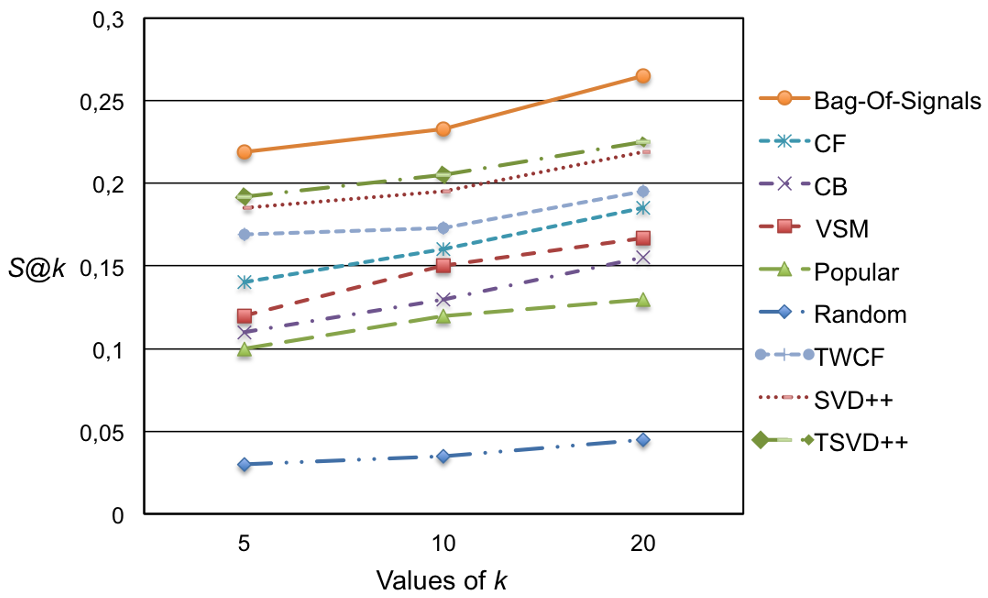 Fig: Comparison showing the Bag-of-Signals (l=4) leading against SVD++, VSM, and other time-aware methods in Success@k.
Interestingly, the results showed that traditional time-aware models like TSVD++ (the algorithm that won the Netflix Prize) struggled in the Twitter context. This suggests that the implicit, high-frequency nature of social media content requires more sophisticated temporal modeling than explicit movie ratings.
Critical Insight & Future Outlook
The "Bag-of-Signals" approach is a powerful bridge between digital signal processing (DSP) and Information Retrieval.
Takeaway: If you are building a system for high-velocity data (Twitter, TikTok, News feeds), stop treating user profiles as static vectors. Start treating them as signals.
Limitations:
- Cold-Start: If a user hasn't tweeted enough to form a signal, the model struggles.
- Concept Extraction: The accuracy depends heavily on the quality of the "Entity Extraction" (e.g., OpenCalais) used at the start.
Future Directions: The authors suggest integrating sentiment analysis into the signals. Imagine not just tracking what someone talks about, but how their attitude toward that topic fluctuates over time as a distinctive signal.