
Dynamic Task Assignment: The Engine of the On-Demand Economy
Dynamic task assignment in spatial crowdsourcing
This paper provides a comprehensive overview of Dynamic Task Assignment (DTA) in spatial crowdsourcing, a paradigm where tasks and workers arrive stochastically with spatiotemporal constraints. It categorizes algorithmic solutions into Batch and Real-time modes, establishing a formal framework for evaluating these online algorithms using Competitive Ratios (CR).
TL;DR
Spatial Crowdsourcing (SC) has revolutionized urban services like Uber, Deliveroo, and Waze. Unlike static optimization, the Dynamic Task Assignment (DTA) problem requires matching workers to tasks in real-time as they appear on the map. This paper provides a rigorous deep dive into the algorithms—from Batch processing to Real-time heuristics—that ensure these platforms remain efficient and profitable despite the chaos of the physical world.
Background: Beyond the Desktop
While traditional crowdsourcing (e.g., Amazon Mechanical Turk) treats workers as stationary units, Spatial Crowdsourcing adds the dimensions of Location and Time. A worker isn't just a "solver"; they are a mobile unit with a path, a deadline, and a limited service radius. The challenge is "online" by nature: you don't know where the next passenger will appear, but you must assign the current one now.
The Core Challenge: Decision-Making Under Uncertainty
The DTA problem is defined by three ruthless constraints:
- Incomplete Information: You can't see the future.
- Irrevocability: Once a driver is dispatched to a diner, you cannot easily reassign them if a "better" task appears 10 seconds later.
- Real-time Requirements: Computational latency translates directly to lost revenue or frustrated users.
To measure success, the authors utilize the Competitive Ratio (CR)—a metric comparing an online algorithm's performance against an "omniscient" offline version that knows all future events.
Methodology: Batch vs. Real-Time
The paper categorizes the solution landscape into two dominant paradigms:
1. Batch Mode (The "Wait and See" Approach)
Platforms aggregate workers and tasks over a window (e.g., every 30 seconds).
- Max-Flow Reduction: The problem is transformed into a network flow graph. Workers and tasks are nodes, and edges represent capacities and constraints.
- The Workflow:
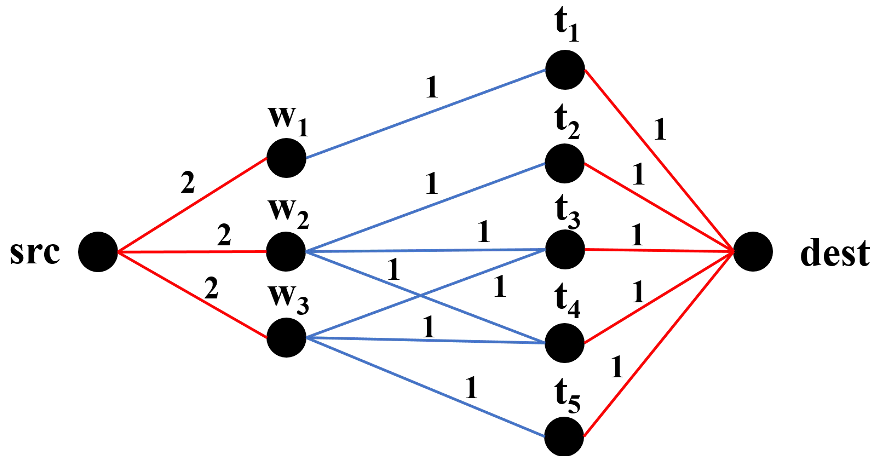
- Pros/Cons: It achieves local optimality within the batch but lacks global guarantees across time intervals.
2. Real-Time Mode (The "Instant Reaction" Approach)
Decisions occur the millisecond a request hits the server.
- Greedy Algorithms: Matching based on the nearest neighbor.
- HST (Hierarchically Separated Trees): Embedding the map into tree structures to decompose the metric space, allowing for randomized algorithms with logarithmic competitive ratios ().
- Thresholding: Only making a match if the "Utility" (profit/success probability) exceeds a certain calculated bar.
Experimental Insights: Theory vs. Reality
One of the most striking insights mentioned is the performance of the Greedy Algorithm. In pure theoretical "Adversarial" models, Greedy is terrible. However, in "Random Order" models (which mimic real cities), Greedy is surprisingly robust.
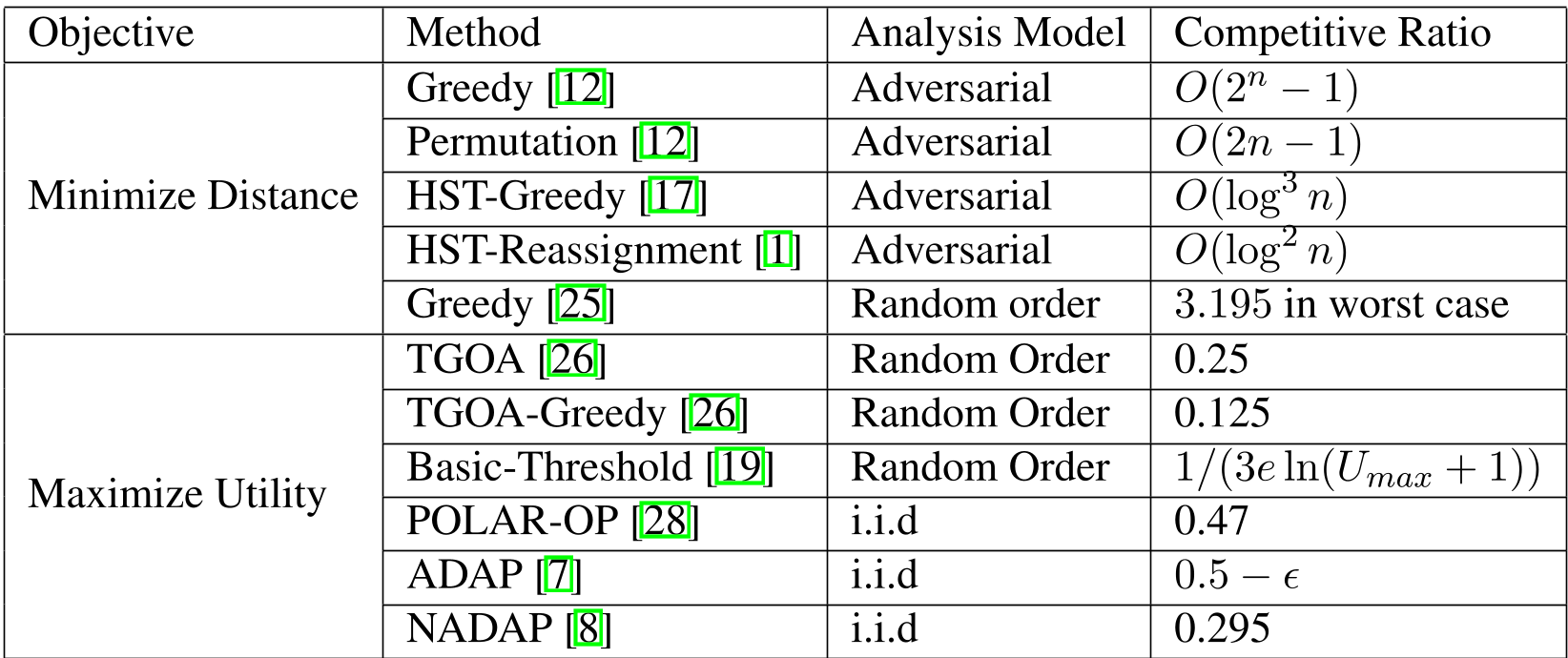
The table above demonstrates that utility-maximization methods like TGOA and ADAP can achieve constant factors of the theoretical optimum, making them highly reliable for industrial deployment.
Critical Analysis & Future Outlook
While the current DTA research is robust, the authors point out several "missing links":
- Spatial Indexing: Current databases are great at finding "nearest neighbors," but they aren't fully optimized for the continuous queries required by DTA.
- Benchmarks: There is a lack of unified, large-scale benchmarks to compare algorithms fairly across different cities or service types.
- Worker Incentives: Most DTA models assume workers are "robots" who follow orders. Future work must integrate Dynamic Pricing and game-theoretic incentives to account for human behavior.
Conclusion
Dynamic Task Assignment is the invisible hand guiding the modern gig economy. By moving from static maximum matching to online stochastic optimization, researchers are providing the mathematical foundation for more efficient, responsive, and sustainable urban infrastructure.