
DTSC: Bridging Persistent Social Ties with Transient Encounters in Mobile Networks
Dynamically Transient Social Community Detection for Mobile Social Networks
This paper introduces the Dynamically Transient Social Community (DTSC) framework for Mobile Social Networks (MSNs). It optimizes data forwarding by combining temporal contact bursts with social tie strength to identify short-lived, high-aggregation node clusters.
TL;DR
In the fluid world of Mobile Social Networks (MSNs), nodes are people moving through space and time. This paper introduces the Dynamically Transient Social Community (DTSC), a routing paradigm that abandons the idea of static communities. By fusing the "when" (temporal intensive contacts) with the "who" (social tie strength), DTSC achieves up to 40% higher delivery rates than traditional social routing with significantly lower overhead.
Problem: The Fallacy of Static Social Graphs
Most data forwarding strategies in MSNs treat social relationships as static links. However, human interaction is ephemeral. We might have a strong social bond with a colleague (Persistent Social Tie), but we only interact during specific windows, like a lunch break (Transient Encounter).
Previous works on Transient Communities (TC) attempted to capture these windows but focused almost exclusively on physical proximity (contact duration/frequency). They ignored the "Social Gravity"—the reason why these nodes meet. Without considering social ties, TC methods struggle to distinguish between a meaningful recurring meeting and a coincidental one-time encounter.
Methodology: Fusing Time and Social Gravity
The core of DTSC lies in its ability to quantify the similarity between two "Intensive Contacts."
1. Intensive Contact Detection
Instead of treating every brief Bluetooth handshake as a connection, the authors define Intensive Contact. If nodes and meet multiple times within a threshold (e.g., 1 hour), these meetings are merged into a single window . This filters out accidental noise and identifies meaningful interaction periods.
2. The Hybrid Similarity Metric (SIM)
How do we know if two contacts belong to the same community? The paper proposes a dual-weighted similarity score:
- (Temporal Similarity): Uses the Jaccard coefficient to measure how much two contact windows overlap.
- (Social Similarity): Measures the proximity of social tie strengths (calculated from message/call history).
- (Sliding Factor): Allows the system to tune the importance of time versus social bonds.
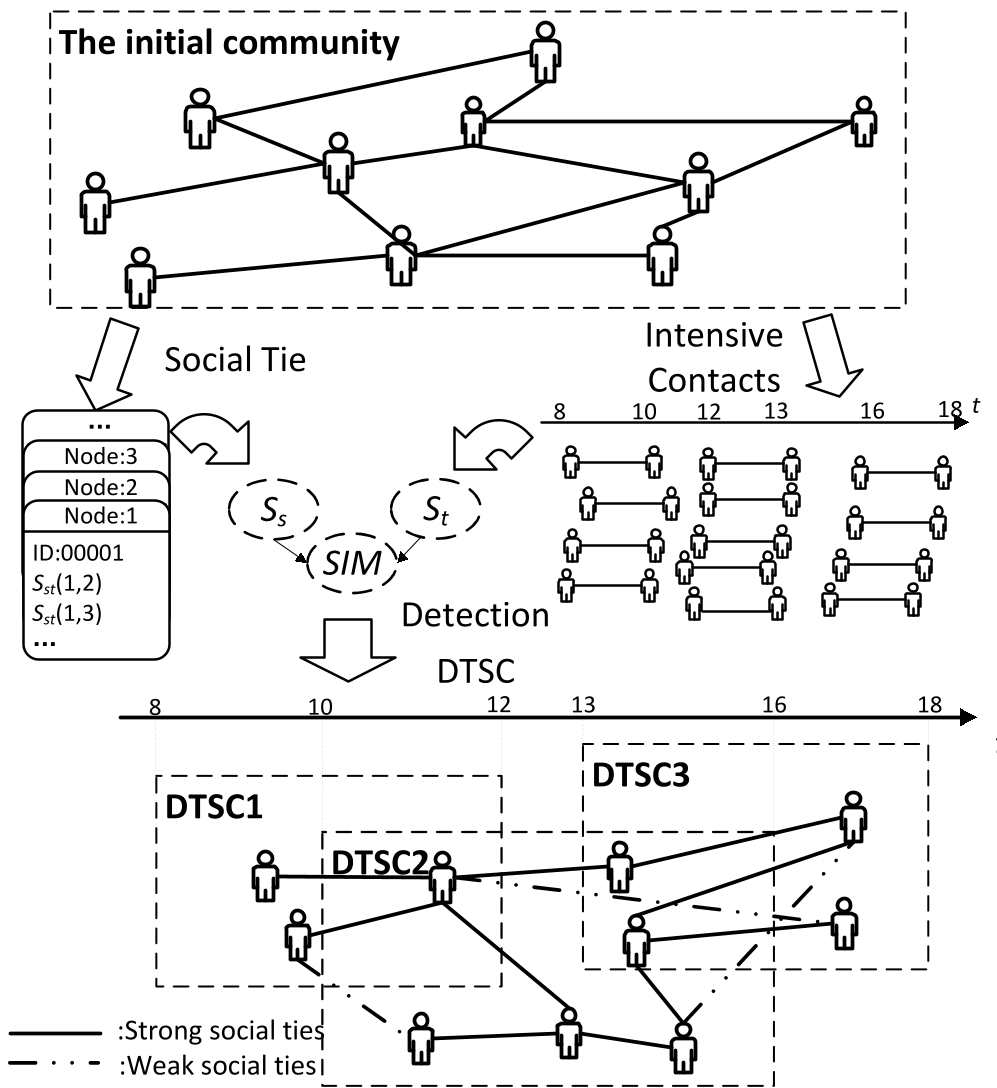 Fig 1: From raw contacts to Intensive Contacts, and finally to clustered Transient Social Communities.
Predictive Routing Algorithm
DTSC doesn't just look at who is near whom now. It uses the statistical "Appearance Patterns" of communities:
- Start Time: Follows a Normal Distribution, peaking around 2:00 PM.
- Duration: Follows an Exponential Distribution, averaging roughly 2.7 hours.
By calculating the probability that a destination's community will emerge within a message's Time-to-Live (TTL), the algorithm chooses the relay node that most effectively bridges the current community to the destination's future community.
Experimental Results: SOTA Performance
The researchers validated DTSC using the MIT Reality Mining dataset (97 participants over 246 days).
Comparison with Baselines:
- Epidemic: The "flood" approach. High delivery but massive overhead.
- BubbleRap: A popular community-based social routing protocol.
- TC (Transient Community): The previous benchmark for time-based routing.
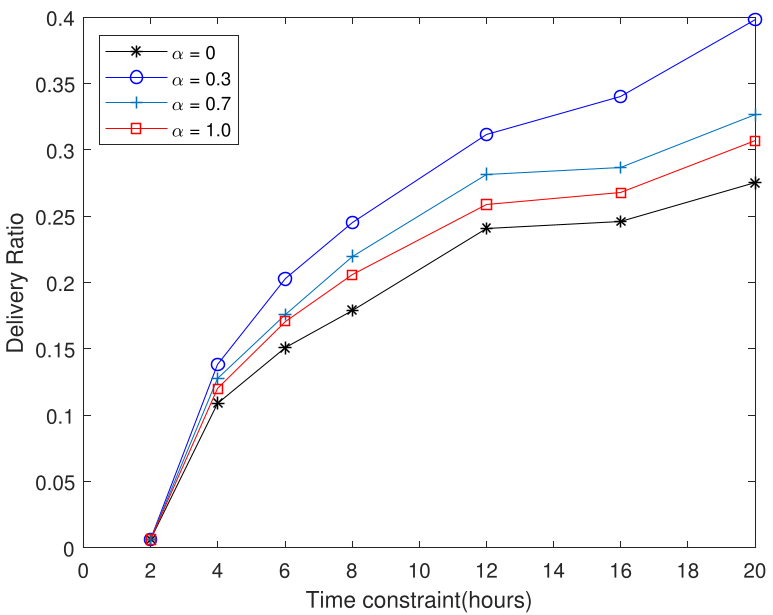 Fig 2: Comparison of Delivery Ratios. DTSC consistently outperforms TC and BubbleRap as time constraints (TTL) increase.
Key Findings:
- Delivery Efficiency: DTSC achieved a 34% improvement over TC routing. By incorporating social ties, it identifies more stable relay paths that simple contact duration misses.
- Overhead Reduction: The overhead was one-third of the Epidemic approach and significantly lower than TC. By being "smarter" about which nodes receive copies, it prevents network congestion.
- The Optimal : Testing showed that is the "sweet spot" for the sliding factor, suggesting that while temporal contact is essential, social tie information actually carries slightly more weight in selecting reliable relays.
Deep Insights & Concluding Thoughts
The DTSC framework succeeds because it aligns with human behavior logic: we are most likely to successfully pass information to people who are not just "nearby," but are part of our recurring social circles at the right time.
Limitations:
- The model relies on having access to some level of social tie data (like call logs or text frequency), which may raise privacy concerns in decentralized environments.
- The complexity of maintaining meeting queues () and calculating matching degrees for every community might be resource-intensive for low-power IoT devices.
Future Outlook: Integrating this social-temporal awareness into 6G and "Internet of People" (IoP) could revolutionize how data is cached and forwarded in dense urban environments, making our networks as dynamic as our social lives.