
Dynamic Trust Framework: Securing the "Edge" of Opportunistic Mobile Social Networks
A Dynamic Trust Framework for Opportunistic Mobile Social Networks
This paper introduces a Dynamic Trust Framework for Opportunistic Mobile Social Networks (OMSN) to detect abnormal nodes. By employing a multi-dimensional trust metric and a "two-hop feedback method," the framework enables reliable trust derivation even in highly disconnected ad-hoc environments, significantly outperforming traditional Bayesian models.
TL;DR
In the decentralized world of Opportunistic Mobile Social Networks (OMSN), cooperation is mandatory but trust is scarce. This paper proposes a Dynamic Trust Framework that shifts away from unreliable end-to-end ACKs toward a two-hop feedback mechanism. By quantifying trust through Connectivity, Fitness, and Satisfaction, it effectively identifies selfish and malicious nodes, ensuring network survival even under conspiracy attacks.
Background: The Wild West of Peer-to-Peer Mobility
Imagine a stadium full of fans sharing instant video clips over Bluetooth. This is an OMSN—no central server, no guaranteed paths, just opportunistic "encounters" between mobile devices. The system relies entirely on the altruism of strangers to relay messages.
The Problem: Traditional security fails here. Cryptographic signatures don't prevent a node from simply "dropping" a packet (Selfishness) or flooding the network with spam (Maliciousness). Most existing trust models ask for a "Final ACK" from the destination to prove a node did its job. But in a sparse network, that ACK might never make it back, leaving honest nodes looking suspicious and malicious nodes undetected.
Methodology: The Three-Pillar Trust Vector
The authors move beyond simple "pass/fail" probabilities by defining trust as a three-dimensional vector:
- Connectivity (): Measures how often a node actually helps in forwarding paths versus just passing by.
- Fitness (): Standardizes behavior to detect flooding. It compares the ratio of messages sent as a source versus messages relayed.
- Satisfaction (): The core of the "Two-Hop" innovation.
The Two-Hop Feedback Innovation
Instead of waiting for the destination to say "I got it," node i sends a message to node j. When node j passes it to node k, node k generates an ACK specifically for node i. This provides immediate, localized proof that node j performed its duty.
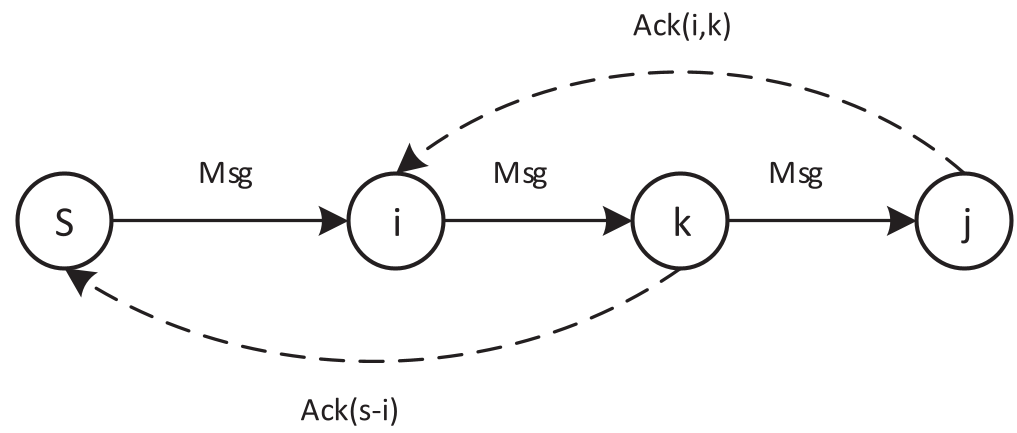 Fig 1: The Trust Evaluation Flow, integrating behavior detection and multi-hop feedback.
Handling Collusion: Blacklist Similarity
One of the hardest problems in distributed trust is the Conspiracy Attack, where two malicious nodes recommend each other as "highly trustworthy." The authors solve this using Blacklist Similarity. A node only accepts a recommendation if the recommender shares a similar "common enemy" list. If we both hate the same malicious nodes, our values are likely aligned.
Experimental Battleground: ONE Simulator
The authors tested their framework against four major routing protocols: Epidemic, Prophet, SprayWait, and FirstContact.
Impact on Performance
The results confirm a massive protection effect. In a network where 10% of nodes are "selfish" (dropping packets), the FirstContact protocol's delivery rate normally crashes to near zero. With the Trust Framework, it maintains functional throughput.
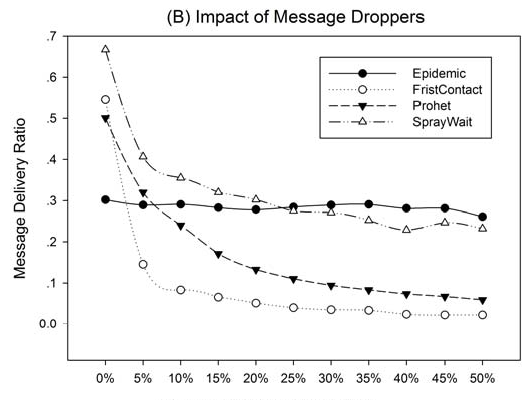 Fig 2: Comparison of different protocols under denial and packet loss attacks.
The framework also reduces Network Load, as normal nodes quickly learn into avoid "Spam" nodes, refusing to forward their garbage data and saving precious battery and bandwidth.
Critical Insight: Why This Matters
The fundamental "Aha!" moment of this paper is the realization that Global Trust is impossible in Local Networks. By focusing on 2-hop local verifications and similarity-based recommendations, the authors created a "reputation economy" that doesn't need a central bank (server).
Limitations & Future Work
While the 2-hop ACK is efficient, it still adds overhead. In extremely high-density environments, the volume of ACKs could lead to congestion. Future research should look at "Adaptive ACK frequency"—reducing feedback when trust is already established.
Conclusion
This Dynamic Trust Framework represents a significant leap for autonomous networks. It provides a mathematical basis for "distributed common sense," allowing mobile devices to navigate social interactions with the same skepticism and verification that humans do in the real world.