
IDEPSR: Shielding Smart Cities with Social-Aware Virus Propagation Modeling
A Dynamic Virus Propagation Model Based on Social Attributes in City IoT
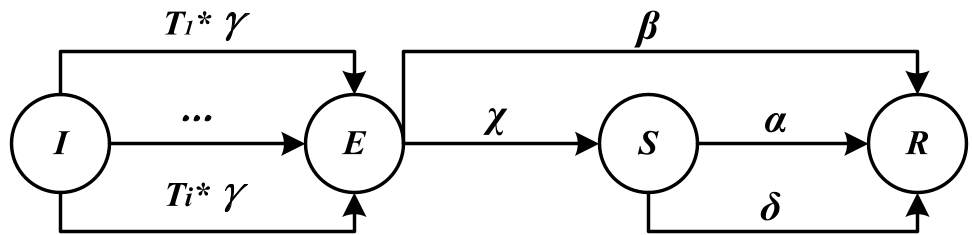
This paper introduces IDEPSR, a dynamic virus propagation model for Social-aware City IoT (SCIoT). It leverages two novel components: DKs-HN for measuring device propagation capability and Pvirus for predicting virus activation probability based on social trust, achieving superior virus containment in smart city simulations.
TL;DR
As smart cities evolve, IoT devices are no longer just isolated sensors; they possess "social attributes" that dramatically alter how malware spreads. The IDEPSR model provides a dynamic framework to predict and control these digital epidemics by quantifying a device's "propagation capability" (how influential it is) and its "identification ability" (how likely it is to trust/activate a malicious payload).
Background: The Rise of Social-aware City IoT (SCIoT)
Urban development has transformed traditional IoT into SCIoT, where devices collaborate to provide smart medical, traffic, and security services. However, this openness makes them vulnerable. If a virus hits a social "hub"—a device with high connectivity and trust—the infection can paralyze critical urban infrastructure within minutes.
Problem & Motivation: Beyond Degrees and K-Shells
Why do existing security models fail?
- Coarse Granularity: Classic metrics like Degree Centrality or K-Shell often assign the same importance to hundreds of nodes, making it impossible to prioritize the most dangerous ones.
- Static Logic: Most models assume a fixed infection rate, ignoring that a device might "trust" information from a frequent collaborator more than a stranger.
Methodology: The Two Pillars of IDEPSR
1. DKs-HN: Identifying the "Digital Super-Spreaders"
The authors improved the K-shell method by creating the DKs-HN algorithm. It uses Dempster-Shafer (D-S) Evidence Theory to fuse two pieces of "evidence":
- Direct Influence (DKs): The node's specific network position and the status of the neighbors it has deleted during the K-shell process.
- Indirect Influence (1-HN): The contribution of its 1-hop neighbors.
2. Pvirus: Predicting Activation through Social Trust
Even if a device receives a virus, it doesn't always "activate" it. The Pvirus method predicts this probability using:
- Social Hierarchy Theory: High-status nodes are less likely to accept messages from low-status nodes.
- NMF 3-D Decomposition: By analyzing historical interaction matrices (), the model uncovers latent trust relationships between devices.
Experiments & Results
Using the Live Journal dataset to simulate a city IoT environment, the researchers found:
- Precision Ranking: DKs-HN outperformed DC, BC, and CC by providing a much finer differentiation of node influence (653 unique ranks vs. ~80).
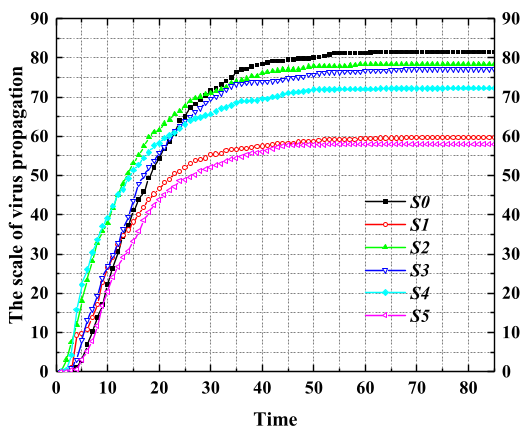
- Superior Control: The IDEPSR model suppressed virus speed more effectively than five other baselines (S0-S4). By controlling just the top 1% of nodes identified by DKs-HN, the "Ignorant" (safe) node proportion remained significantly higher than other methods.
Critical Insight: The Cost of Security
The experimental results highlight a vital takeaway: Targeted suppression is more efficient than broad patching. By identifying nodes with the highest "DKs-HN" score, city managers can achieve max security with minimal resource expenditure—essentially "vaccinating" the digital heart of the city first.
Conclusion & Future Outlook
The IDEPSR model successfully integrates social dimensions into IoT security. While the current work focuses on propagation, the authors note that future research must address data privacy and encrypted transmission to ensure that while we stop viruses, we don't compromise user information.
Takeaway: In the future of smart cities, knowing who a device talks to is just as important as knowing how it talks.