
Dynamic Weighting: Solving the Identity Crisis in Heterogeneous Social Networks
Dynamic Weight-Based Individual Similarity Calculation for Information Searching in Social Computing
The paper introduces a Dynamic Weight (DW)-based similarity calculation framework designed to identify and integrate heterogeneous individual data across distributed social networks. By leveraging a recursive semantic similarity metric that accounts for link types, directions, and dynamic importance, the method achieves State-of-the-Art performance in searching similar individuals within linked data environments.
TL;DR
The explosion of Linked Data across platforms like DBpedia, LinkedIn, and Facebook has created a massive data silo problem: Peter on Facebook and Peter on LinkedIn might be the same person, but how do we prove it mathematically? This paper introduces Dynamic Weight (DW), a recursive similarity calculation that weights connections based on their "uniqueness." It’s not just about if you are connected, but how rare that connection is.
Problem & Motivation: The "Smith" Paradox
Imagine you are searching for a specific "John Smith." If two nodes both have the link hasLastName connected to Smith, how much does that tell you? Very little. However, if two nodes are both connected to Oswald Veblen as their doctoral_advisor, the probability that they are related (or the same person) sky-rockets.
Current State-of-the-Art (SOTA) methods like SimRank fail because:
- Static Weights: They treat all links as equally important.
- Expert Dependency: They require humans to pre-assign weights to properties, which is impossible in the open web with 30,000+ property types.
- Directional Ignorance: They often ignore the difference between "In-links" and "Out-links" in directed social graphs.
The authors' insight is simple yet powerful: The weight of a link depends not just on the link type, but on the rarity of the individuals it connects.
Methodology: The Dynamic Weight (DW) Framework
1. The Core Intuition: Inverse Link Frequency
Borrowing from the Information Retrieval concept of IDF (Inverse Document Frequency), the authors define the weight as: Where represents how many people share that specific neighbor via that specific link. If 1,000 people were born in New York, the weight for that link drops. If only 2 people share a rare attribute, the weight approaches 1.0.
2. Recursive Similarity Calculation
The method builds upon a recursive structure where similarity propagates through the graph. Unlike SimRank, which uses a constant decay factor , this approach replaces with :
 In this example, similarity between A and B is derived by weighting the similarity of their neighbors C and D by the "uniqueness" of the links connecting them.
3. System Architecture
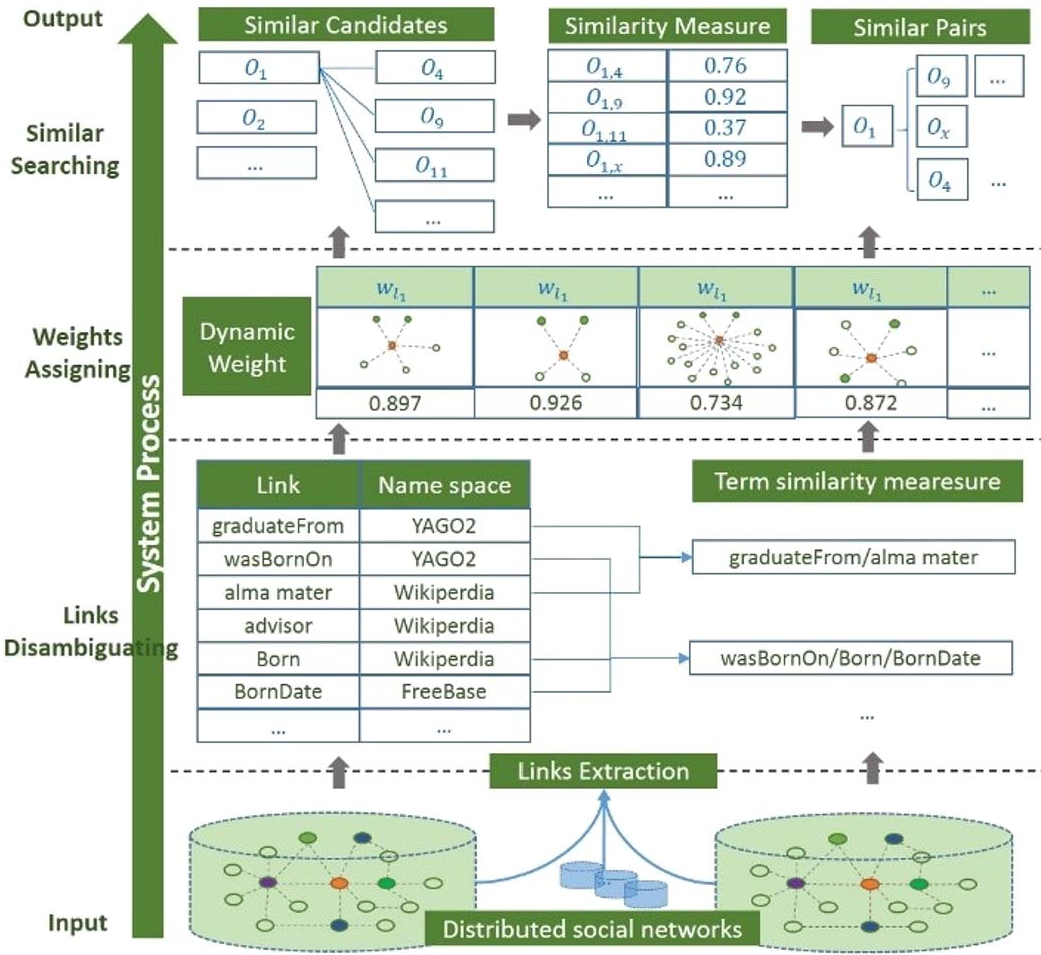
The proposed framework involves three stages:
- Link Disambiguating: Merging equivalent properties (e.g.,
Alma_MatervsgraduatedFrom) using external corpora like WordNet. - Link Weight Assigning: Applying the DW formula.
- Candidate Filtering: Using Jaccard similarity to prune the search space before running the expensive recursive mining.
Experiments & Results: Robustness Under Pressure
The authors tested DW against heavyweights like Logmap, ASMOV, and RiMOM across several OAEI (Ontology Alignment Evaluation Initiative) benchmarks.
Key Performance Wins:
- Precision and Recall: On the IIM-2012 dataset, DW achieved a near-perfect 0.99 F-measure, significantly higher than the 0.75 of traditional SimRank.
- Resilience to Data Loss: In "Sandbox Case-05," where 40% of the links were intentionally removed to simulate noisy real-world data, DW maintained an F-score of 0.938, outperforming Logmap (0.92) and SBUEI (0.92).
 The chart demonstrates that DW remains more stable across varying data corruption scenarios (Case 01-05) compared to competitors.
The Threshold () Trade-off
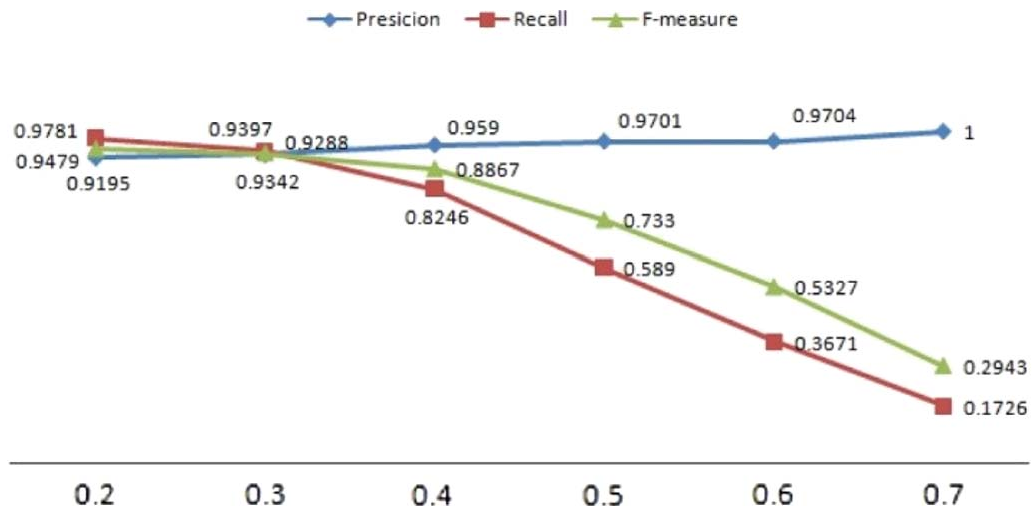
The paper provides an honest look at the sensitivity of the threshold . For high-quality data, a of 0.6 is optimal. However, in "missing link" scenarios, the threshold must be lowered to 0.3 to maintain recall, showing the inherent difficulty of similarity searching in sparse environments.
Critical Analysis & Conclusion
The Takeaway: This paper successfully bridges the gap between Statistical-based and Experience-based weighting. By making the weight "usage-aware," it avoids the pitfalls of manual tuning while outperforming global statistical averages.
Limitations: The authors rightfully admit that the system currently ignores Textual Semantic Meaning. For example, it might struggle to realize "L. Skywalker" and "Luke Skywalker" are the same if the link structure around them is slightly different.
Future Outlook: Integrating Natural Language Processing (NLP) and Large Language Model (LLM) embeddings to handle the "Literal similarity" alongside this "Structural similarity" would likely create the ultimate entity-linking engine for the modern web.