
DSED: Bridging the Gap Between Keyword Bursts and Emotional Engagement in Social Sensing
Dynamic windowing mechanism to combine sentiment and N-gram analysis in detecting events from social media
The paper proposes DSED (Dynamic Social Event Detection), a stream-based framework that integrates an unsupervised dynamic windowing mechanism with hybrid N-gram and sentiment analysis. It achieves a 100% topic recall on the FA Cup dataset and significantly outperforms existing methods like BNGram and SFPM in event coverage.
TL;DR
Social media is the "digital sensor" of our physical world. However, detecting events from this stream is challenging due to the fluctuating velocity of data. The DSED (Dynamic Social Event Detection) framework breaks the limitations of fixed windowing by introducing an adaptive windowing mechanism and a hybrid detection logic that blends N-gram frequency with sentiment oscillations. The result? A perfect 100% topic recall on sports benchmarks.
Problem & Motivation: The Static Window Fallacy
Most state-of-the-art (SOTA) event detection systems operate on fixed windows (e.g., "analyze every 5 minutes"). This is fundamentally flawed:
- Event Fragmentation: A long-term event (like a political debate) might be split across windows, diluting its signal.
- Noise Overshadowing: Short-term bursty events (like a goal in a football match) might be buried in the average statistics of a long window.
- The "Silent" Event: Some events don't trigger a massive volume of posts but do trigger a massive shift in how people feel. Standard frequency-based methods miss these "emotional spikes."
Methodology: The Core of DSED
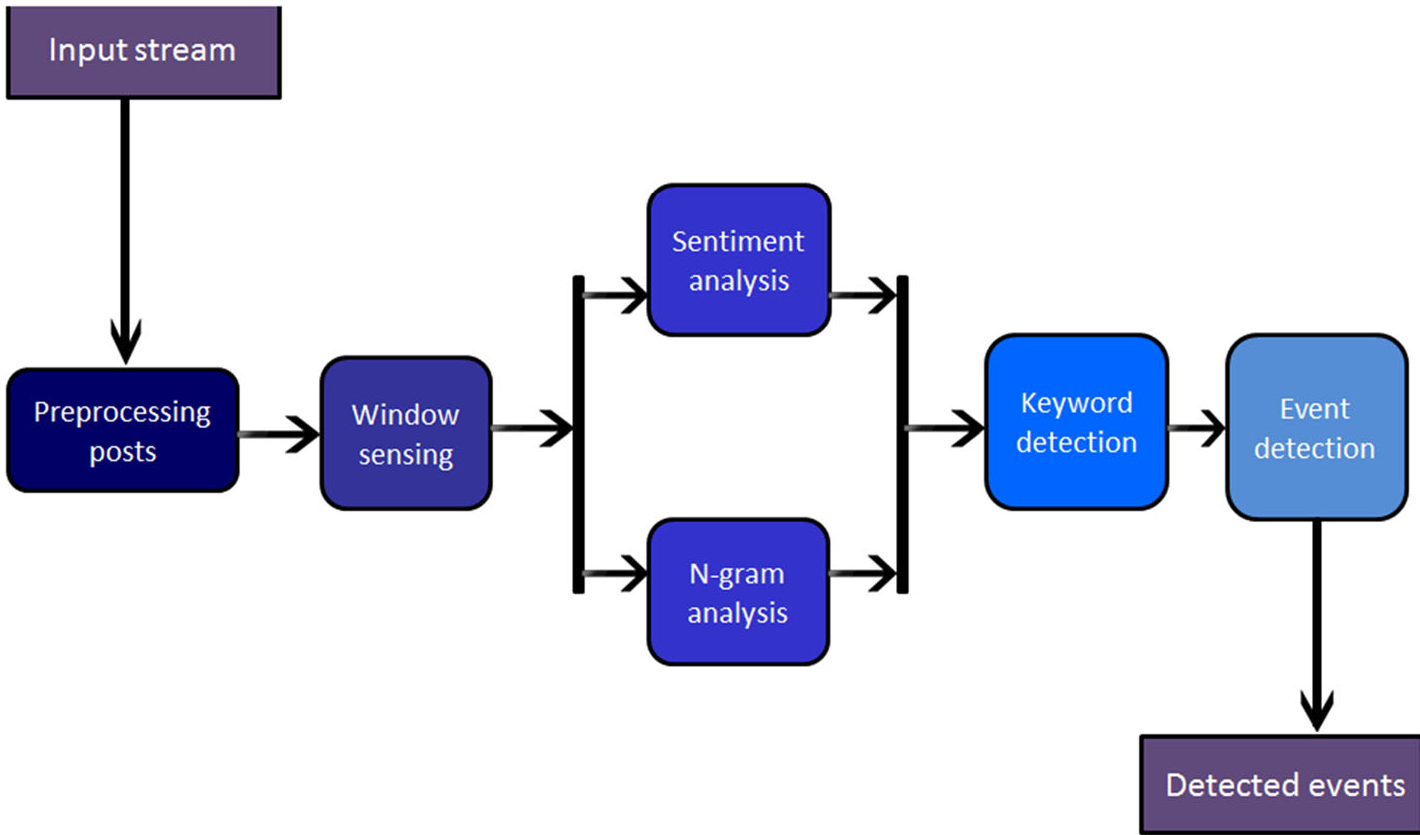
The DSED method consists of a six-phase pipeline, but its brilliance lies in two components: Dynamic Windowing and Sentiment Integration.
1. The Dynamic Windowing Mechanism
Instead of a fixed timer, DSED monitors the input rate of posts (). A window stays open while the discussion is active and closes only when the input rate drops below a threshold or hits a maximum size limit. This ensures that the window size "breathes" with the real-world pace of the event.
2. Sentiment-Augmented Keyword Detection
While most systems use simple frequency, DSED calculates a modified score. Crucially, it adds two emotional filters:
- Positive Sentiment Threshold (): Captures celebratory events (e.g., a goal).
- Negative Sentiment Threshold (): Captures controversial or disastrous events.
This hybrid approach allows the model to identify "maze running" events where the volume is low but the emotional intensity is high.
Experiments: Performance under Pressure
The researchers tested DSED on two massive datasets: the 2012 FA Cup Final and Super Tuesday.
Key Findings:
- Topic Recall: DSED achieved a Topic Recall of 1.0 (100%) on the FA Cup dataset, outperforming BNGram (0.769) and Signal-based methods (0.769).
- Adaptability: The histogram of window sizes confirms that during high-intensity moments, window sizes naturally shortened to capture granular details, while lengthening during lulls to prevent false positives.
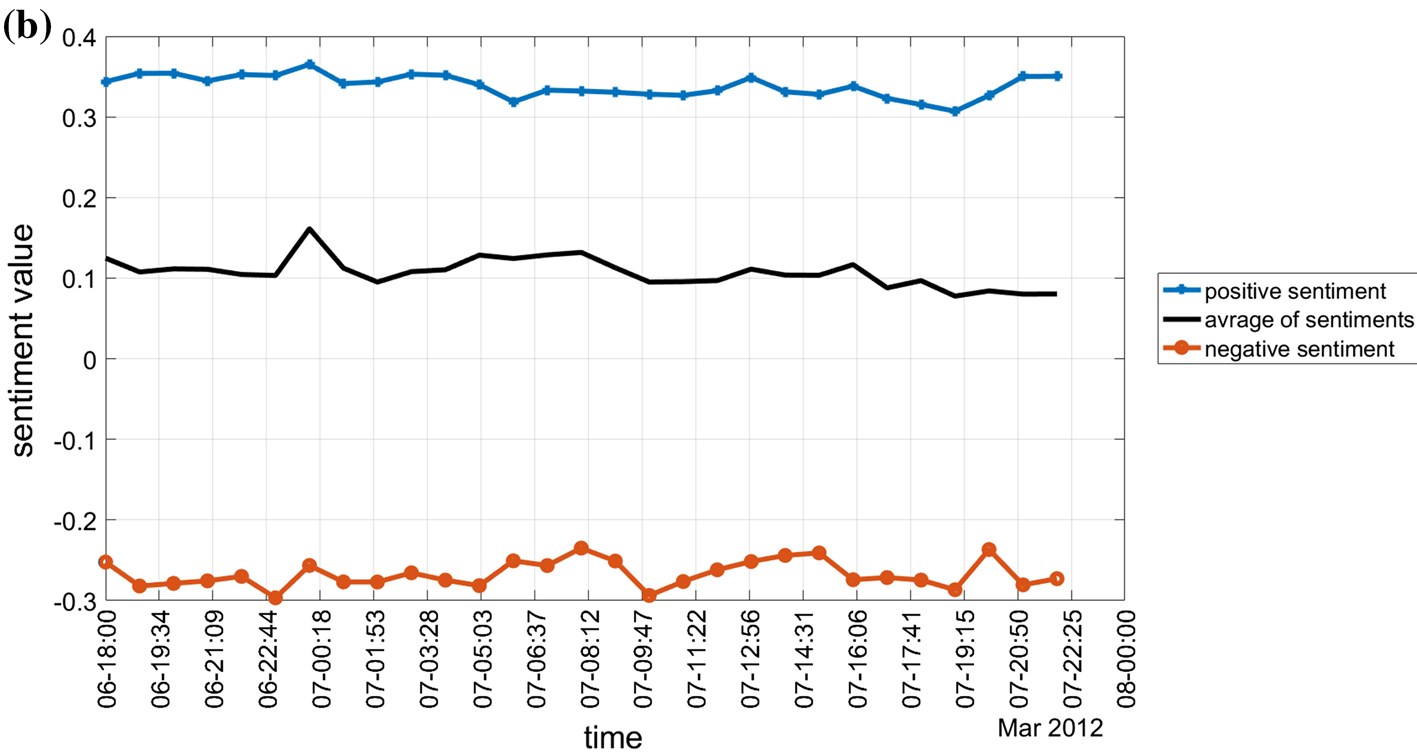 In the figure above, note how local minimums in sentiment (negative spikes) often correlate with key match moments that volume-only methods might ignore.
Comparison with SOTA
| Method | Topic Recall (FA Cup) | Keyword Precision | F-Score |
|---|---|---|---|
| DSED (Ours) | 1.000 | 0.764 | 0.577 |
| BNGram | 0.769 | 0.298 | 0.393 |
| Signal-based | 0.769 | 0.453 | 0.496 |
Critical Insight & Conclusion
DSED proves that the velocity and vibe (sentiment) of social media are just as important as the volume. By treating users as "sensors" that provide not just data points but emotional signals, DSED captures the nuance of human reaction.
Limitations: While the system is highly effective at recall, the use of FP-Growth for frequent pattern mining can be computationally expensive as the number of extracted keywords grows. Future iterations should explore distributed MapReduce implementations to maintain real-time performance on global-scale streams.
The Takeaway: For anyone building real-time monitoring tools (from brand reputation to disaster response), the shift from static to dynamic windowing is no longer optional—it is a prerequisite for accuracy.