
Decoding the Pulse of Twitter: A Dynamical Model of Information Diffusion
A Dynamical Model of Twitter Activity Profiles
This paper proposes a dynamical model of Twitter activity profiles using three core mechanisms: endogenous stimuli (retweeting), exogenous stimuli (media/external injection), and interest decay. By introducing two intrinsic user parameters—contagion threshold (η*) and decay rate (λ)—the authors successfully reconstruct and sub-classify the four temporal popularity profiles (Symmetric, Asymmetric, Peak, and Sparse) originally identified by Lehmann et al.
TL;DR
Why do some hashtags like #SuperBowl explode and vanish, while others like #Activism linger for weeks? This paper presents a concise mathematical framework that replicates complex Twitter activity profiles using just two primary behavioral parameters: Contagion Threshold (η)* and Decay Rate (λ). By simulating these on an empirical network, the researchers moved beyond mere "curve fitting" to explain the behavioral mechanics that drive viral trends.
The "Why" Behind the Peak: Problem & Motivation
Most social media studies fall into two camps: structural analysis (who is connected?) or content analysis (what are they saying?). However, the temporal aspect—the specific way activity builds up and dies down—remains largely empirical.
The authors observed that existing models struggled to explain the diversity in the "Lehmann Classes" of hashtags. They hypothesized that the shape of a trend isn't just random; it's a result of how sensitive users are to their peers (Endogenous) and how quickly they lose interest after the "event" (Decay).
Methodology: The Three Engines of Activity
The researchers constructed a model governed by three distinct mechanisms:
- Exogenous Injection: New info entering via media coverage (#BreakingNews).
- Endogenous Spreading: The viral "retweet" effect, governed by the parameter η* (Influence Threshold).
- Interest Decay: The post-peak exhaustion of a topic, governed by the rate λ.
The Behavioral Logic
The model assumes that a user’s probability to "inject" news is inversely proportional to how many "leaders" they follow—essentially, "information consumers" rarely create, while "influencers" (high followers, low leaders) act as bridges for external news.
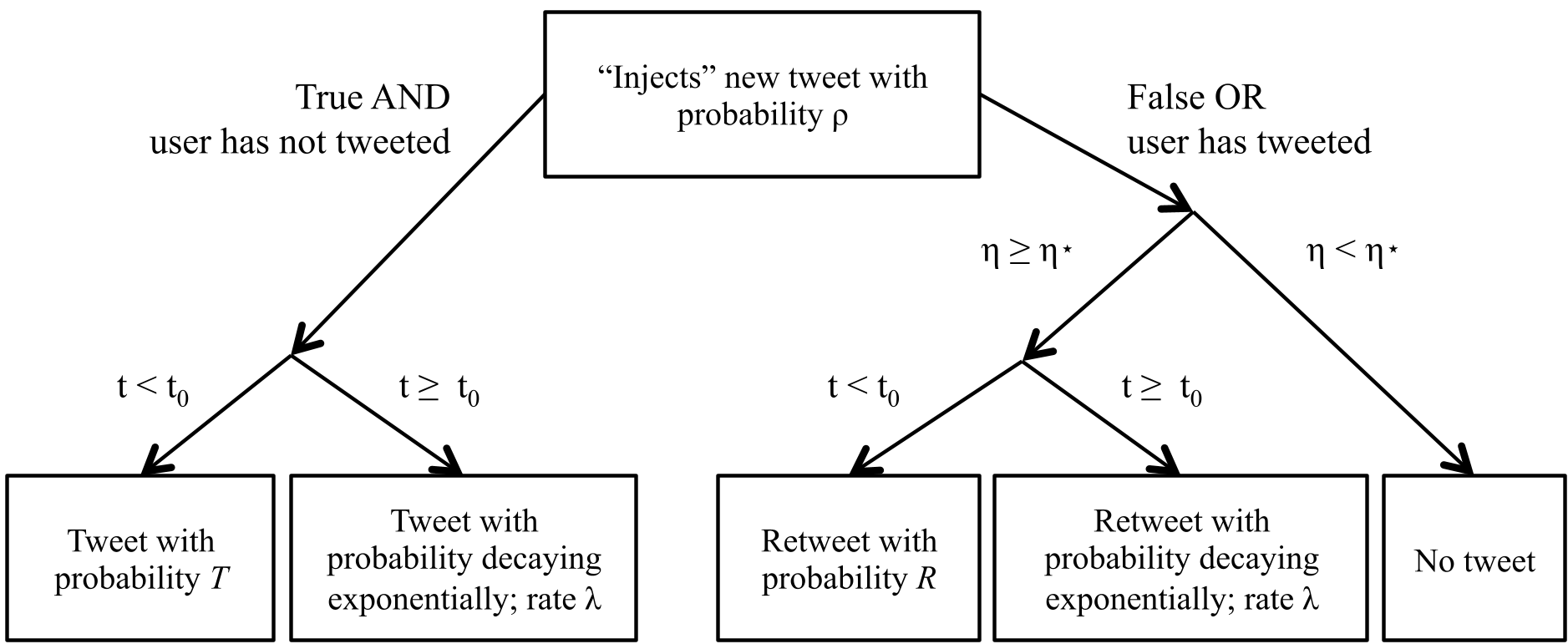 Fig 1: The decision-making flowchart for users within the simulation, balancing external exposure against peer influence.
A critical innovation is the Contagion Condition: A user only retweets if the collective weight of their leaders who have already tweeted exceeds a certain threshold. This captures the "social proof" requirement of modern digital engagement.
Experimental Results: Mapping the Hashtag Universe
The authors tested their model against an empirical dataset of 115 hashtags. By scanning the (λ, η*) parameter space, they found that specific types of content naturally cluster together.
Performance & Classification
- Class S (Symmetric): Low threshold, low decay. These are "sticky" topics like technology releases (#Safari) or activism (#pman) that spread easily and stay relevant.
- Class P (Peak): High threshold or high decay. These are ephemeral flashes like #Oscars or #SuperBowl.
- Class A/B (Asymmetric): These represent sudden shocks or anticipated events where interest is front-loaded or back-loaded.
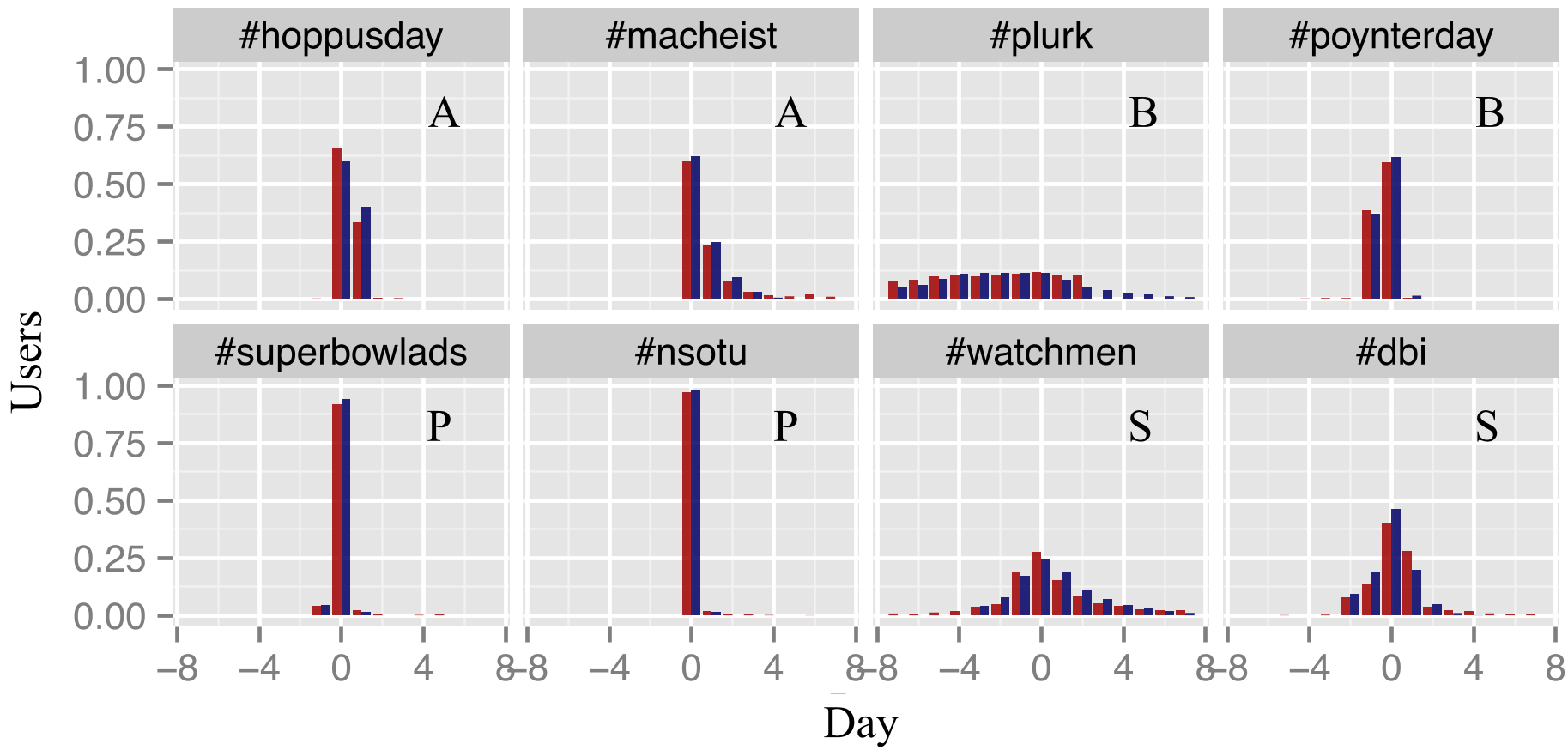 Fig 2: Comparison between model simulations (blue) and real-world Twitter data (red) across the four primary dynamical classes.
Critical Insight: Subclasses and Content Nature
One of the most significant findings is the discovery of subclasses. For instance, "Marketing" hashtags aren't all the same: some are "Long-range" (staying in Class A for a long time), while others are "Short-range," dying out as soon as the incentive (like a free giveaway) ends.
Limitations
The model performs poorly (the remaining 20% of cases) when "anticipation" is a factor. Humans have a "sense of time"; if we know a deadline or event is approaching, our behavior changes in ways a simple decay/contagion model cannot yet capture.
Conclusion: A Blueprint for Trend Engineering
This work demonstrates that the complex "macro" behavior of a global social network can emerge from "micro" behavioral rules. For marketers and policymakers, the takeaway is clear: the success of a campaign isn't just about the network graph; it's about shifting the η* (making it easier to join in) and slowing the λ (maintaining relevance).
As social platforms evolve, incorporating this "sense of time" and anticipation will be the next frontier in predicting the next global viral moment.