
Beyond SIR: How Stochastic Meetings and Intra-Host Biology Trigger Periodic Epidemics
Dynamical modeling of viral spread in spatially distributed populations : stochastic origins of oscillations and density dependence
The paper introduces a novel stochastic mathematical model for spatio-temporal viral spread, integrating individual-level viral-immune system dynamics within a spatially distributed host population. By coupling differential equations for intra-host viral load and immune effectors with a Poisson process for inter-host encounters, it identifies the stochastic origins of periodic epidemic oscillations and the specific thresholds for sustained outbreaks.
TL;DR
Researchers Henry C. Tuckwell and Laurent Toubiana have developed a hybrid epidemic model that bridges the gap between individual biology and population-level spread. By replacing the "well-mixed" assumption of traditional SIR models with a spatial Poisson encounter process and individual differential equations for viral load, they discovered that approximately periodic disease outbreaks can emerge purely from stochastic interactions and biological variability, even when individuals don't exhibit recurring illness naturally.
The Flaw in Classical Epidemiology
For decades, the SIR model has been the gold standard for predicting disease spread. However, it treats a population like a chemical solution—perfectly blended and uniform. This "homogeneous mixing" ignores two vital realities:
- Spatiality: You are more likely to infect your neighbor than someone three towns away.
- Biological Diversity: Every person’s immune system reacts differently to a viral load.
Tuckwell and Toubiana argue that these "ignored" factors are actually the primary drivers of complex epidemic behaviors, such as the periodic waves observed in seasonal influenza.
Methodology: The Bio-Spatial Hybrid
The model operates on two distinct levels:
1. The Individual (Intra-Host)
Every host in the simulation is governed by a system of two differential equations:
- Viral Load (): Grows logistically but is cleared by effectors.
- Immune Effectors (): Produced in response to the presence of the virus.
Importantly, the parameters (, etc.) are randomly assigned to each host, simulating a realistic population where some have stronger immune systems than others.
2. The Population (Inter-Host)
Hosts are placed randomly in a 2D habitat. Meetings occur based on a Poisson process where the rate decays exponentially with distance:

Transmission only happens if a meeting occurs, the donor's , and a transmission roll succeeds with probability .
The Stochastic Origin of Oscillations
The most striking finding is the emergence of periodic outbreaks. Even when parameters were set so that individuals would normally clear the virus and become immune (non-oscillatory), the population as a whole often experienced recurring spikes in infection.
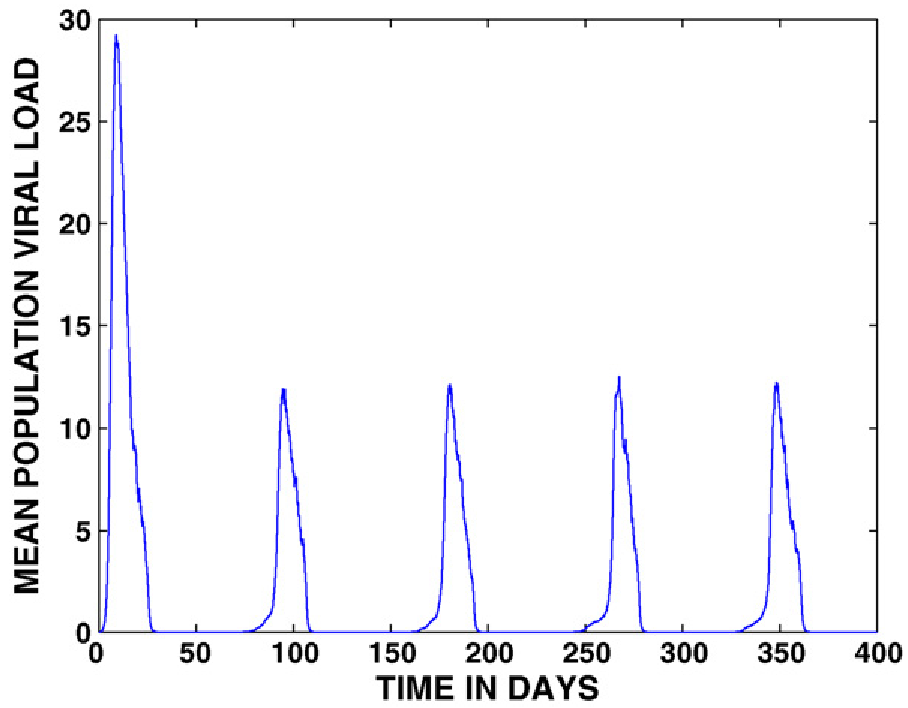 Fig 4: Mean viral load across the population showing near-periodic peaks resulting from stochastic interactions.
Key Drivers of Multiplicity:
- Density (): As population density increases, the "single outbreak" scenario vanishes, replaced by mandatory recurring waves.
- Transmission Probability (): A critical threshold exists (around 0.3-0.5) where the system transitions from a localized dampening to sustained global oscillations.
- Viral Growth Rate (): Higher mutation rates leading to faster viral replication significantly increase the frequency of these waves.
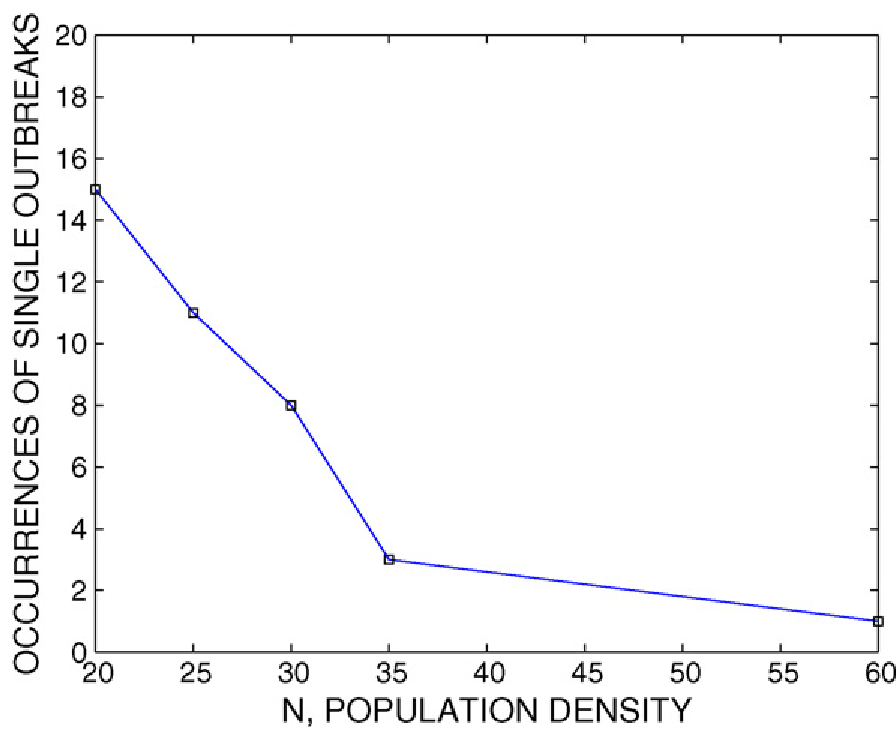 Fig 7: The sharp decline in single-outbreak events as population density increases.
Critical Insight: The Role of "Spiral Points"
In dynamical systems theory, a "stable spiral" equilibrium means the system oscillates as it returns to balance. The authors found that if a population has a distribution of individuals whose immune parameters put them near these spiral points, they act as biological "reservoirs" that can re-ignite the fire in the rest of the population, provided the contact rate is high enough.
Conclusion and Future Outlook
Tuckwell and Toubiana's work demonstrates that we cannot understand epidemics by looking at populations in aggregate. The "noise" of individual variation and the "chaos" of random meetings are not just background interference; they are the mechanisms that allow viruses to persist and recur.
Limitations: The model currently uses relatively small populations () due to computational constraints. Future work involving larger social networks (like EpiSims) and airline travel data will be necessary to apply these insights to global pandemic forecasting.
Final Takeaway: To prevent the next wave, we must look at the intersection of spatial proximity and individual immune variability. One "superspreader" at the center of a dense cluster is worth more than a thousand infected individuals at the periphery.