
Battle of the Bubbles: Strategic Maneuvering in Multi-Campaign Social Networks
Dynamics of multi-campaign propagation in online social networks
The paper proposes the Multi-Campaign Independent Cascade Model (MCICM) to simulate the competitive spread of information in online social networks. It introduces "Campaign Efficiency" as a metric and evaluates two structural intervention strategies—node coercion and link cutting—based on betweenness centrality to ensure a specific campaign's dominance.
TL;DR
In the digital arena, information doesn't spread in a vacuum—it competes. This paper introduces a sophisticated framework for modeling Multi-Campaign Independent Cascades (MCICM) and provides a mathematical metric for "Efficiency" to determine how easily a campaign can win over its rivals. By testing strategies like Link Cutting and Node Coercion on real-world Twitter election data, the authors demonstrate how structural interventions can pivot public opinion.
Academic Positioning: This work bridges the gap between traditional epidemiology (disease models) and adversarial social influence, moving beyond simple "virality" to "strategic dominance."
The Friction of Competition: Why Single Models Fail
The fatal flaw of many prior diffusion models—like the classic Independent Cascade (IC) or Linear Threshold (LT) models—is the Closed-World Assumption. They often treat a single piece of news as if it’s the only thing the user sees.
In reality, social networks are a zero-sum game for attention. During an election or a product launch, if a user is "activated" by Campaign A, they are often rendered immune or resistant to Campaign B. The authors’ core insight is that to help a campaign succeed, one must not only boost its signal but also strategically dampen the "survivability" of its competitors.
Methodology: Engineering a Victory
The authors define success binary: a campaign wins if it captures more than 50% of the network (). To achieve this, they propose two surgical intervention methods:
- Link Cutting: Identifying and removing high-traffic "bridges" (edges) used by competing campaigns.
- Node Coercion: Forcing influential "seed" nodes of competitors to become inactive (neutral), allowing them to be re-captured by the supported campaign.
Both methods rely on Betweenness Centrality—a measure of a node's or edge's "brokerage" power.
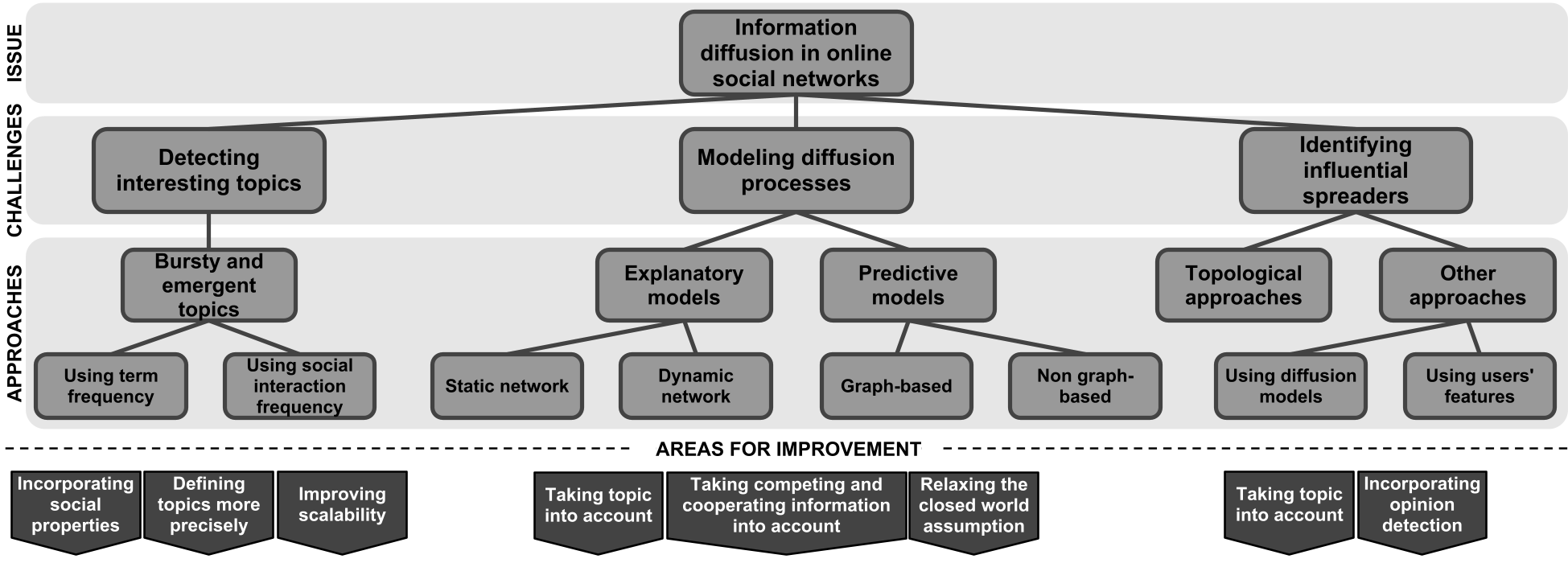 Fig 1: The taxonomy of information diffusion challenges addressed by the paper.
The Formal Efficiency Metric
The paper introduces a clever "Efficiency" () formula: Essentially, efficiency is high if you can flip the network while only cutting a small fraction of the enemy's resources.
Experimental Insights: Nodes vs. Edges
The study utilized 10 Twitter datasets from the 2012 "Super Tuesday" US Republican primary.
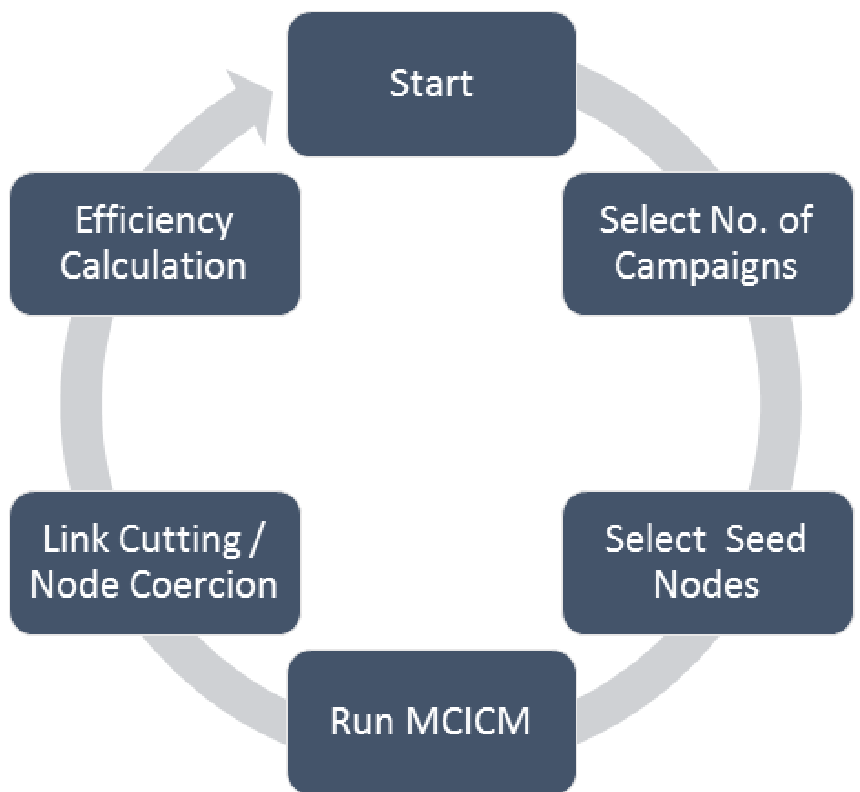 Fig 2: The iterative methodology for calculating campaign efficiency.
Key Findings:
- The Threshold of Campaign Count: For 2 or 3 campaigns, Link Cutting is the champion. It achieves higher efficiency because removing a few vital bridges can isolate entire sub-communities from a competitor.
- Scalability: Surprisingly, as the number of campaigns increases (simulating a fractured multi-party field), Node Coercion becomes more effective. When the network is cluttered with many small voices, neutralizing the "shouters" (seeds) works better than trying to cut the messy web of links.
- Efficiency Distribution: In 2-campaign scenarios, over 67.85% of cases reached an efficiency of >90% using Link Cutting, suggesting that social networks are remarkably vulnerable to targeted edge removal.
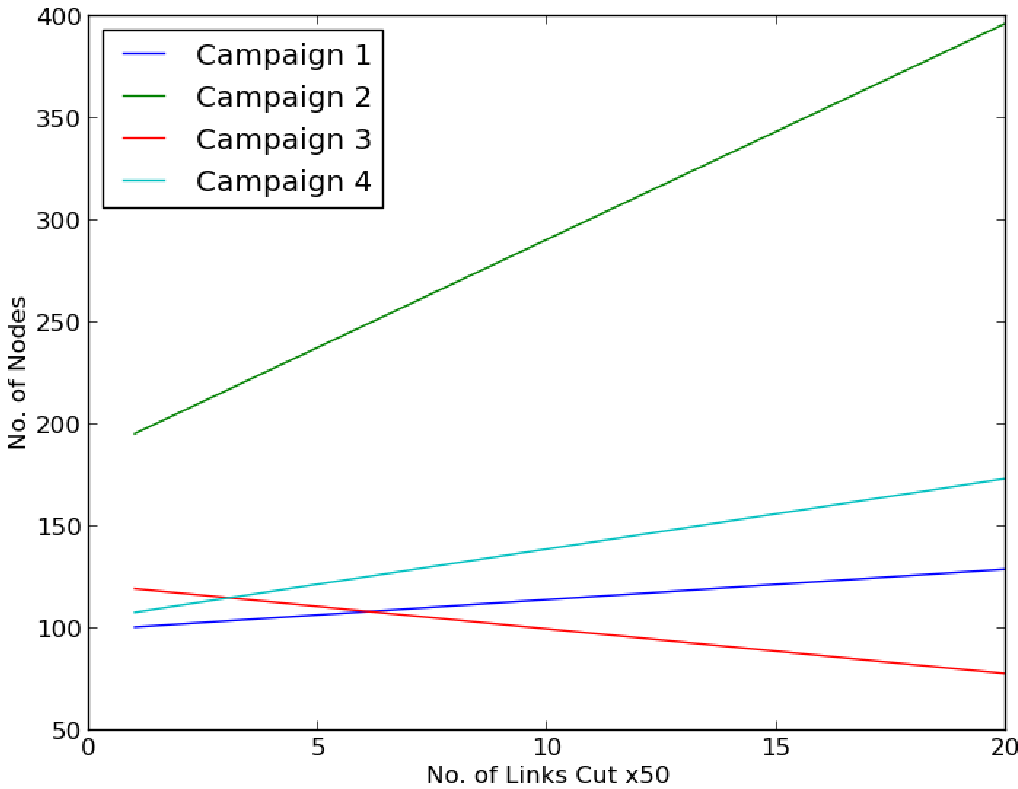 Fig 3: The growth of the supported campaign (Campaign 2) as competitor links are cut.
Critical Analysis & Conclusion
This paper provides a chillingly efficient blueprint for how information ecosystems can be "steered." By focusing on Efficiency, the authors highlight that one doesn't need to silence every opposing voice; they only need to target the nodes and links with the highest Betweenness Centrality.
Limitations: The model assumes a "unit activation" logic—once you are in a campaign, you don't leave. Real human psychology is more fluid; people change their minds or can be influenced by multiple sources simultaneously.
Future Outlook: As we move toward a world of AI-driven bots and algorithmically curated feeds, understanding the "Efficiency" of influence will be critical for national security and the defense against automated misinformation campaigns. The next frontier will likely involve applying these models to dynamic, time-varying networks where links appear and disappear in seconds.