
The Predictability of Polarization: How Monotone Dynamics Shape Our Opinions
Dynamics of opinion forming in structurally balanced social networks
This paper investigates opinion dynamics within social communities modeled as signed graphs, specifically focusing on "structurally balanced" networks. By establishing a formal analogy between Heider’s structural balance theory and monotone dynamical systems, the author demonstrates how antagonistic factions lead to highly predictable, order-preserving opinion forming processes.
TL;DR
In a world split between "friends" and "enemies," our opinions aren't just random—they are mathematically destined to polarize. This paper bridges the gap between Social Balance Theory and Monotone Dynamical Systems, proving that in a balanced social network, the evolution of opinions is as predictable as a one-dimensional system, leading inevitably to monolithic, antagonistic factions.
The Social Physics of "Us vs. Them"
Why do political systems often devolve into two warring camps where internal nuance is lost? Social scientists call this Structural Balance. According to Heider (1946), a community is balanced if "the friend of my friend is my friend" and "the enemy of my enemy is my friend."
The technical challenge has always been: how do we model the dynamic change of opinions in such a world? Previous models often focused on consensus (everyone agreeing), but failed to explain the stability of "wall-against-wall" fights typical of two-party systems.
The Core Insight: Social Balance as Monotonicity
The author, C. Altafini, provides a brilliant mathematical bridge. He argues that if we treat "influence" as a partial derivative in a dynamical system, a balanced social network behaves exactly like a Monotone Dynamical System.
1. The Kamke Condition
For a system to be monotone, the influence of person on person must have a constant sign. If and are friends, the influence is positive; if they are enemies, it is negative.
2. The Gauge Transformation
The most striking part of the methodology is the use of Gauge Transformations—a concept borrowed from Ising spin glasses in physics.
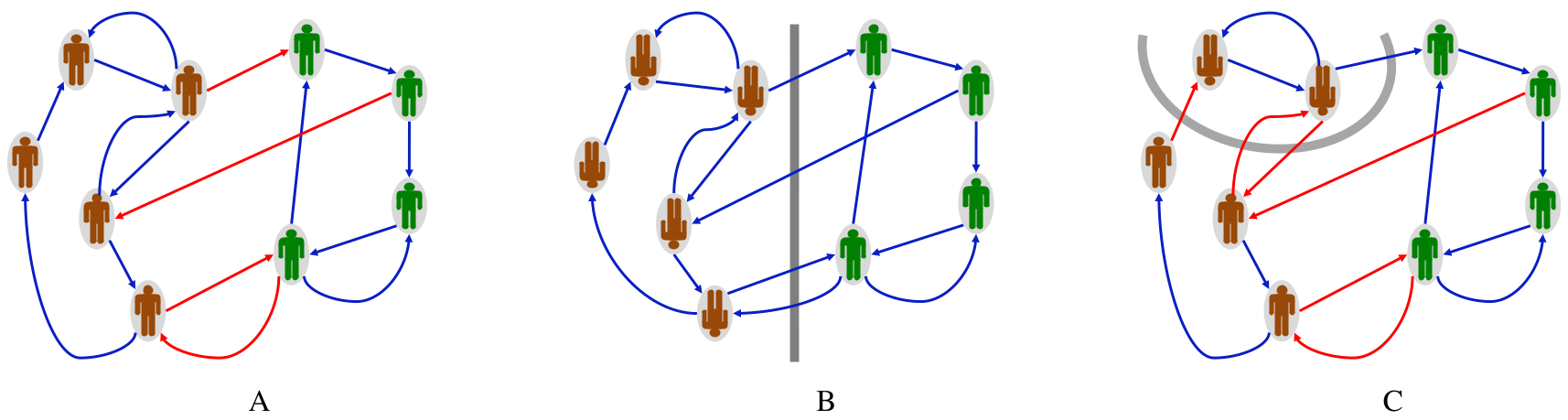
As shown in Figure 1, by "flipping" the signs of individuals in one faction, a network of enemies can be mathematically transformed into a network of all-friends. This proves that an antagonistic balanced system is just a "disguised" cooperative system.
Experiments: How Opinions Spread
Using a nonlinear "Michaelis-Menten" kinetic model (often used to describe biological reactions), the paper simulates how opinions propagate through these networks.
The Power of the First Seed
Monotone systems possess order-preserving flows. If you are the first to seed an opinion in a connected network, you have a "strong competitive advantage." Because the system is monotone, your initial lead is unlikely to be overturned by internal dynamics alone.
In-Degree vs. Faction Size
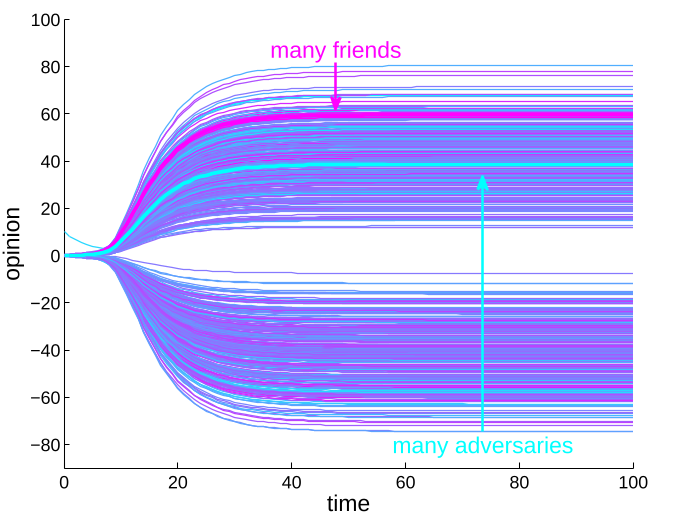
The simulations reveal that an individual's opinion strength isn't just about how many friends they have. It's about their Total Connectivity (in-degree). Even if you are surrounded by enemies, their negative influence effectively "pushes" you further into your own faction's ideology.
Critical Analysis: The Tragedy of Balance
The beauty of this work lies in its qualitative robustness. You don't need to know the exact "math" of how people change their minds; as long as the signs of their relationships remain constant, the outcome (polarization) is topologically guaranteed.
Limitations:
- Fixed Networks: The model assumes social ties are static. In reality, people often break ties with those they disagree with (homophily), which the author notes as a separate research direction.
- Exact Balance: Real networks are rarely perfectly balanced. They contain "frustration"—triangles of three enemies, for example—which breaks monotonicity and could lead to more complex (chaotic) dynamics.
Conclusion
This paper reframes social polarization not as a psychological failure, but as a formal property of structured influence. Under a balanced regime, neutrality is impossible, and the "predictable" nature of monotone systems ensures that once a community splits, the factions become monolithic and the discussion becomes a "wall-against-wall" fight. For those designing social media algorithms or political strategies, this highlights a grim reality: structure often dictates content.