
Decoding the Silent Majority: Predicting News Clicks via Twitter Dynamics
Dynamics and Prediction of Clicks on News from Twier
The paper presents a two-step, memoryless geometric generative model designed to predict news article clicks on Twitter. By leveraging a unique dataset from BuzzFeed, the authors demonstrate that clicks can be accurately interpolated from public social media receptions (follower counts) with a significantly lower error rate than current SOTA methods like Hawkes Intensity Processes (HIP).
TL;DR
While we often measure a story's success by its "Retweets," the reality of consumption happens in the "Clicks"—a metric usually hidden from public view. This paper introduces a simple yet powerful Geometric-Memoryless Model that predicts private click counts using only public follower data. By shifting the focus from "cascades" to "impressions," the authors achieve a staggering 5-8x improvement in accuracy over previous state-of-the-art methods.
Background: The Follower Fallacy
In the world of social media research, we are often drunk on public data. We track shares, retweets, and likes because they are visible. However, as this study points out, there is a "silent majority" of users who read without reacting. Existing models like the Hawkes Intensity Process (HIP) treat information spread as a series of triggered bursts, but they often fail to capture the long-tail decay of actual web traffic.
The Core Insight: Impressions are the Missing Link
The authors identify a three-stage pipeline for news diffusion:
- Receptions: The sum of followers of everyone who tweeted the link (Public).
- Impressions: The number of times the link actually appeared on a user's screen (Private).
- Clicks: The final act of engagement (Private).
The breakthrough observation is that the ratio between Impressions and Clicks is remarkably stable over time for a specific source. While retweets happen in bursts, the "activation" of a potential reader follows a memoryless geometric decay.
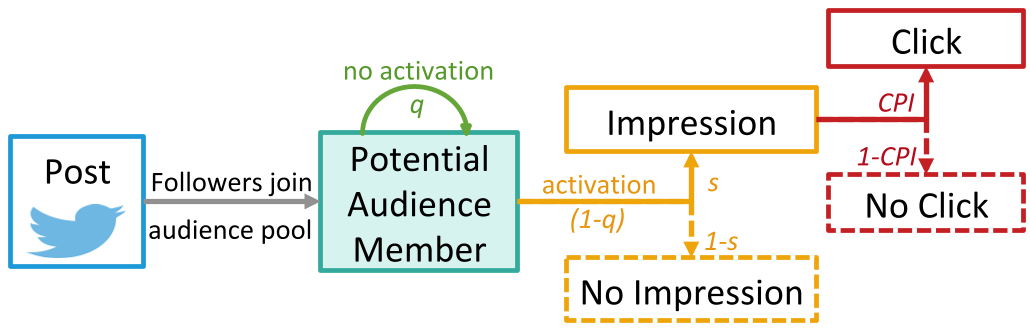 Figure 1: The two-stage generative model: Receptions Impressions Clicks.
Methodology: The Geometric-Memoryless Model
Unlike complex Bayesian or reinforcement processes, the proposed model uses two primary parameters:
- (Scaling): How many receptions successfully convert into impressions?
- (Activation): The probability a user remains in the potential audience pool without seeing the link yet.
Because these parameters are largely dependent on the source (e.g., a BuzzFeed follower's habit) rather than the specific content, the model can be trained on just one hour of data and remain robust for the next 24 hours.
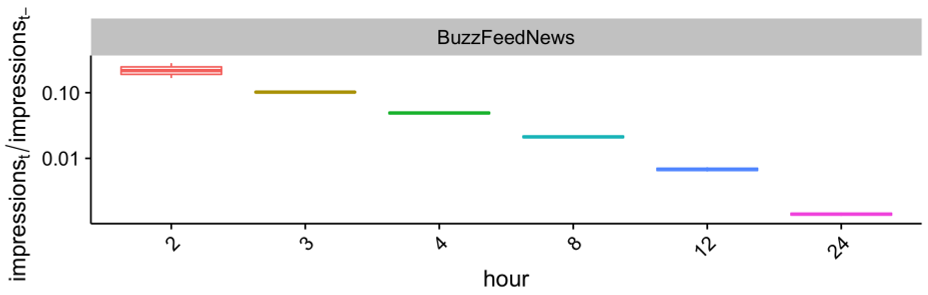 Figure 2: Evidence of geometric decay in hourly impressions.
Experimental Results: Precision vs. Noise
The researchers tested their model against a proprietary BuzzFeed dataset and several mainstream news outlets. The results were clear:
- Accuracy: In real-time interpolation, the Geometric model achieved a 17.29% MAPE, while the HIP model struggled at 102.2%.
- Foresight: Even when predicting 24 hours into the future based on the first 4 hours of activity, the model maintained high precision (12.68% error).
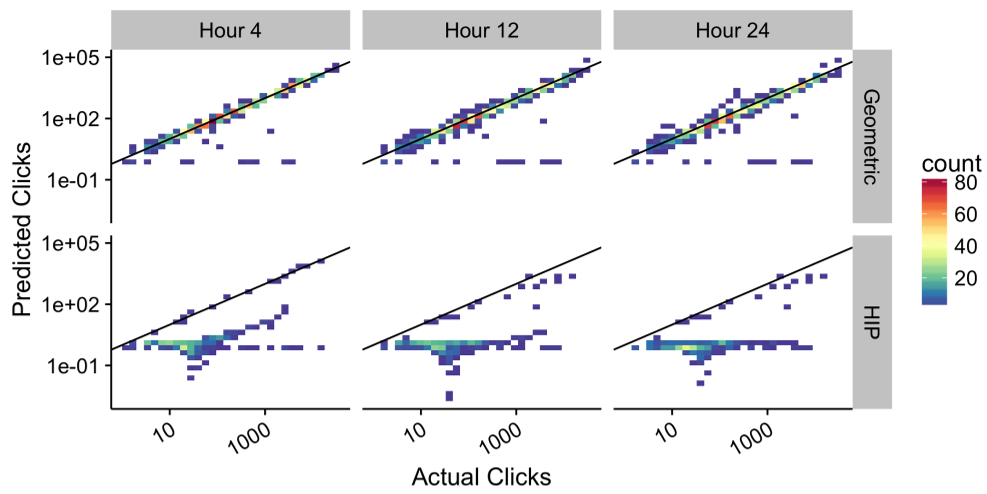 Figure 3: Prediction accuracy. The Geometric method (Red) aligns much closer to the ground truth than the HIP baseline.
Critical Analysis & Conclusion
This work challenges the industry's reliance on "viral" metrics. It proves that the dynamics of reading are slower and more predictable than the dynamics of sharing.
Takeaway: If you want to know how many people are actually reading an article, look at the followers of the sharers and apply a geometric decay—don't just count the retweets.
Limitations: The model assumes a relatively stable follower-to-impression ratio for a source. It may struggle with "black swan" events or extreme outliers where a piece of content transcends the typical behavior of a source's audience.
Future Outlook: Transitioning this model to other platforms (like LinkedIn or Instagram) could provide researchers with a standardized way to estimate true content reach without requiring API access to private platform analytics.