
The Volatility of Influence: How Group Evolution Reshapes Social Roles in the Blogosphere
Dynamics of Social Roles in the Context of Group Evolution in the Blogosphere
This paper investigates the dynamics of social roles during group evolution within the blogosphere. Utilizing the "Salon24" dataset, the authors propose a model that correlates specific group events (e.g., merging, splitting, deletion) with transitions in user roles, categorizing users into four levels of significance based on their interaction patterns.
TL;DR
In the digital landscape of the blogosphere, your influence is not just a product of your content, but a reflection of the group structure around you. This paper explores how group "life events"—such as merges, splits, and deletions—cause users to gain or lose social status. By analyzing five years of data from a major Polish blog portal, the researchers demonstrate that while "standard" users remain stable, influential figures are highly susceptible to demotion when their social groups undergo structural reorganization.
Background & Motivation: Beyond Static Communities
Most social network analysis (SNA) treats communities as snapshots. However, the blogosphere is a living organism where groups form, grow, fracture, and die. The core research question here is: Does the way a group changes determine your future role? If your community merges with another, do you stay a leader or become a follower?
Methodology: Mapping Roles to Events
The researchers built a comprehensive model of social organization , tracking five key elements: Users, Relations, Stable Groups, Local Roles, and Evolution Events.
1. Defining Social Roles
Roles were categorized by "significance levels":
- Level 1 (Influential): Bloggers and Users who receive massive feedback (Selfish vs. Social depending on whether they engage back).
- Level 2 (Influential Commentators): High-impact engagers who don't post original blogs.
- Level 3 (Standard): Typical active users.
- Level 4 (Low Activity): The "silent majority."
2. Identifying Group Events
Using the SGCI (Stable Groups Change Identification) algorithm and Jaccard similarity, the authors identify 7 event types:
- Weak Reorganization: Constancy, Change-size, Addition.
- Strong Reorganization: Deletion, Merge, Split, Split-Merge.
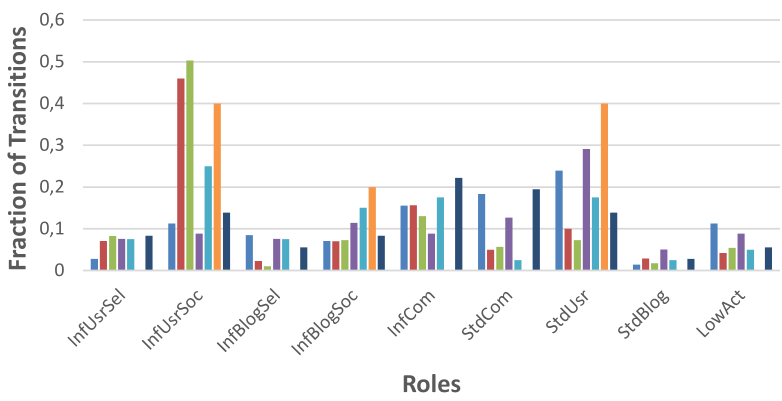 Note: Above chart illustrates the diverse transition pathways users take following specific architectural changes in their groups.
Experimental Insights: Who Survives Reorganization?
The study utilized the Salon24 dataset, encompassing over 5.7 million comments across 504 time slots.
The Fragility of Influence
One of the most striking findings is the instability of high-level social roles. The InfBlogSoc (Influential Blogger Social) role is the least stable; almost any group event—even simple additions—has a high probability of causing a demotion to StdUsr (Standard User).
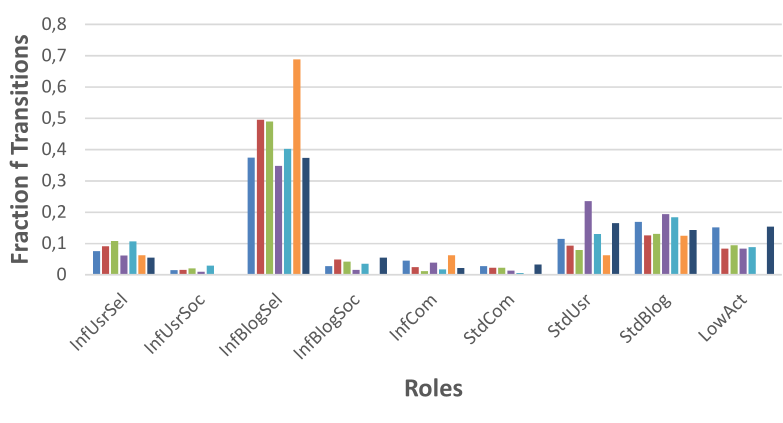 Fig 2: Fraction of transitions for Influential Social Users. Note how 'split-merge' and 'deletion' events drive users toward standard roles.
Event-Specific Impacts
- Merge Events: Frequently lead to a loss of meaning for influential users, with a roughly 15% chance of dropping to
LowAct. - Split Events: These are "identity shifters." For
InfUsrSel, a split often forces a transition intoInfBlogSel, suggesting that when a group fractures, leaders must pivot their engagement style to maintain relevance. - Stability of the "Bottom": The
LowActrole is the most resilient. 80% of low-activity users remain so regardless of what happens to the group.
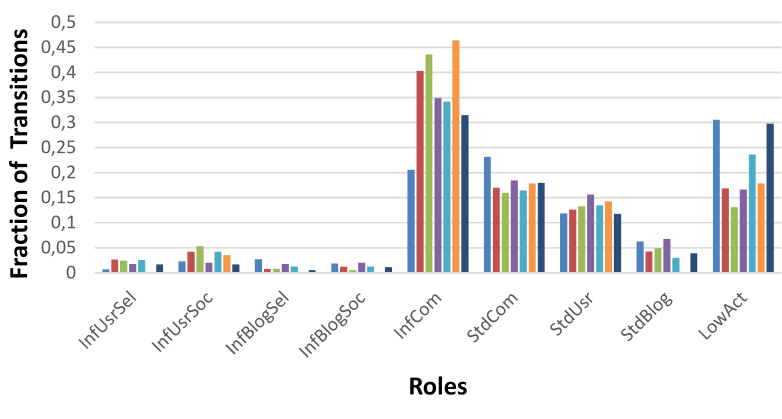 Fig 10: Comparison of role maintenance. Influential roles (left side of the X-axis) show significantly lower stability across all event types compared to standard roles.
Critical Analysis & Conclusion
Takeaways
The paper successfully bridges the gap between Group Evolution and Individual Role Dynamics. It proves that social roles are "local"—they are tied to the specific structural context of a group. When that structure dissolves (deletion) or complexifies (split-merge), the existing social hierarchy is challenged.
Limitations & Future Work
While the structural approach is robust, it lacks content awareness. A leader might maintain their role despite a group split specifically because of the quality of their content, not just the graph topology. The authors acknowledge this and suggest that future versions of the model will integrate sentiment analysis and content-based prediction to further refine role transition probabilities.
In the evolving blogosphere, staying at the top requires more than just activity; it requires a group structure that remains stable enough to support your influence.