
From "Post and Hope" to "Post and Expect": Decoding Software Crowdsourcing Dynamics
Dynamics of Software Development Crowdsourcing
The paper introduces a data-driven framework to transform software development crowdsourcing from a "Post and Hope" model to a "Post and Expect" paradigm. By analyzing 2.5 years of historical data from Topcoder (competition-based) and Upwork (hiring-based), the authors identified key predictors for task completion and quality, achieving high predictive accuracy (F-scores up to 0.89) using Machine Learning.
TL;DR
Crowdsourcing software development is often seen as a gamble—technically known as the "Post and Hope" model. This research moves the needle toward a deterministic "Post and Expect" model by analyzing years of data from Topcoder and Upwork. By leveraging Machine Learning, the authors prove that task success isn't random; it’s a predictable outcome of task design, poster reputation, and worker demographics.
Background: The Complexity Barrier
While micro-tasks like image tagging are easily crowdsourced, software development requires sustained cognitive effort and high-level skills. The primary barrier to industrial adoption isn't a lack of talent—it's a lack of confidence. Managers don't know if a task posted to the world will return a high-quality solution on time. This paper seeks to replace "managerial intuition" with "quantitative assessment."
Methodology: A Tale of Two Models
The study analyzes two fundamentally different engagement models:
- Topcoder (Competition-based): Multiple workers compete; only one or two win. It’s driven by prizes and ranking.
- Upwork (Hiring-based): Traditional freelancing where a poster interviews and selects a specific worker.
The authors extracted over 85,000 data points and evaluated over 35 features, including budget, duration, worker ratings, and even the geographic location of the participants.
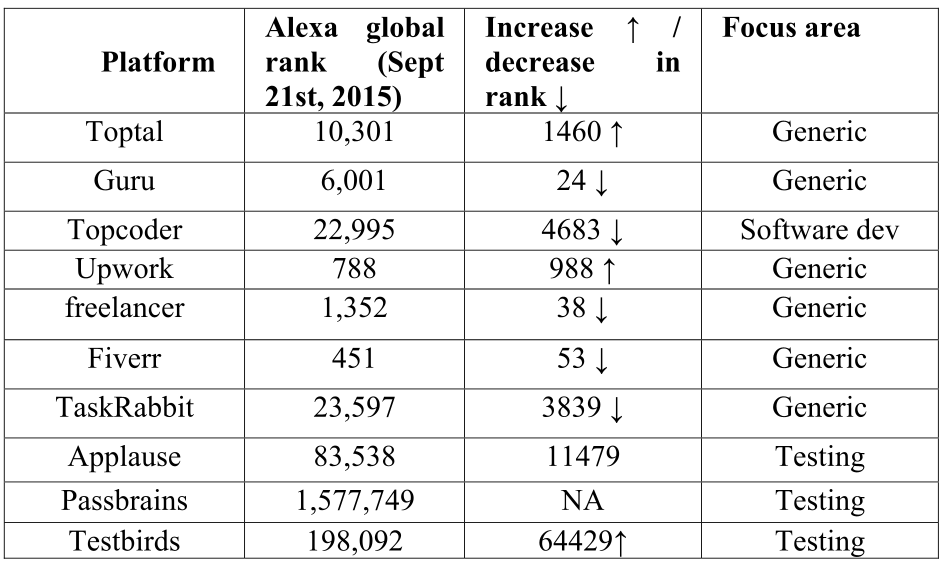 The study focused on Topcoder and Upwork as the most representative and data-rich platforms for software engineering.
Key Insights: What Actually Drives Success?
1. The Reputation Paradox
On Upwork, the most critical factor for task completion is not the worker—it's the Task Poster. Characteristics like "Hiring Rate," "Total Money Paid," and "Payment Verification" (Information Gain: 0.13–0.24) are the primary drivers. Workers flock to reliable "bosses."
2. The Incentive Engine
On Topcoder, success is driven by Worker Capability (Max Rating: 0.195) and Prize Structure. Interestingly, the Second Prize is almost as vital as the first because it mitigates the risk for high-skill workers to enter the competition.
3. Geographical Hotspots
India emerged as the dominant force, providing the highest number of workers on both platforms. However, the study noted a "demand-supply gap" in certain categories: high-demand categories like "Assembly" often suffer from skill shortages, while "Conceptualization" is over-saturated with workers.
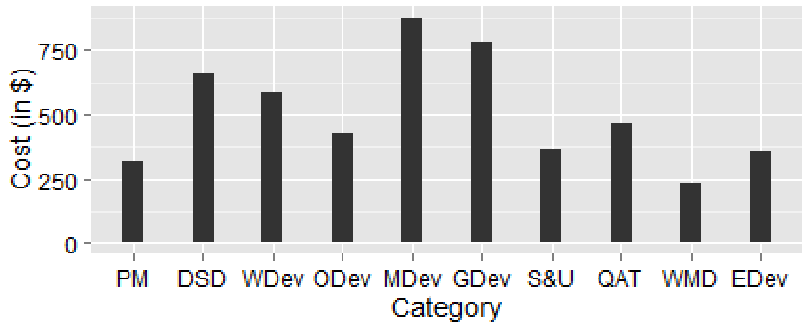 Analysis shows cost typically scales with duration, but plateaus after a certain point, reflecting a "sweet spot" for task complexity.
Predictive Power: Machine Learning Results
The researchers tested several algorithms (Naïve Bayes, Decision Trees, Random Forest, SVM). Using Random Forest combined with SMOTE (to handle imbalanced datasets where most tasks are successful), the model achieved:
- Accurate Completion Prediction: F-Score of 0.89 (Topcoder) and 0.87 (Upwork).
- Accurate Quality Prediction: F-Score of 0.85 (Topcoder) and 0.89 (Upwork).
This proves that with the right historical data, a platform can tell a poster exactly how likely their task is to succeed before they even click "Post."
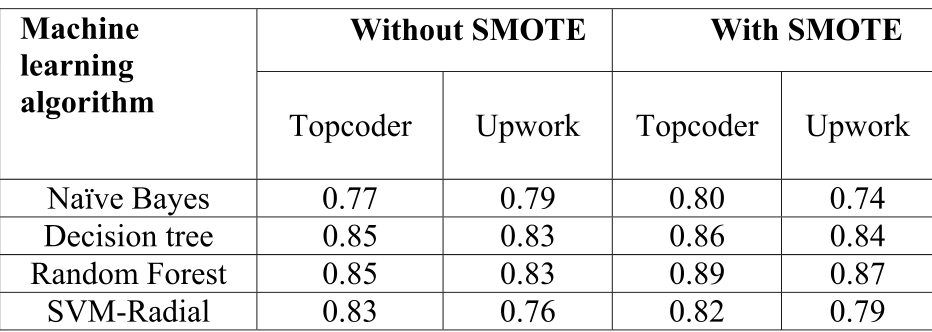 Random Forest consistently outperformed other models, proving robust across both hiring and competition models.
Critical Analysis & Takeaways
The "Post and Expect" model is viable, but it requires a change in behavior:
- For Upwork users: Verify your payment and maintain a high hire rate to attract top talent.
- For Topcoder users: Don't skimp on the second prize and ensure your task category matches the current "hot" skills of the crowd.
Limitations: The study relies on platform-reported data which can be subject to "rating inflation" (80% of Upwork tasks are rated 'Excellent'). Further research is needed to investigate the internal quality of code (via static analysis) rather than just the subjective rating given by the poster.
Conclusion
This work provides a foundational roadmap for the "Workforce Analytics" of the future. By treating the crowd not as a chaotic mass, but as a predictable dynamical system, organizations can finally integrate crowdsourcing into their core software development lifecycles with confidence.