
Dynamix: Leveraging Social Dynamics to Supercharge Anonymous Communication
Dynamix: Anonymity on Dynamic Social Structures
Dynamix is a novel framework for anonymous P2P communication that leverages the dynamic nature of social network structures. By modeling social dynamics as random walks on weighted multigraphs, the authors improve quantitative sender anonymity compared to traditional static graph models.
TL;DR
Most privacy-preserving systems built on social networks treat your "friends list" as a frozen-in-time snapshot. Dynamix breaks this mold by proving that the evolution of your social ties—how often and when you interact—is actually a goldmine for anonymity. By converting dynamic social churn into a weighted multigraph, Dynamix provides a more realistic and robust way to hide senders in a crowd of peers.
Background: The Static Social Fallacy
In the world of decentralised anonymity, your friends act as "mixers." You send a message to a friend, they pass it to theirs, and after hops, the trail is cold. Previous SOTA works, such as Pisces or SybilGuard, assumed social graphs were static.
The Problem? Real social networks are "living" structures. Edges appear and disappear; some friends are lifelong, others are fleeting. Ignoring this dynamic nature means our privacy models are built on a foundation of sand, failing to account for the "depth" and "recency" of trust.
Methodology: From Dynamics to Weights
The authors suggest that we shouldn't just look at a single snapshot of a network. Instead, they propose a Multigraph Model.
1. The Dynamic Formalization
They represent a dynamic graph as a series of snapshots . These are then collapsed into a single Weighted Multigraph.
2. Physical Intuition: Weights as Memory
The core insight is that an edge isn't just "there" or "not there." By assigning weights based on interaction frequency or "Link Age," the random walk (the path your message takes) becomes biased toward stronger, more reliable social ties.
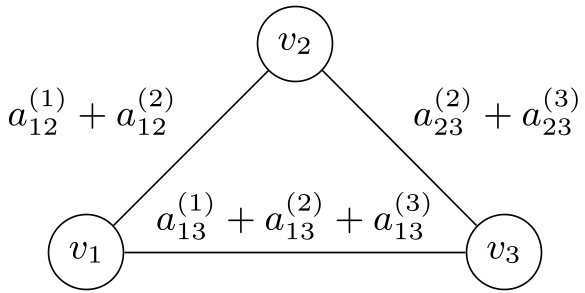 Figure 1: Illustration of converting a temporal dynamic graph into a weighted structure where edge thickness represents interaction history.
The authors mathematically prove the Stationary Distribution for these weighted walks, ensuring that even in a complex, shifting network, we can calculate exactly how "hidden" a sender is.
Experiments & Results: The Cost of Realism
The study utilized two massive real-world datasets:
- DBLP: A co-authorship graph representing professional ties.
- Facebook: A wall-post interaction graph representing social ties.
Key Finding: Entropy vs. Anonymity Set
The authors discovered a fascinating trade-off. While unweighted graphs technically show higher entropy (the random walk spreads out more uniformly), weighted graphs are more "truthful."
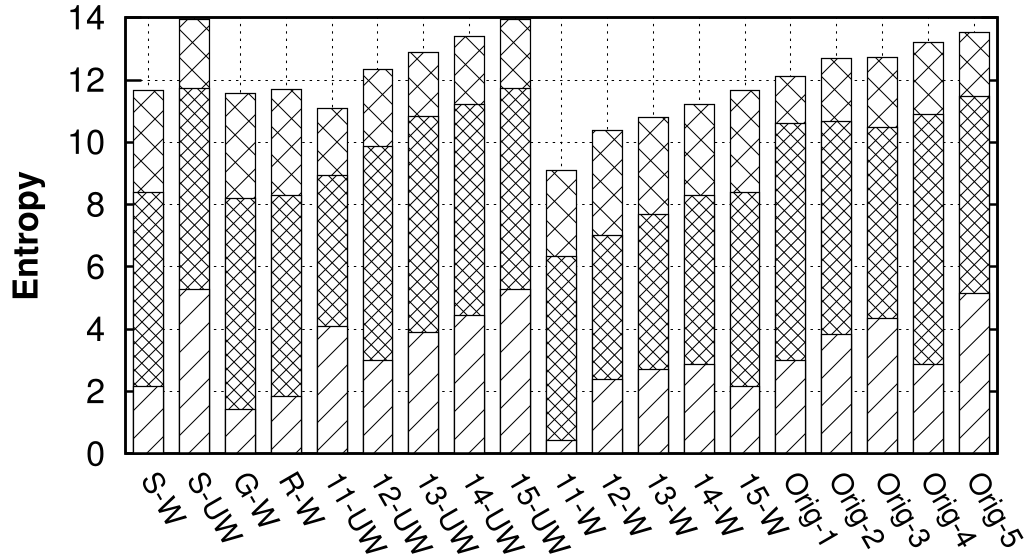 Figure 2: Comparison of average entropy across various weighting scenarios (Geometrical, Reciprocal, Unweighted) on the Facebook dataset.
In DBLP, using the dynamic model (DBLP-15) resulted in an anonymity set increase of over 6,700 nodes compared to static snapshots. This proves that capturing the "growth" of a network over time naturally expands the crowd you can hide in.
Critical Analysis & Insight
The brilliance of Dynamix isn't just in making the math harder—it's in the Security-Usability Trade-off.
- The Bias Effect: By weighting edges, we "bias" the walk. This actually decreases raw entropy because the walk is more likely to hit "popular" or "highly active" nodes.
- Why it's actually better: In a real-world attack, an adversary might inject "Sybil" nodes. In an unweighted model, your message might easily slip into an attacker's hands. In a weighted Dynamix model, your message stays on "high-weight" (trusted, long-term) paths, significantly increasing the cost for an attacker to infiltrate your social circle.
Conclusion
Dynamix shifts the paradigm from "Who do you know?" to "How well do you know them, and for how long?" This paper proves that social dynamics are not a nuisance to be ignored but a feature to be exploited. While weighted walks may converge to a smaller mathematical set than uniform walks, they represent a far more resilient form of "Social Entropy" that reflects the reality of human interaction.
Future Work: The authors aim to transform "unstructured" power-law social graphs into "structured" graphs to further optimize the mixing time and privacy guarantees.