
QOSS: Revitalizing E-business Social Networks with Genetic Algorithms and Visualization
E-Business Social Network Optimization and Visualization
This paper introduces the Query Optimization Search System (QOSS), a framework that combines parallel web crawling with Genetic Algorithms (GA) to optimize e-business social network discovery. The system significantly enhances information retrieval relevance and provides visual mapping of relationships between e-business entities in the Multimedia Super Corridor (MSC) Malaysia context.
TL;DR
The paper introduces the Query Optimization Search System (QOSS), a novel approach to mapping the e-business landscape. By combining scalable parallel crawling with Genetic Algorithms (GA), it solves the problem of "isolated information silos." QOSS doesn't just find pages; it optimizes the connections between them, boosting retrieval accuracy (F1-score) from 73.33% to 91.17%.
Problem & Motivation: Beyond the List of Links
In the vast World Wide Web, search engines like Google have mastered finding what you are looking for, but they often fail at showing how those entities are connected. For the e-business sector—specifically within Malaysia's Multimedia Super Corridor (MSC)—understanding the community structure of ICT companies, government agencies, and universities is vital.
The authors identified two major gaps:
- Low Quality of Connection: Existing search results appear as disconnected lists rather than a cohesive network.
- Inefficient Retrieval: Searching for relevant results in a massive solution space is often impractical with exhaustive search methods.
Methodology: The Genetic Evolution of Search
The QOSS architecture is built on three pillars: Retrieval, Optimization, and Visualization.
1. Parallel Crawling
To handle scalability, a parallel crawler retrieves web documents using a Breadth-First Search (BFS) strategy. This ensures the system finds the shortest paths between nodes and avoids "blind alleys" in web navigation.
2. GA-Driven Optimization
This is the core "intelligence" of the system. The process treats document retrieval as an evolutionary problem:
- Encoding: Documents are converted into Binary Chromosomes (vectors of 0s and 1s) representing the presence or absence of specific keywords.
- Selection & Crossover: High-fitness chromosomes (those most relevant to the user query) are selected and "bred" to create offspring.
- Mutation: Random bit-flipping allows the system to explore new keyword combinations that a human might not have entered, effectively performing automated query expansion.
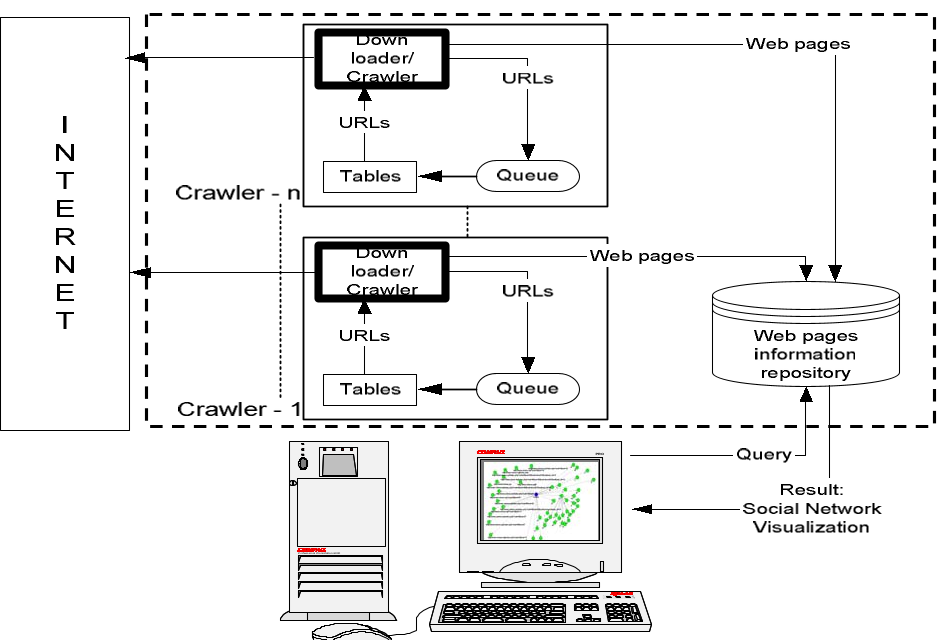 The GA flow: Applying genetic operators to generate an optimized population of results.
Experiments & Results: Quantitative Superiority
The evaluation focused on three standard IR metrics: Precision (P), Recall (R), and the F1-score.
Comparing results with and without the Genetic Algorithm across varying document counts (100 to 500) revealed an impressive trend:
- Recall Boost: Without GA, recall plummeted as the document count increased (averaging only 61.43%). With GA, recall remained robust at 91.73%.
- Balanced Accuracy: The F1-score, which represents the harmonic mean of precision and recall, saw a nearly 18% absolute increase.
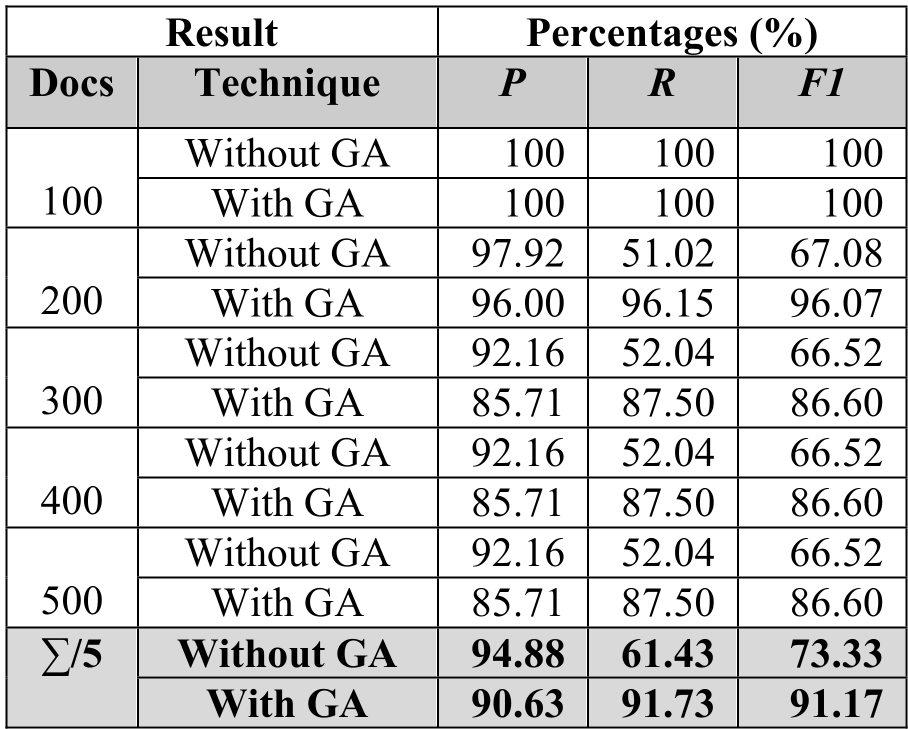 Table 3: Comparative analysis showing the sustained high performance of GA-enabled searching.
Critical Analysis & Conclusion
Takeaway
QOSS successfully demonstrates that heuristic optimization methods like GA can improve the "big picture" view of a social network. By evolving keywords, the system discovers nodes that are contextually relevant but might not share the exact initial search terms.
Limitations
While effective, the paper relies on Binary Term Vectors, which treat all keywords with equal weight. Modern approaches usually utilize TF-IDF or Word Embeddings (Word2Vec/BERT) to capture semantic nuances. Additionally, while the visualization is mentioned as a key benefit, the underlying graph layout algorithms are not deeply explored.
Future Outlook
The logical next step for this research is the integration of Graph Neural Networks (GNNs). While Genetic Algorithms are excellent for searching the space, GNNs could learn the latent representation of the business connections itself, potentially offering even higher precision in automated social network visualization.