
eLRS: Bridging Sparse Learning Paths through Social Association Retrieval
e-learning recommender system for learners in online social networks through association retrieval
This paper introduces an e-learning Recommender System (eLRS) that integrates Online Social Networks (OSNs) with Association Retrieval techniques. By leveraging learners' pedagogical attributes—Learning Styles (LS) and Knowledge Levels (KL)—the system constructs a social graph to provide personalized resource recommendations, significantly outperforming traditional Collaborative Filtering (CF).
TL;DR
Information overload in e-learning makes it difficult for students to find materials suited to their unique learning styles. This paper proposes a novel recommender system that uses Online Social Networks (OSNs) and Association Retrieval. By calculating technical "friendships" based on pedagogical traits and propagating queries across multiple social hops, the system overcomes the notorious "Sparsity Problem" that plagues standard Collaborative Filtering.
The Problem: The Sparse "Classroom"
In a typical e-learning environment, the number of available resources (books, papers, videos) is vast, but the number of ratings per student is tiny. This creates a Sparsity Problem.
Standard Collaborative Filtering (CF) relies on direct overlaps: if Student A and Student B haven't rated the same book, the system assumes they have nothing in common. However, in reality, they might share the same Learning Style or Knowledge Level, or they might share a common friend. This paper argues that ignoring these "transitive associations" is a missed opportunity for better education.
Methodology: Engineering a Pedagogy-Aware Social Graph
The authors' approach is divided into three sophisticated phases:
1. Defining "Similarity" Beyond Ratings
Unlike generic social networks, an e-learning social link should represent academic compatibility. The authors define Preferential Similarity using:
- LSsim (Learning Style Similarity): Based on the Felder-Silverman model (Active/Reflective, Sensing/Intuitive, etc.).
- KLsim (Knowledge Level Similarity): Based on student grades.
2. Query Propagation
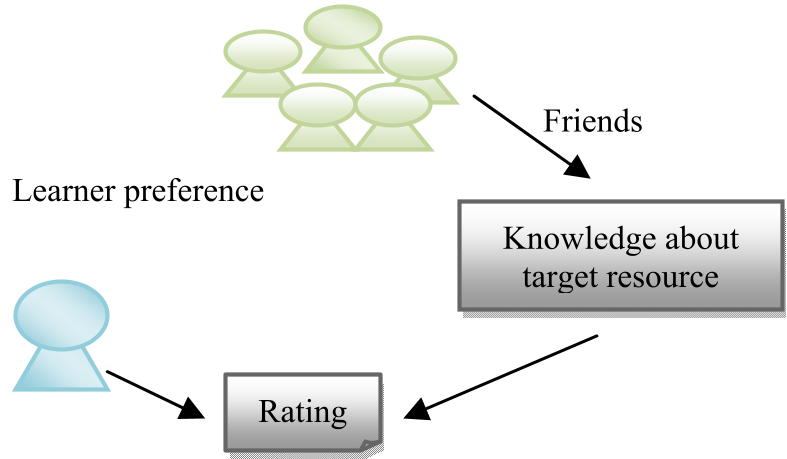
When a learner seeks a resource (e.g., "Operations Research by Kantiswaroop"), the system doesn't just look at a database. It sends a query to "Instant Friends" (1-hop). if they haven't seen the book, the query propagates to "Distant Friends" (2-hop).
3. Transitive Association Retrieval
This is the mathematical core. If Learner A is similar to B, and B is similar to C, the system infers a relationship between A and C using a min-linking logic for similarity: This allows the system to harvest ratings from "friends of friends," effectively filling in the holes in the sparse rating matrix.
Experimental Insights
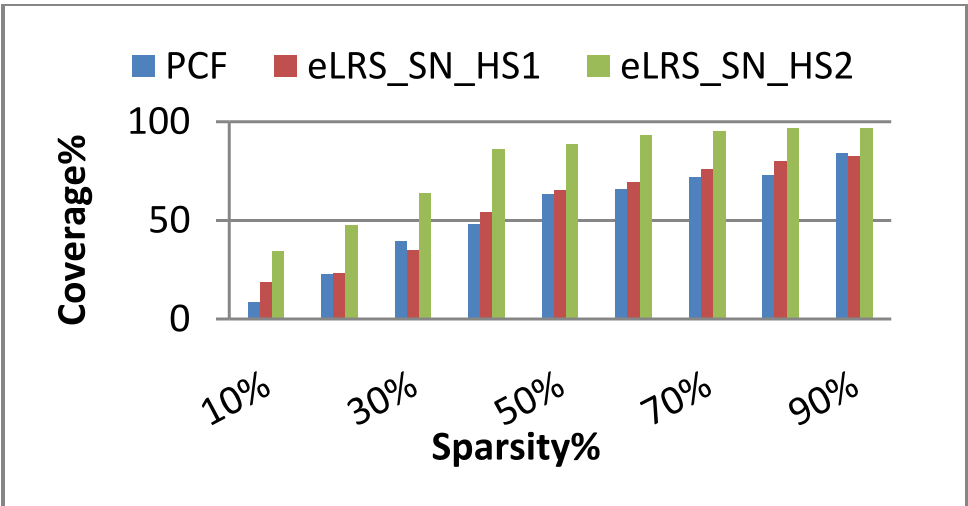
The researchers compared their system (eLRS_SN_HS2 - 2 hops) against standard Pearson Collaborative Filtering (PCF).
- Accuracy: The proposed system achieved an F1-measure of 0.6434, significantly higher than PCF's 0.5583.
- Robustness to Sparsity: As shown in the performance charts, even when 90% of data was removed (extreme sparsity), the social-network-based approach maintained much higher coverage than traditional methods.
Critical Analysis & Conclusion
Takeaway
The genius of this work lies in not treating the student as a mere ID in a matrix, but as a learner with a specific profile. By merging pedagogical theory (Learning Styles) with graph-based retrieval (Association Retrieval), the authors move from "statistical matching" to "meaningful academic connection."
Potential Limitations
- Scalability: Propagating queries through many hops in a massive social network could lead to "query flooding."
- Dynamic Knowledge: The current model uses grades (KL) as a static measure, but a learner's knowledge level is constantly evolving.
Future Outlook
This work sets the stage for "Trust-aware" systems. In future iterations, we might see "Reputation" scores where a recommendation from a "High-Achievement" friend carries more weight than a novice, further refining the quality of e-learning environments.