
Beyond Satisfaction: Why "Mercenary" Users Switch and How SNS Can Trap Them
E-Loyalty Building in Competitive E-Service Market of SNS: Resources, Habit, Satisfaction and Switching Costs
This study investigates E-loyalty formation in the competitive Chinese Social Networking Service (SNS) market. Using a Resource-Based View (RBV), it identifies "Critical Mass" and "Supplemental Entertainment" as key resources that drive loyalty via habit, satisfaction, and switching costs.
TL;DR
Being satisfied isn't enough to keep a user loyal in the "one-click" era of the Internet. This study explores the Chinese SNS market (focusing on Qzone) to prove that habit and switching costs are the true anchors of loyalty. By leveraging unique resources like Critical Mass (your friends are here) and Supplemental Entertainment (social games), platforms can transform "mercenary" users into loyalists.
The "Mercenary" Problem: The Satisfaction Trap
In the early days of e-commerce, the mantra was simple: Satisfy the customer, and they will stay. However, the authors point out a fatal flaw in this logic within highly competitive markets. When services are homogeneous and switching costs are low, users become "Mercenaries." These users are perfectly happy with your service, but they will leave the moment a competitor offers a shiny new feature or a slight discount.
The business environment is no longer a monopoly; it’s a battlefield where rivals "duplicate" features instantly. Therefore, relying solely on satisfaction surveys is a recipe for business failure.
Methodology: The Resource-Based View (RBV)
The researchers look at SNS through the lens of RBV, treating specific platform attributes as competitive assets. They categorize these into:
- Internal Resources (Supplemental Entertainment): Value-added features like "Happy Farm" that provide pleasure and foster habitual daily logins.
- External Resources (Critical Mass): The social graph. If your entire family and friend group is on one platform, the "cost" of leaving is the loss of those connections.
The Theoretical Framework
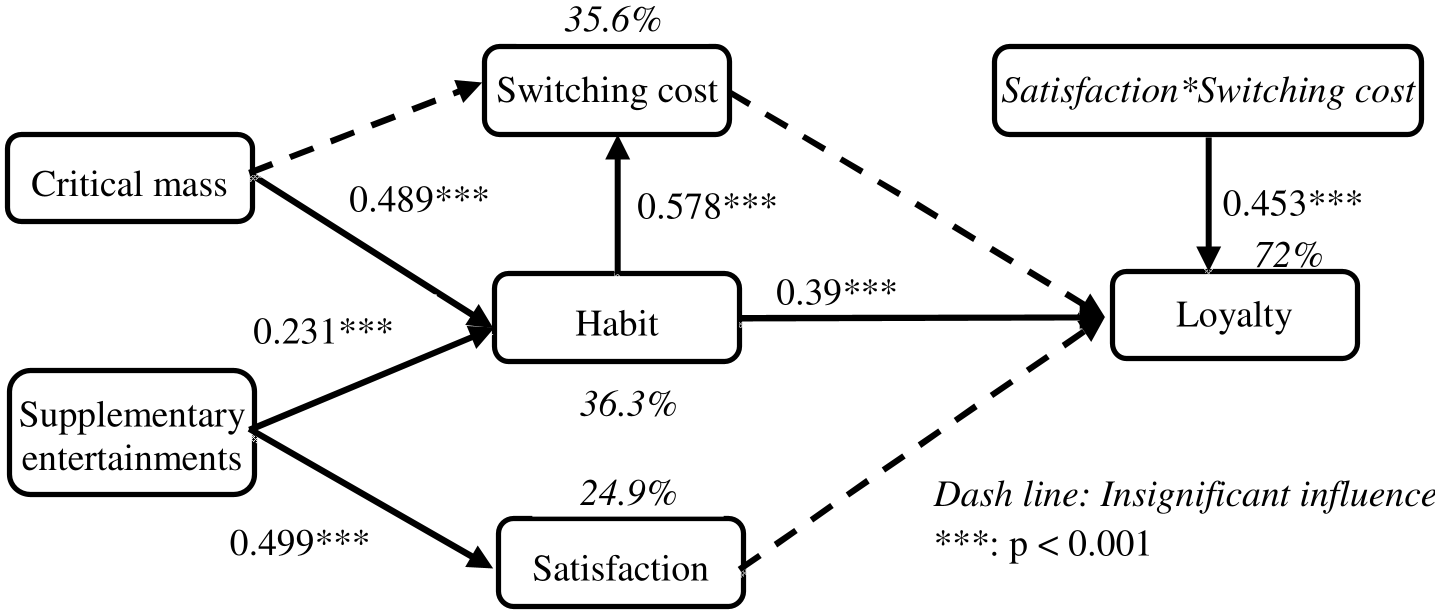
The model tests how these resources influence three psychological pillars: Habit, Satisfaction, and Switching Costs, which ultimately dictate Loyalty.
Key Insights from the Data
The study analyzed 221 active users of Tencent's Qzone, and the results challenge traditional marketing wisdom:
- The Interaction Effect: Satisfaction and switching costs do not work in isolation. A satisfied user with low switching costs will leave. A frustrated user with high switching costs is a "hostage." True Loyalty only occurs when high satisfaction is coupled with the perceived difficulty of moving.
- Habit is King: Habitual behavior was found to be the strongest determinant of loyalty. If using a service becomes an "automatic response" (like checking your feed upon waking up), the conscious decision to switch becomes much harder.
- Games as Glue: Supplemental entertainment (social games) doesn't just make users happy; it builds habit. It creates a recurring reason to return that is independent of the platform's primary communication function.
 Table: Categorizing users into Loyalists, Defectors, Mercenaries, and Hostages based on Satisfaction vs. Loyalty.
Critical Analysis & Conclusion
This paper provides a sophisticated roadmap for platform stickiness. It argues that the "Value" of a network isn't just in its code, but in the social inertia (Critical Mass) it creates.
Limitations
The study was conducted in 2011/2012, focusing on PC-based SNS (Qzone). In today's mobile-first world of TikTok and algorithmic feeds, the definition of "habit" has shifted from social connection to "dopamine loops." However, the core insight—that satisfaction is a "leaky bucket" without switching costs—remains more relevant than ever.
Future Outlook
For product managers, the takeaway is clear: Stop optimizing and polishing features that competitors can copy in a week. Instead, invest in network effects and habit-forming loops that make the "cost" of leaving too high for the user to contemplate.