
E-Participation in the Era of Web 2.0: Beyond the Interface to Human Motivation
E-participation in the era of web 2.0: factors affecting citizens' active e-participation in local governance
This study investigates the motivational and social factors driving active e-participation in local governance, using the "Oasis" platform of the Seoul Metropolitan Government as a case study. It integrates the Technology Acceptance Model (TAM), social network theory, and citizen participation values to identify gender-specific engagement drivers.
TL;DR
This research explores what actually makes citizens "active" in digital governance rather than just passive observers. Analyzing Seoul’s "Oasis" e-participation platform, the study finds that while men participate for political influence (instrumental value), women participate for self-growth (intrinsic value). Crucially, women with weaker offline social ties are more active online, using digital platforms to bypass traditional social barriers.
Contextual Positioning
Published in the wake of the Web 2.0 revolution, this paper moves beyond the technical "Ease of Use" focus of the early Technology Acceptance Model (TAM). It positions e-participation as a sociotechnical phenomenon where the offline social fabric directly dictates online civic muscle.
The "Motivation-Social" Gap
Why do some citizens post dozens of policy suggestions while others merely lurk? The authors argue that previous models oversimplified the "why." They identify a core tension:
- Intrinsic Value: The educational and developmental joy of participating.
- Instrumental Value: The desire to actually change policy or gain social recognition.
- Social Constraints: The idea that our real-world social circles (Strong vs. Weak ties) act as either a springboard or a barrier to digital engagement.
Methodology: Testing the "Oasis"
The study utilized a 2009 survey of the Cheon Man Sang Sang Oasis, an innovative platform by the Seoul Metropolitan Government.
 Note: The research tests how Intrinsic Value, Instrumental Value, and Social Network Strength correlate with the frequency of user-generated policy suggestions.
The team used OLS (Ordinary Least Squares) regression to isolate these variables, controlling for factors like age, income, and "Social Altruism" (volunteer history).
The Gender Paradox: Results & Insights
The most striking findings emerged when the data was split by gender.
1. The Male "Instrumental" Driver
For men, the platform is a tool for power and influence. They are motivated by the instrumental outcome—seeing their ideas become reality or gaining status.
2. The Female "Intrinsic & Compensatory" Driver
Conversely, women showed a strong correlation with intrinsic value. More fascinatingly, the data showed a negative relationship between offline social network strength and online activity for women.
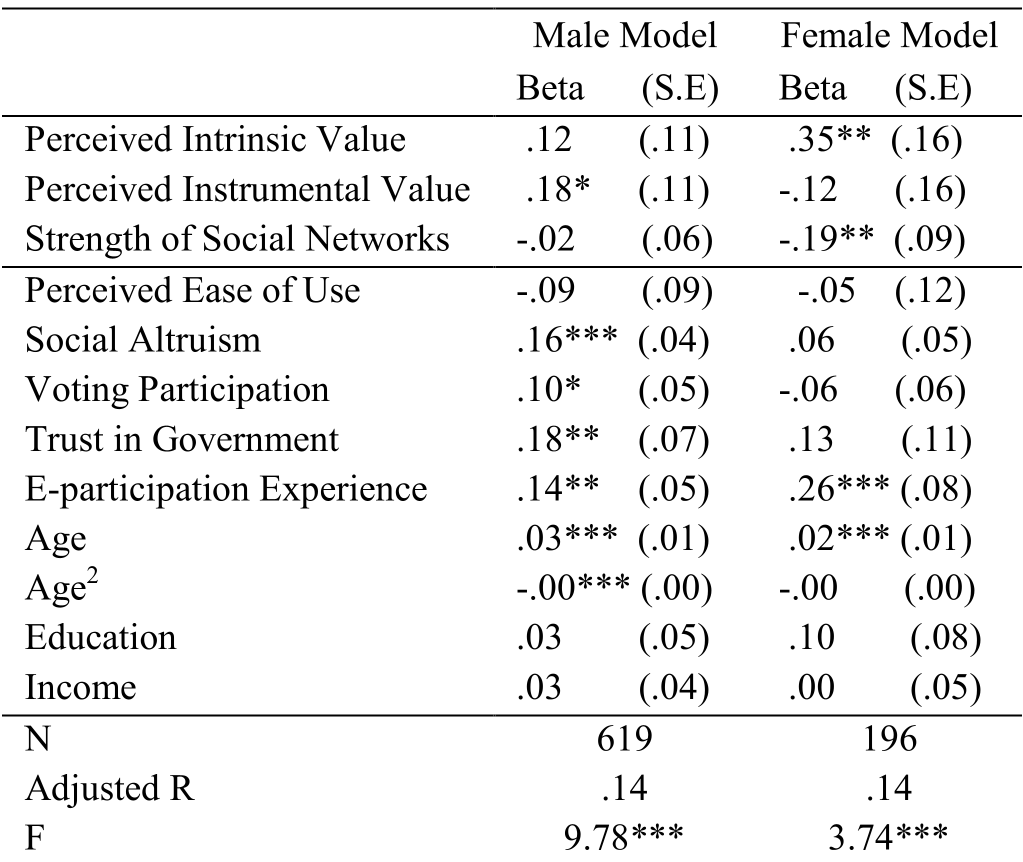 Key Insight: Note the negative Beta (-0.19) for 'Strength of Social Networks' in the Female model, suggesting the internet serves as a "social outlet" for those less integrated offline.
Critical Analysis & Takeaways
The "Compensation Hypothesis" derived from this paper is a goldmine for digital democracy:
- Digital as an Equalizer: For underrepresented groups who might feel peripheral in physical town halls or local clubs (weak offline networks), e-participation provides a low-cost, high-autonomy alternative to voice their interests.
- Beyond Ease of Use: "Perceived Ease of Use"—a staple of TAM—was not a significant predictor of active participation here. This suggests that for civic tech, value and purpose trump UI/UX simplicity.
Future Outlook
While this study focused on Web 2.0 (forums/suggestions), its logic applies to the modern era of AI-driven governance and social media activism. The core lesson remains: to build a digital city, you must understand the psychological "why" of its citizens, specifically acknowledging that a platform might serve as a primary community for those whom the physical world has ignored.
Limitations: The study is cross-sectional (a snapshot in time) and focused on South Korea's specific political culture. Future research must look at how online social networks (like Twitter/X or Reddit) now interact with these institutional platforms.