
EAGLE-3: Breaking the Scaling Wall of Speculative Sampling with Training-Time Test
EAGLE-3: Scaling up Inference Acceleration of Large Language Models via Training-Time Test
EAGLE-3 is an advanced speculative sampling framework that accelerates Large Language Model (LLM) inference by introducing a "training-time test" architecture. It replaces feature-level regression with direct token prediction and multi-layer feature fusion, achieving up to 6.5x speedup over vanilla autoregressive decoding.
TL;DR
The efficiency of Large Language Model (LLM) inference has long been throttled by the sequential nature of autoregressive decoding. While Speculative Sampling (drafting then verifying) has emerged as the standard solution, it recently hit a performance ceiling. EAGLE-3 shatters this ceiling by introducing a Training-Time Test architecture. By fusing multi-layer features and removing rigid feature-matching constraints, it achieves a massive 6.5x speedup and, for the first time, demonstrates a scaling law where more data directly translates into faster inference.
The Motivation: Why did EAGLE hit a wall?
In traditional speculative sampling, the draft model is often a smaller, independent LLM. The original EAGLE improved on this by reusing the top-layer features of the target model to guide the draft model.
However, the authors of EAGLE-3 identified a critical bottleneck: Feature Uncertainty. Previous versions forced the draft model to predict the exact hidden features of the target model before predicting tokens. This "Feature Regression" acts as a restrictive constraint; as you scale training data, the draft model spends too much "intelligence" trying to mimic the target model's internal vector space rather than focusing on the ultimate goal: predicting the next token correctly.
Methodology: Training-Time Test & Multi-Layer Fusion
EAGLE-3 introduces two architectural shifts to overcome these limitations:
1. Training-Time Test (Direct Token Prediction)
Instead of predicting the next feature (), EAGLE-3 predicts the token directly. To handle multi-step drafting, it employs a technique called Training-Time Test. During training, the model simulates the actual inference process: it takes its own previous output () and feeds it back into the next step.
- The Benefit: This eliminates the "distribution shift" between training (where gold features are used) and inference (where predicted features are used).
- The Result: The acceptance rate for later tokens in the draft chain stays high, effectively preventing error accumulation.
2. Multi-Layer Feature Fusion
While prior works only looked at the "top-layer" features (just before the LM head), EAGLE-3 recognizes that semantic information is distributed across the model. It extracts features from Low, Middle, and High layers, concatenates them, and compresses them through a Fully Connected (FC) layer.
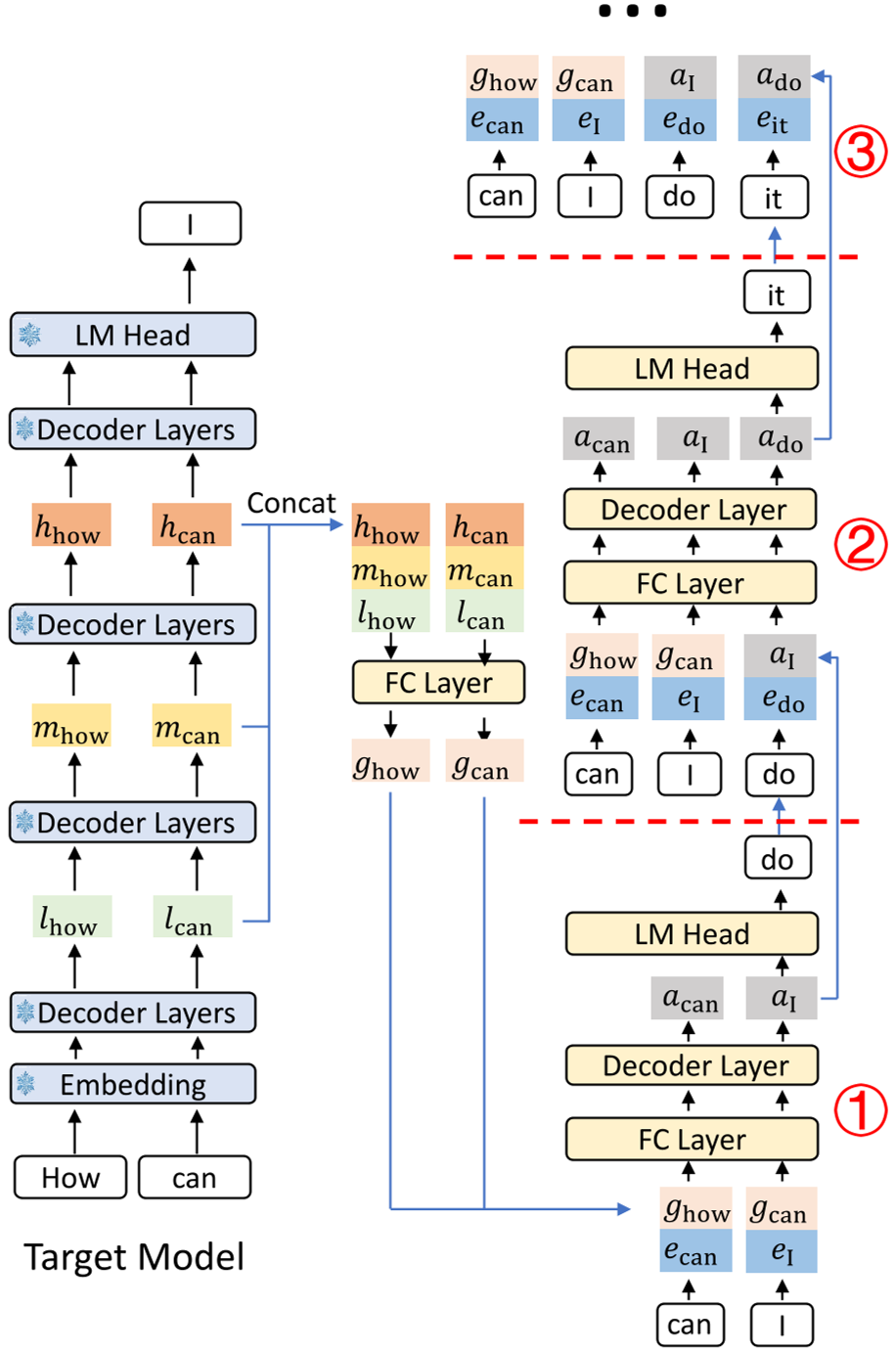 Figure: The EAGLE-3 pipeline showing how l, m, and h features are fused with embeddings to drive the draft model.
The Discovery: A Scaling Law for Speed
The most significant academic contribution of EAGLE-3 is the discovery of an Inference Scaling Law. In previous architectures (like EAGLE or Medusa), adding more data to the draft model eventually stopped helping. With EAGLE-3’s unconstrained token prediction, the Acceptance Rate continues to grow as training data scales from 1x to 8x.
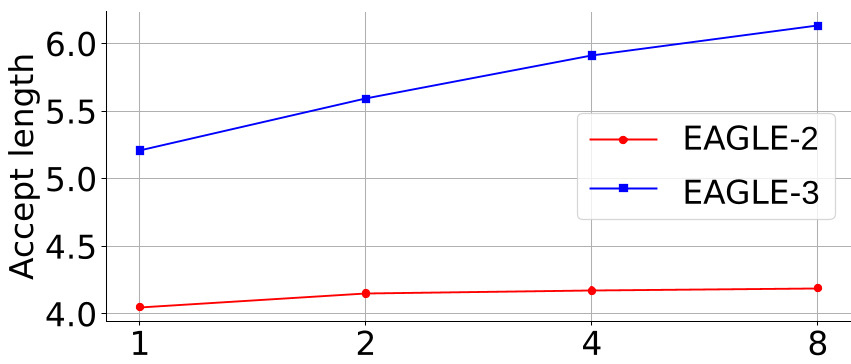 Figure: Comparative scaling curves showing EAGLE-3's performance (MT-bench) continuing to rise with data, unlike previous methods.
Experimental Results: SOTA Performance
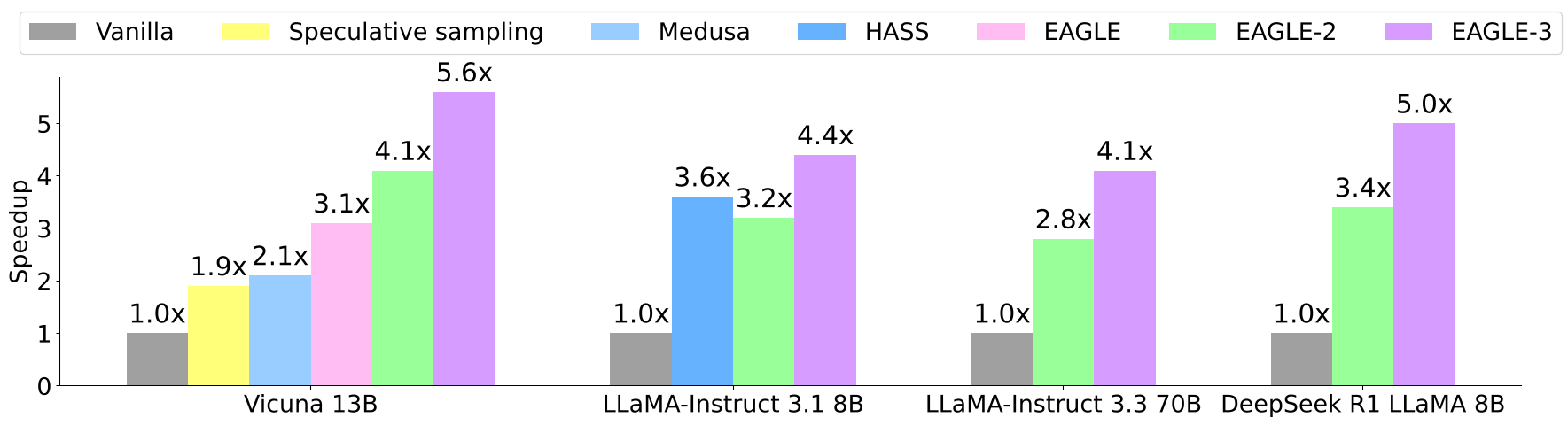
EAGLE-3 was tested across diverse models (, , ).
- Raw Speedup: Reached up to 6.5x on code generation tasks (HumanEval).
- Throughput in Production: One of the biggest criticisms of speculative sampling is that it kills throughput at high batch sizes. Experimental data from the SGLang team shows that EAGLE-3 maintains a 1.38x throughput gain even at a batch size of 64 on an H100 GPU.
Critical Analysis & Conclusion
EAGLE-3’s success stems from simplification. By removing the auxiliary feature-prediction loss, the authors allowed the draft model to focus on its primary objective. The use of multi-layer features provides a "global view" of the target model's reasoning, which is particularly effective for complex reasoning models like DeepSeek-R1.
Takeaway: The bottleneck for LLM acceleration is no longer the model architecture, but our ability to train draft models that truly "understand" the target model's intent. EAGLE-3 provides the blueprint for scaling this understanding.
Limitations: Training the draft model still requires running the target model to generate a high-quality "synthetic" dataset (e.g., ShareGPT/UltraChat), which can be computationally expensive for the 400B+ parameter models. However, once trained, the marginal cost of inference is drastically reduced.