
Predicting the Emotional Pulse: Why Early Comments Matter More Than the News Itself
Early Commenting Features for Emotional Reactions Prediction
The paper proposes a novel approach to predict the volume of emotional reactions (love, surprise, joy, sadness, anger) to news posts on social media using early commenting features. By analyzing user behavior and comment content within the first 10-30 minutes, the authors achieve significant performance gains over traditional text-only baselines across multiple emotional categories.
TL;DR
Can we predict if a news post will make people angry, sad, or joyful before it even reaches its peak? This paper demonstrates that the "secret sauce" isn't just in the article's text, but in the first 10 to 30 minutes of user comments. By combining traditional text analysis with early social activity metadata, researchers significantly outperformed traditional models in predicting emotional reaction volumes on Facebook.
Background: Beyond Simple Popularity
While predicting how many people will see a post (popularity) is a well-studied field, predicting how they will feel (emotional reaction) is a much steeper mountain to climb. An article about a local traffic strike might trigger intense anger in a few people but have zero impact on the masses. This paper shifts the focus from "Will this go viral?" to "What is the emotional signature of this virality?"
The Problem: The Limits of Pre-Publication Content
Most prior attempts focused on "Cold Start" scenarios—trying to predict a post's success based solely on its headline and body. However, as the authors point out, content alone is insufficient. Social media is a dynamic ecosystem where the structure of the network and early engagement patterns act as catalysts that the text alone cannot account for.
Methodology: The Power of Early Signals
The researchers proposed a methodology utilizing three distinct categories of features:
- Post Terms (The Baseline): Traditional TF-IDF bag-of-words from the news post.
- Early Commenting Activity: Metadata-driven features like the time difference to the first comment, the number of unique authors, and the commenting ratio.
- Early Comments' Content: Deep dive into what the first commenters are saying—measuring average comment length, sentiment polarity (Positive/Neutral/Negative), and semantic relevance to the original post using Word2Vec embeddings.
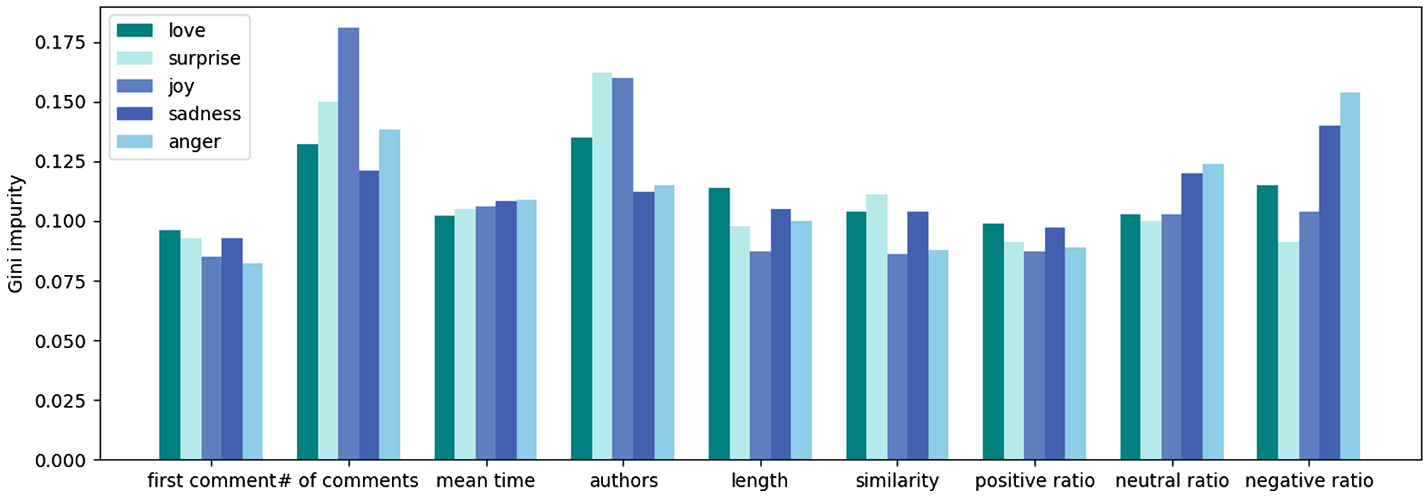 Figure: Gini impurity scores showing the predictive power of different features across emotions.
Experiments and Results
Using a dataset of 26,560 New York Times Facebook posts, the team employed a Random Forest classifier for both 3-class (Low, Medium, High) and 5-class (Very Low to Very High) ordinal classification.
Key Findings:
- The 10-Minute Window: Even just 10 minutes of commenting data provides enough signal to outperform text-only models.
- Emotion-Specific Patterns:
- For Joy and Surprise, the number of comments and unique authors were the strongest predictors.
- For Sadness and Anger, the negative sentiment ratio within the comments was the most informative feature.
- The Synergy Effect: The best results always came from combining "Post Terms + Activity + Content."
 Table: Comparison of MAE across different feature sets. Lower is better.
Critical Analysis & Conclusion
This research highlights a fundamental truth about social media: The audience helps define the post. A "Sad" post becomes a "Sad" trend because the early commenters validate that emotion, creating an affective feedback loop.
Takeaways for the Industry:
- Content Moderation: Early emotional prediction can help identify potential "flame wars" (High Anger) before they spiral out of control.
- Fake News Detection: Since fake news often relies on triggering extreme "Surprise" or "Anger," these models can serve as early warning systems.
Limitations: The study is heavily influenced by the 2016 US Election cycle (as seen in the high Gini scores for terms like "Trump" and "President"), suggesting the model's textual components may need frequent retraining to stay relevant to current events.
Future Outlook
The next step is moving beyond classification into Regression—predicting the exact number of reactions. As we move toward more real-time AI, integrating these early social signals into recommendation algorithms could allow platforms to prioritize content that fosters healthy emotional engagement rather than just outrage.