
Beyond Words: Rethinking Early Depression Detection via Linguistic Metadata
Early Detection of Depression Based on Linguistic Metadata Augmented Classifiers Revisited - Best of the eRisk Lab Submission
This paper presents a revisited analysis of the eRisk 2017 lab submissions for early depression detection on Reddit. It utilizes an ensemble of logistic regression and LSTM-based neural networks augmented with linguistic metadata, achieving top-tier performance in F1-score (0.64) and ERDE metrics.
Executive Summary
TL;DR: This research revisits the eRisk 2017 challenge, identifying critical flaws in how we measure "early" detection and proposing a robust framework that combines traditional NLP (RNNs/BoW) with linguistic metadata. While the team secured top rankings, their analysis reveals a deeper truth: the hardest part of mental health AI isn't the model—it's the data quality and the evaluation math.
Positioning: This work is a foundational "post-mortem" and refinement of a SOTA competition entry, shifting the focus from pure architecture to feature engineering and metric validity.
1. The Hidden Trap in Global Datasets
The authors uncover a startling "cheat code" in the eRisk 2017 dataset. By simply using the timestamp of the last post as a feature, a basic logistic regression achieves an of 0.78—outperforming every specialized AI model.
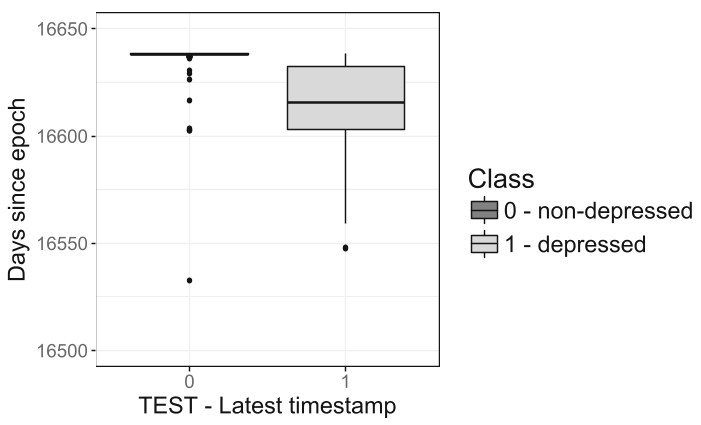 Fig 1: The distribution of post times between depressed (1) and control (0) groups is so distinct and non-overlapping that it creates a "hidden feature" that bypasses linguistic analysis entirely.
2. Methodology: The Power of Metadata
The core innovation lies in the BCSGA and BCSGC architectures. Instead of relying solely on text, the authors inject "User-Level Metadata"—features like the frequency of first-person pronouns ("I", "me") and absolutist words ("always", "never").
The Architecture
- Ensemble LR: Using Bag-of-Words (BoW) with different weightings.
- RNN-LSTM: A sequence-aware model processing document embeddings (Paragraph Vectors) while concatenating the linguistic metadata vector at the final hidden layer.
- The Sentiment Experiment: The team integrated NRC and VADER sentiment scores, expecting depressed users to show higher "negativity."
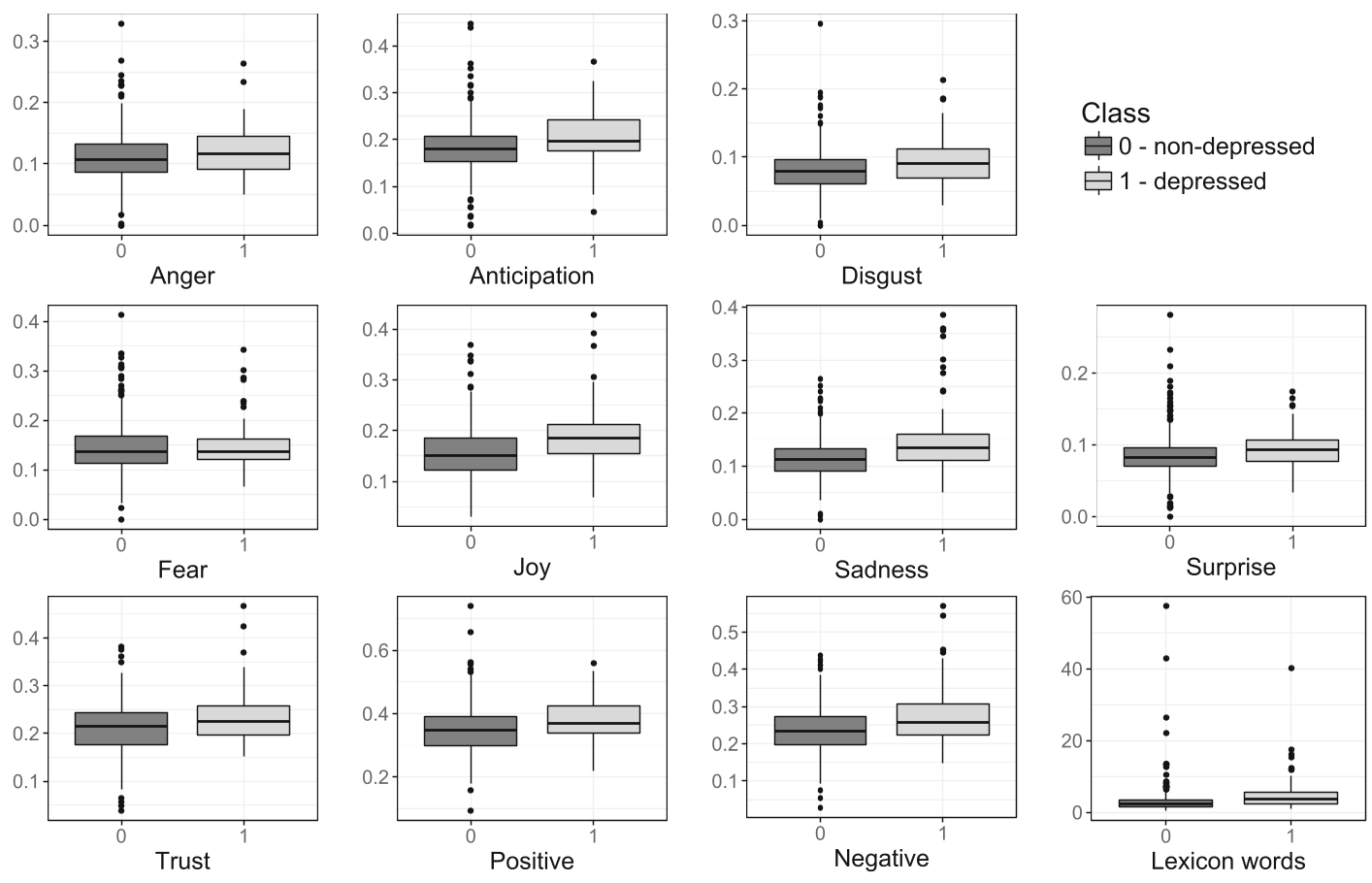 Fig 2: Correlation matrix showing that sentiment features (VADER, SentiWordNet) actually had low correlation with the depression label, likely due to the noise in the control group's writing style.
3. The Crisis: Why Current Metrics Fail
The paper provides a scathing analysis of the Early Risk Detection Error (ERDE).
- The Problem: punishes models based on the absolute number of documents seen.
- The Catch: In competition "chunks" (where users receive 100 posts at once), it's mathematically impossible to achieve a good score for most users.
- The Solution: The authors advocate for , which balances standard with a sigmoid-based penalty for median delay.
4. Experimental Reality Check
The results (Table 1) show that while metadata is a powerful signal, the Sentiment Lexica (NRC/VADER) did not help.
- Why? The control group often posted news headlines or single words, while the depressed group wrote long, emotional prose. This "style gap" made sentiment analysis a proxy for "length of post" rather than "mental state."
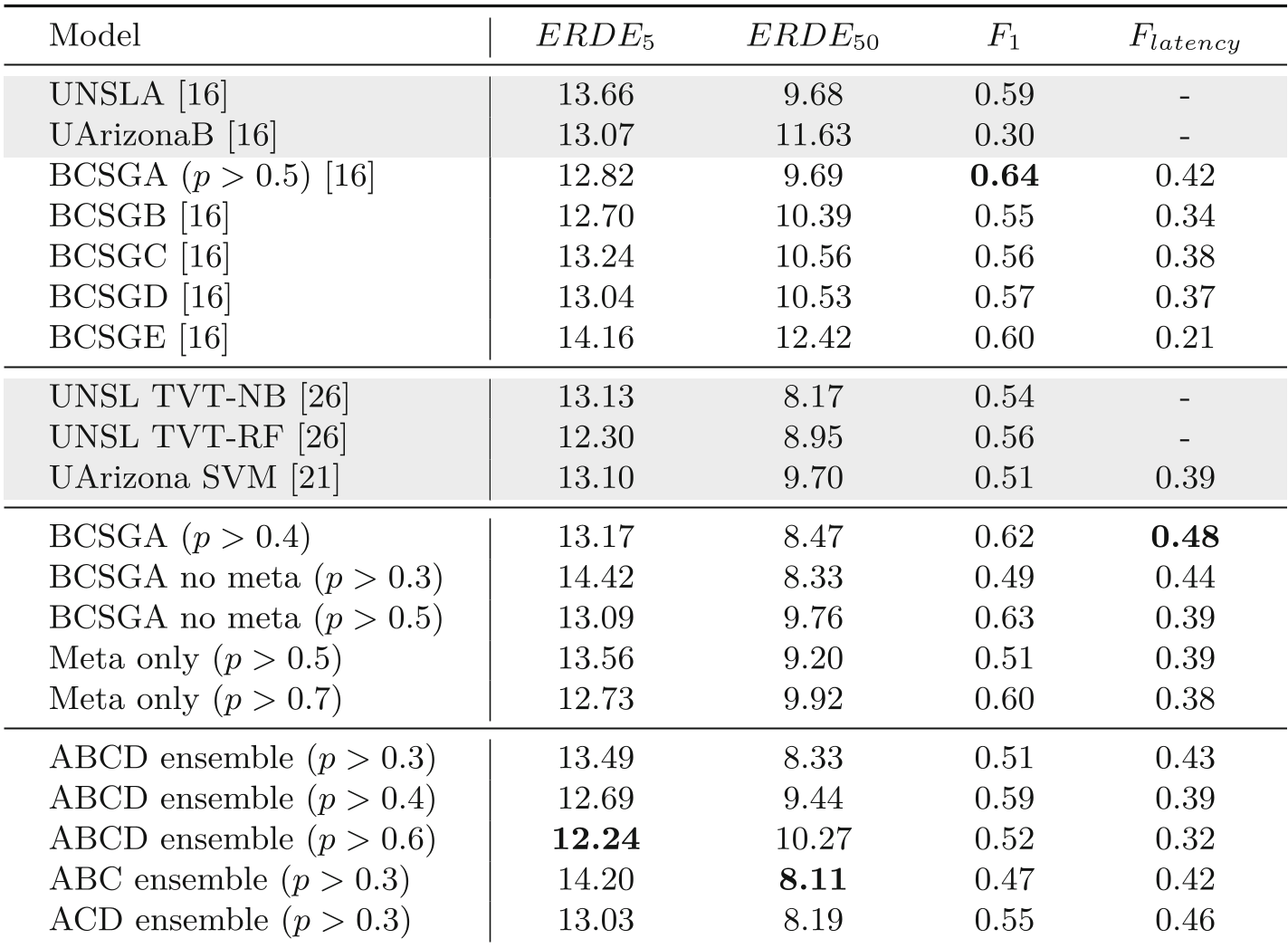 Table 1: Performance comparison showing BCSGA (Ensemble + Metadata) achieving the peak F1-score.
5. Critical Analysis & Future Outlook
Takeaways
- Metadata is King: In clinical NLP, how someone speaks (metadata) is often as important as what they say (semantics).
- Metric Matters: Evaluating "early" detection is still an open mathematical challenge.
Limitations
The study admits that the control group selection was too random. Future datasets need "active control groups"—users who post in similar subreddits but aren't depressed—to force models to learn subtle clinical nuances rather than just detecting "emotional" vs. "unemotional" text.
Conclusion
Early detection is a race against time. By refining the metrics and avoiding the "timestamp trap," we move closer to AI tools that can genuinely assist therapists in identifying at-risk individuals before it's too late.