
DTM_Kernel: Predicting Academic Failure through Temporal Trajectory Profiling
Early In-trouble Student Identification Based on Temporal Educational Data Clustering
2019-12-01
Summary
Problem
Method
Results
Takeaways
Abstract
The paper introduces DTM_Kernel, an ensemble clustering framework for the early identification of at-risk students. By combining Dynamic Topic Modeling (DTM) with Kernel k-means and optimizing via the S_Dbw validity index, the method transforms student performance tracking into a ranked information retrieval task, achieving SOTA performance in identifying potential dropouts.
## TL;DR
Researchers have developed **DTM_Kernel**, a sophisticated ensemble learning method that identifies "in-trouble" students by analyzing how their performance evolves over time rather than looking at a single GPA snapshot. By combining Dynamic Topic Modeling (DTM) with Kernel k-means, the system achieves perfect recall in some scenarios, identifying nearly every student at risk of dropping out without requiring historical labeled training data.
## The Illusion of the Static Grade
Most pedagogical early-warning systems treat a student's record as a flat vector of grades. This approach suffers from two fatal flaws:
1. **Context Blindness**: A "C" grade in a freshman year followed by a "B" indicates an upward trajectory, whereas a "B" falling to a "C" signals trouble.
2. **The Label Scarcity**: Supervised models (like Decision Trees or ANNs) require years of historical "dropout" labels to work, which are often inconsistent across different student generations.
The authors of this paper argue that academic failure is a **latent process**—a "topic" that develops over semesters.
## Methodology: Stacking Temporal Intelligence
The DTM_Kernel method operates as a pipeline that bridges the gap between probabilistic modeling and geometric clustering.
### 1. Capturing the Time-Varying Signal (DTM)
The authors use **Dynamic Topic Modeling (DTM)**. Usually applied to track how themes in news articles change over decades, here it tracks how "performance themes" change over semesters. Each student is represented as an association vector with temporal clusters, preserving the "study trend."
### 2. Finding Non-Linear Patterns (Kernel k-means)
Standard k-means fails when data isn't perfectly spherical. By using a **Gaussian Kernel**, DTM_Kernel projects student data into a high-dimensional feature space where the boundary between "passing" and "in-trouble" is more easily separable.
### 3. Automated Optimization (S_Dbw)
Rather than guessing the number of student groups ($k$), the researchers use the **S_Dbw (Scattering and Density between clusters)** index. The algorithm iterates through various $k$ values and selects the one that minimizes density between clusters, ensuring the most distinct groupings.

*Figure 1: The DTM_Kernel Algorithm workflow, from Temporal Data to the Ranked Retrieval List.*
## Experimental Victory
The researchers tested the model on three real datasets (2006-2008) from a Computer Science program. The challenge was significant: the datasets were highly imbalanced (e.g., only 4.39% "positive" samples in the 2006 set).
### Key Findings:
* **Recall Dominance**: In the 2006 dataset, DTM_Kernel achieved a **Recall of 1.00**, meaning it flagged *every single* student who eventually dropped out.
* **Outperforming Supervised Learning**: Despite having no "labels" during training, the method outperformed C4.5 and ANN by a wide margin, proving that the internal structure of student data is more informative than historical labels from different generations of students.
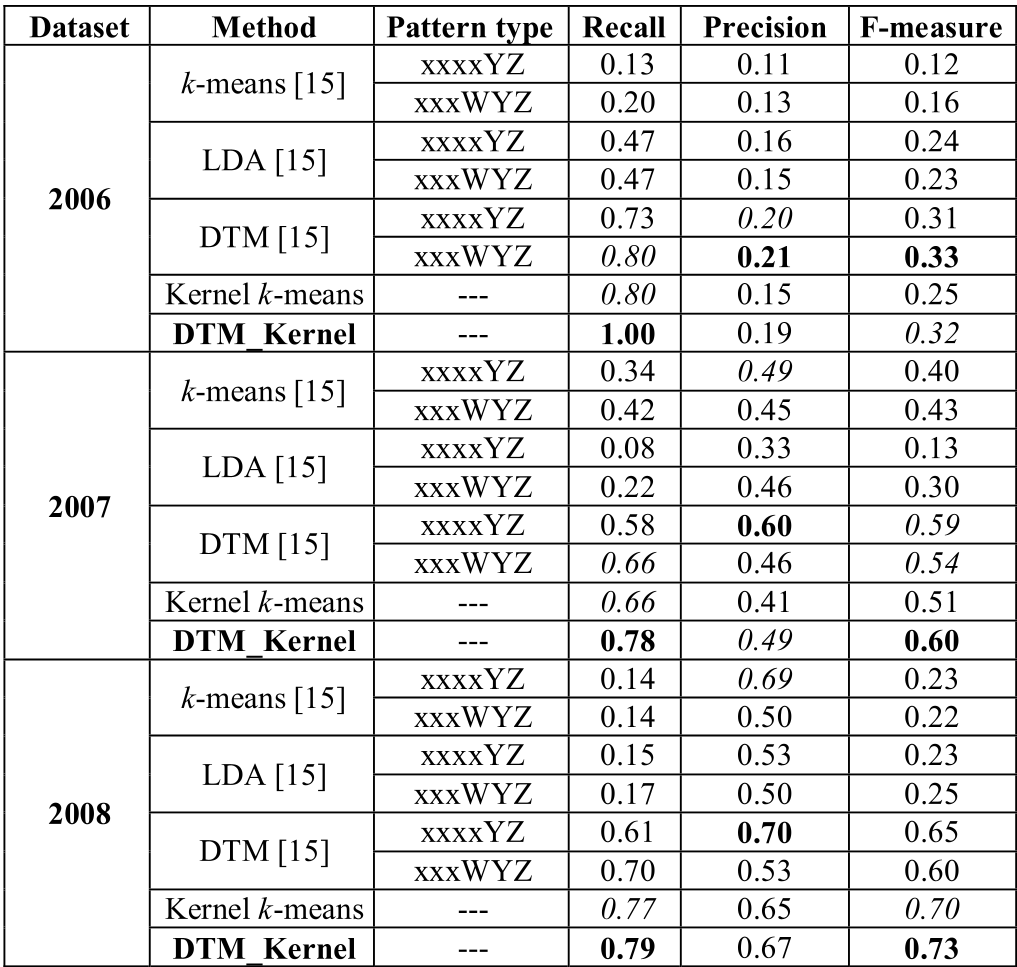
*Table 1: Performance comparison against unsupervised baselines showing the leap in Recall and F-measure.*
## Critical Analysis: The Precision-Recall Trade-off
While the **Recall** is world-class, the **Precision** remains relatively low (around 0.19 to 0.67 depending on the year). This means the system "over-identifies" at-risk students, flagging some who are actually just "warned" but might still graduate.
However, in an educational context, a **False Positive** (giving extra help to a student who might have passed anyway) is far less costly than a **False Negative** (ignoring a student who is about to drop out).
## Conclusion
DTM_Kernel marks a shift in Educational Data Mining from "Classification" to "Information Retrieval." By ranking students based on their temporal drift toward academic failure, universities can prioritize their limited counseling resources on those at the very top of the "in-trouble" list. Future iterations that refine cluster homogeneity could further reduce the noise of false alarms, making this a "must-have" tool for modern academic credit systems.