
FARM: Leveraging Fuzzy Association Rules and Big Data for Enterprise Financial Early Warning
Early warning of enterprise finance risk of big data mining in internet of things based on fuzzy association rules
This paper introduces the FARM (Fuzzy Association Rules Mining) algorithm, a time-series data mining approach integrated with IoT and Big Data technologies to provide early warnings of corporate financial risk. By combining FCM (Fuzzy C-Means) clustering with a parallelized association rule mining framework, the method identifies frequent fuzzy itemsets and extracts risk-indicative rules from multi-dimensional financial indicators.
TL;DR
Financial crises rarely happen overnight; they are the culmination of shifting trends across multiple indicators. This paper proposes the FARM (Fuzzy Association Rules Mining) algorithm, which utilizes Fuzzy C-Means (FCM) clustering and Parallel Data Mining to extract hidden risk rules from massive IoT-enabled financial datasets. By moving away from rigid thresholds and adopting a "fuzzy" approach, researchers have created a more robust system for predicting corporate distress.
Contextualizing Financial Risk
The study of financial risk has evolved from simple single-variable analysis in the 1930s to multivariate Z-scores and neural networks. However, in the era of Big Data and the Internet of Things (IoT), these methods often struggle with the sheer volume and the "fuzzy" nature of economic transitions. An enterprise doesn't just wake up bankrupt; it passes through stages—Blind, Sluggish, Wrong-Action, Crisis, and Extinction. To capture this, we need a method that respects the continuity of time and the ambiguity of risk boundaries.
The Problem: The Rigidity of Traditional Mining
The authors identify three fatal flaws in prior work:
- Assumption Heaviness: Many models assume linear relationships that don't exist in volatile markets.
- Scalability Issues: Traditional Apriori algorithms suffer from exponential time complexity as data grows.
- Boundary Issues: Discretizing continuous data (like "Debt Ratio") into "High" or "Low" creates artificial jumps that ignore the nuances of the enterprise life cycle.
Methodology: Softening the Boundaries
The core innovation lies in the FARM workflow, which bridges the gap between raw time-series data and actionable risk intelligence.
1. Data Softening (FCM Clustering)
Instead of hard-coding thresholds, the authors use Fuzzy C-Means (FCM). This algorithm allows a data point to belong to multiple "clusters" with varying degrees of membership. For example, a company's profit margin might be 70% "Healthy" and 30% "Sluggish," allowing the model to capture the transition toward a crisis.
2. Parallel Mining Architecture
To handle the Big Data requirement of IoT, the mining process is parallelized across multiple processors. Each processor calculates local fuzzy support counts independently, and their results are synchronized to generate global association rules.
 Figure 1: Conceptual integration of IoT and Big Data for Financial Processing.
3. Quantitative Risk Mapping
The authors introduce a Crisis Coefficient (): This formula translates the abstract "association rules" into a tangible score that places an enterprise on a specific risk stage.
Experimental Evidence: Success on "ST" Companies
The model was tested using 15 years of data (2003–2018) from Chinese "Special Treatment" (ST) companies—firms officially flagged as being in financial distress.
Efficiency Gains
When compared to the standard Apriori algorithm, FARM showed a massive reduction in running time as the support threshold decreased. This confirms its suitability for large-scale IoT financial systems.
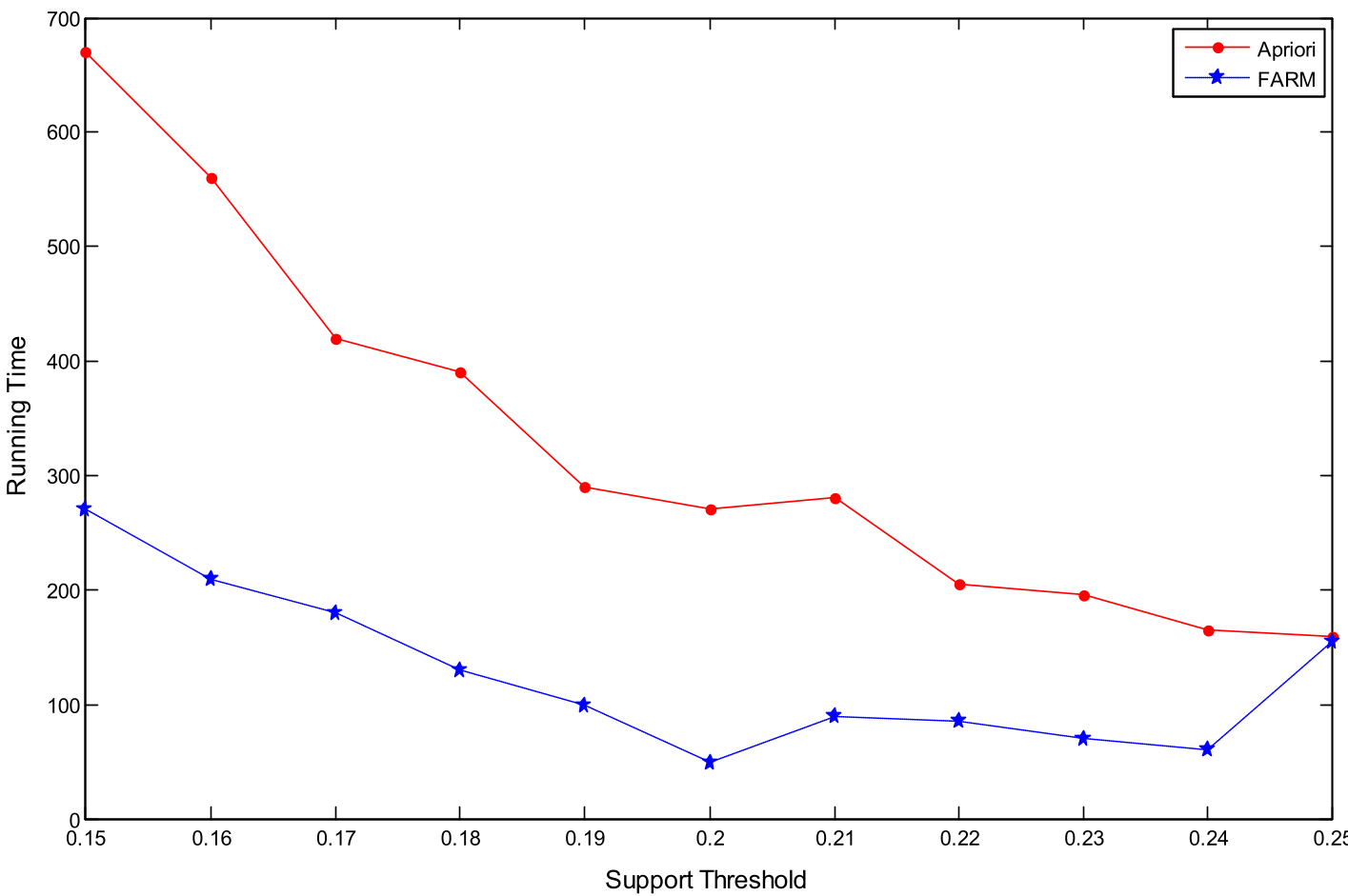 Figure 2: Running time of FARM vs. traditional Apriori as a function of support thresholds.
Key Risk Indicators
The mining process distilled 32 indicators down to 10 critical factors. Notably, "Receivable Turnover Rate" and "Net Profit Growth Rate" appeared most frequently in rules leading to "Crisis" or "Extinction" outcomes.
 Table 1: The 10 most predictive indicators identified by the fuzzy mining algorithm.
Conclusion and Future Outlook
The FARM algorithm proves that fuzzy logic is not just a mathematical curiosity but a practical necessity for financial forecasting. By moving away from binary "Pass/Fail" indicators and adopting a parallelized, fuzzy approach, the model achieves both higher accuracy and the scalability required for modern IoT environments.
Future Directions: While the current model focuses on financial statements, the next logical step is integrating social media sentiment and macroeconomic news (unstructured data) into the fuzzy association rules to provide an even more holistic "early warning" radar.