The Sanctioner's Dilemma: Why We Secretly Hate Your Social Media Posts but Never Tell You
8502_It's easier than causing confrontation Sanctioning Strategies to Maintain Social Norms and Privacy on Social Media.
This paper investigates how young adults enforce social norms and privacy on Social Networking Sites (SNS) through a qualitative study of 23 college students. It identifies a "sanctioning" taxonomy—on-site/off-site, individual/collective, and visible/invisible—to describe how users react to inappropriate content. The study reveals a strong preference for indirect, discreet sanctions that prioritize maintaining social relationships over effective norm correction.
TL;DR
To maintain social harmony, young adults frequently use "invisible sanctions"—like gossiping or silent muting—rather than telling friends their posts are inappropriate. Research from Indiana University shows that current social media tools force a choice between "awkward confrontation" and "ineffective silence," resulting in a breakdown of online social norm enforcement.
Background Positioning
This study sits at the intersection of Communication Privacy Management (CPM) and Human-Computer Interaction (HCI). While most privacy research focuses on how we protect our data, this paper shifts the lens to the viewer as a co-owner of the space, exploring how we "police" others to maintain collective standards of appropriateness.
The Pain Point: The Cost of "Calling Out"
Why don't we tell our friends their oversharing is annoying? According to the authors, imposing sanctions is costly. A direct comment on a post risks a public "flame war" or a permanent rift in a friendship.
The authors identify a gap in existing systems:
- Prior Work suggests confrontation is best for norm correction.
- Reality shows users would rather gossip behind your back or "mute" you than risk a confrontation.
Methodology: Mapping the Sanctioning Universe
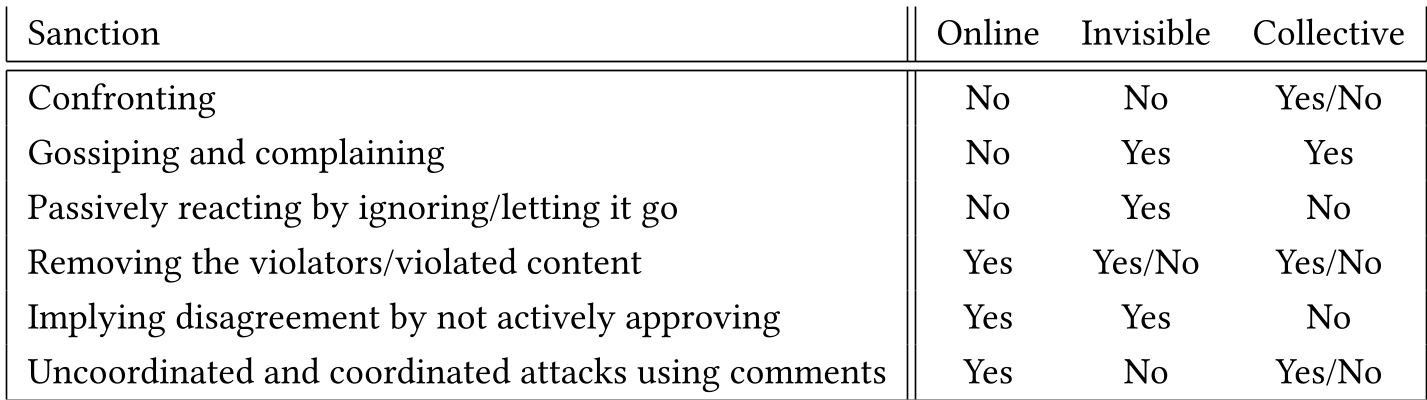
Through 23 deep-dive interviews, the researchers developed a taxonomy of how we punish online "sins":
The Three Dimensions of Sanctioning
- Source: Is it just you (Individual) or the whole friend group (Collective)?
- Location: Do you handle it on the app (On-site) or via a text/face-to-face (Off-site)?
- Transparency: Is it obvious you're mad (Visible) or are you secretly muting them (Invisible)?
Key Insights: The Rise of "Invisible" Discipline
The study found a fascinating trend toward Invisible Sanctions.
- Gossip as a Tool: Users take screenshots of "cringe" posts to share in private group chats. This reinforces the norm within the "in-group" but leaves the violator totally in the dark.
- The "Mute" Workaround: Features like "Unfollow" on Facebook or "Mute" on Twitter allow users to perform a "digital shunning" that preserves the social facade of friendship while cleaning the user's personal space.
- Modality Switching: When a violation is too big to ignore, users "switch channels"—texting a friend privately to ask them to take down a photo, thereby avoiding public embarrassment (saving "face").
Designing for a "Polite" Police Force
The authors argue that social media platforms are currently designed for Punishment (Blocking) rather than Signaling (Education).
Proposed Design Interventions:
- Anonymous Feedback: Allowing users to send a "nudge" (e.g., "this post feels a bit too personal for this group") without their name attached.
- Normative Nudges: AI tools that warn a user before they post: "You’ve posted 10 times today; most people in this group post once. Proceed?"
- Support Buttons: Instead of just "Like," a button to show solidarity with a victim of a privacy breach without escalating the fight with the poster.
Critical Analysis & Future Outlook
The brilliance of this paper lies in its recognition that privacy is a collective labor. However, its reliance on a Western college demographic is a limitation—privacy norms in collectivist cultures or among older generations may differ significantly.
The Takeaway: If social media feels increasingly toxic or annoying, it might be because the "social immune system" (sanctions) is broken. By designing tools that allow for low-friction, face-saving feedback, we can help online communities self-regulate without losing our friends in the process.