
The Echo Chamber: How Social Networks Silence Strategic Voters
The Echo Chamber: Strategic Voting and Homophily in Social Networks
The paper proposes a behavioral model of strategic voting where voters are embedded in social networks and infer election outcomes based on the ballots of their neighbors. Using plurality voting as a case study, it introduces the "Echo Chamber" effect—where homophily in networks dampens strategic behavior—and evaluates its impact on social welfare and Duverger's Law.
TL;DR
Does knowing what your friends think make you a smarter voter? Not necessarily. While strategic voting—voting for a "lesser evil" to prevent a worse outcome—generally improves social welfare, a phenomenon called homophily (our tendency to associate with likeminded people) creates an "Echo Chamber." This effect tricks voters into thinking their favorite candidate is more popular than they actually are, discouraging beneficial strategic shifts and keeping voting patterns "honestly" inefficient.
Background: The Gap Between Theory and Reality
In classic Social Choice Theory, researchers often assume voters either have no info or perfect info about everyone else's intentions. In reality, we learn through our "neighbors"—friends, news feeds, and social media. This paper bridges the gap by placing voters on a graph where they only see what their immediate connections are doing.
The Core Insight: Why Strategizing is Actually Good
One of the paper's most provocative findings is the Price of Honesty (PoH). In plurality voting (where you pick just one winner), being "honest" can be socially expensive.
- The Logic: If everyone votes for their absolute favorite, a polarized or widely disliked candidate might win through a split vote.
- The Strategic Fix: When voters see their favorite has no chance, they move to a "hopeful" second choice. The authors show this nearly always increases the total "happiness" (Social Welfare) of the group.
Methodology: Modeling the "Echo Chamber"
The authors use a sophisticated response model where voters aren't just following the crowd; they are calculating the mathematical probability of a tie.
1. The Network Architecture
The study compares four types of networks:
- Erdös-Renyi (ER): Random connections.
- Barabási-Albert (BA): "Scale-free" networks with influential hubs (like celebrities or major news outlets).
- Homophilic Variants: Where people with similar political views are more likely to be linked.
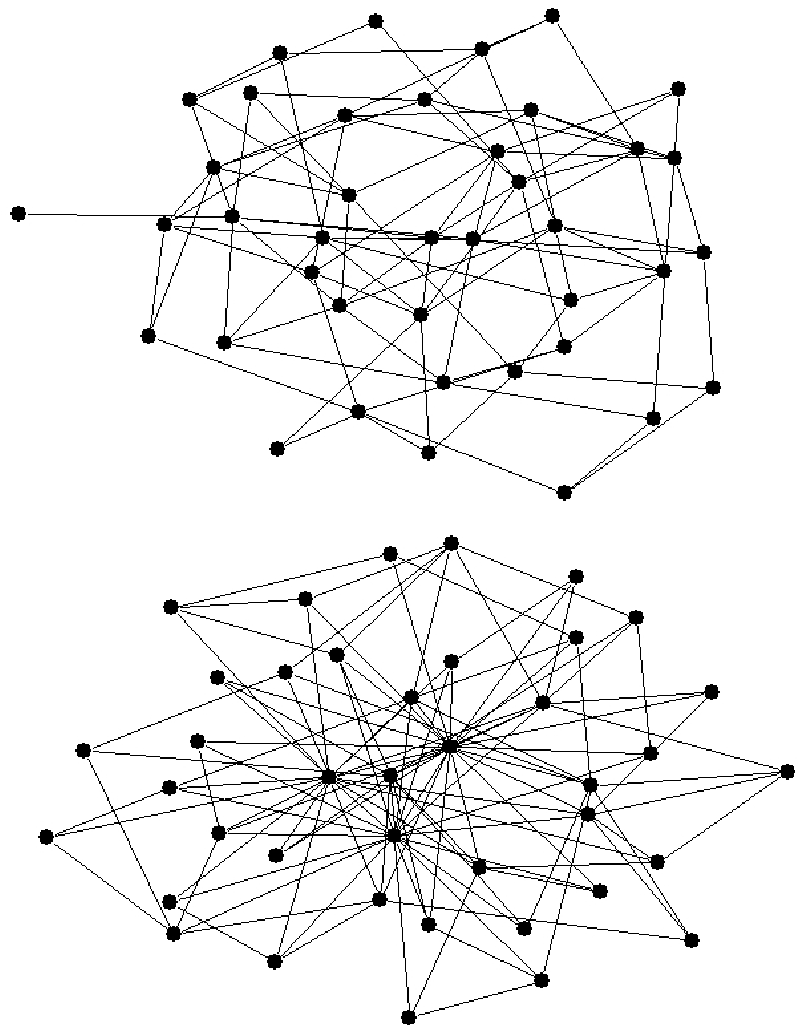 Above: ER (Top) vs BA (Bottom) models. Notice the "hubs" in the BA model which mirror real-world social influences.
2. The Decision Engine
Voters assume their friends are a representative sample of the world. Using a Multinomial Distribution with Laplace smoothing, they estimate the likelihood of candidates Tying for first place. If a vote swap can break a tie in their favor, they switch.
The Results: The "Saturation" of Strategy
As connectivity increases (more friends), people strategize more—but only up to a point.
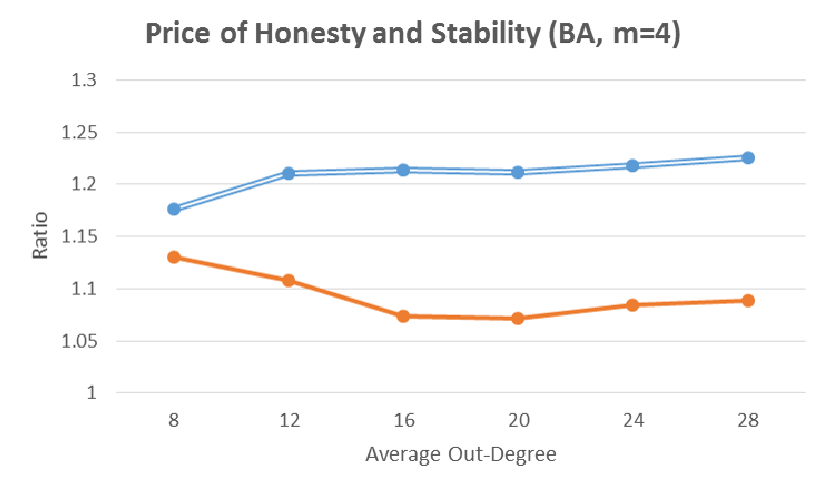 Above: The fraction of agents strategizing. Note how homophilic graphs (hER, hBA) hit a much lower ceiling than purely random ones.
The Echo Chamber Effect found in the data reveals:
- Lower Ceiling: In homophilic networks, voters are surrounded by people who agree with them. They rarely see their favorite candidate as "hopeless," so they never feel the need to switch to a strategic second choice.
- Duverger's Law: This political science rule suggests plurality leads to two-party systems. The study finds that homophily actually helps "restore" this law even when information is low, as local clusters quickly consolidate around strong regional candidates.
Performance & Stability
Does this iterative "I change my vote, then you change yours" ever stop? While the authors provide a mathematical counter-example (a cycle where voters flip-flop forever), they found that in real-world network structures, the system converges to stability very quickly (usually within 10 rounds).
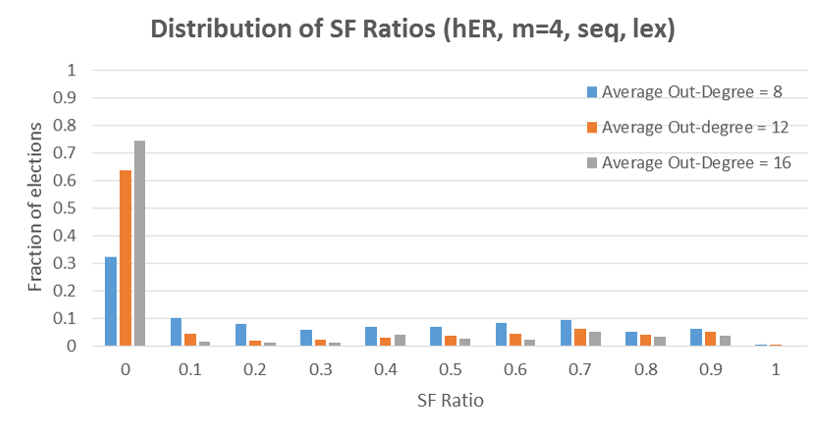 Above: The SF Ratio (Support for 3rd/2nd Candidate). A ratio near 0 indicates a total shift to a 2-candidate race (Duverger's Law).
Conclusion and Deep Insight
The "Echo Chamber" isn't just a political buzzword; it's a structural dampener on rational behavior. By providing a "biased sample" of global opinion, homophilic networks keep voters "honestly" trapped in losing positions.
Key Takeaway for AI & Social Science: To improve collective decision-making, we need to break homophily. If voters (or autonomous agents) only interact with similar peers, the "Price of Honesty" remains high, and the social group fails to reach the most beneficial consensus.