
CI and ML in Bioenvironmental Sciences: Bridging Data and Ecology
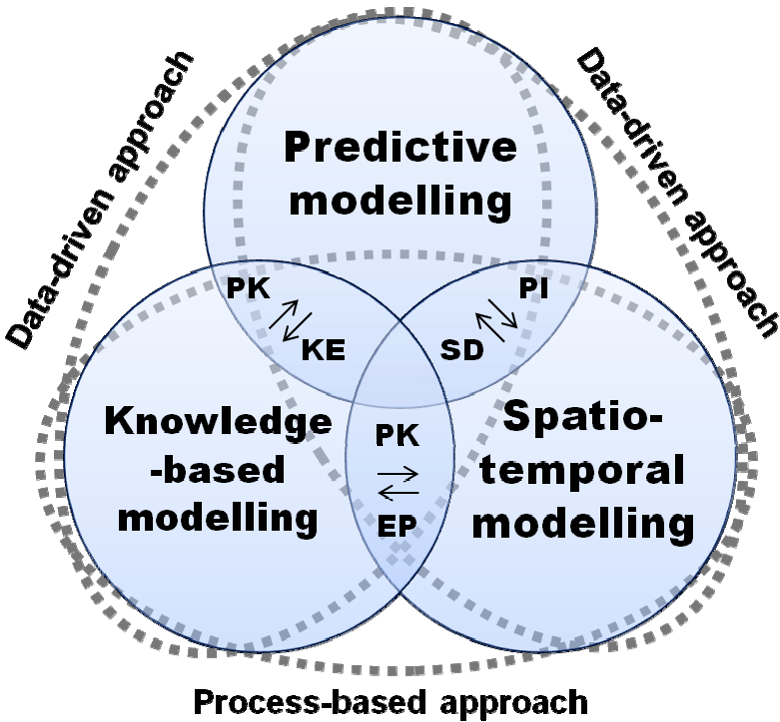
Figure 1. Conceptual framework of ecological modelling, in which PK stands for prior knowledge, KE is knowledge extraction, EP is emergent property, SD is system dynamics and PI is parameter identification. A Short Review on the Application of Computational Intelligence and Machine Learning in the Bioenvironmental Sciences
This paper provides a concise review of Computational Intelligence (CI) and Machine Learning (ML) applications in bioenvironmental sciences. It categorizes methodologies like Fuzzy Systems (FSs), Artificial Neural Networks (ANNs), and Genetic Algorithms (GAs) across domains such as agriculture, ecology, and water management, highlighting the shift toward data-driven predictive modeling.
TL;DR
Bioenvironmental sciences are undergoing a paradigm shift from rigid process-based modeling to flexible, data-driven frameworks. This review explores how Computational Intelligence (CI)—including Fuzzy Systems and Neural Networks—and Machine Learning (ML) are being deployed to solve complex nonlinear problems in agriculture, ecology, and water management, specifically addressing the trade-off between predictive accuracy and scientific interpretability.
Problem & Motivation: The Complexity of Nature
Modeling biological and environmental systems is notoriously difficult. Unlike physics, where laws are often deterministic, bioenvironmental systems are:
- Highly Nonlinear: Small changes in temperature or nutrients can lead to catastrophic shifts in populations.
- Spatiotemporally Dynamic: Environmental conditions shift across both space and time simultaneously.
- Data-Heterogeneous: Researchers must deal with everything from expert "rule-of-thumb" knowledge to massive automated sensor streams.
Historically, researchers used process-based models (based on first principles) which were interpretable but often lacked accuracy, or statistical models which were accurate but acted as "black boxes." The motivation behind this review is to showcase how CI and ML can unify these two worlds.
Methodology: The Three Pillars of Ecological Modeling
The authors categorize the modeling landscape into three synergistic approaches:
- Predictive Modeling: Using ML algorithms like Support Vector Machines (SVMs) and Random Forests (RF) to achieve maximum accuracy.
- Knowledge-based Modeling: Leveraging Fuzzy Logic to encode expert human "if-then" rules into computer systems, ensuring the model remains grounded in biological reality.
- Spatiotemporal Modeling: Using Cellular Automata (CA) and Stochastic formulations to account for the fact that nature is never static.
The Synergetic Framework
As shown in the framework below, the integration of these approaches allows for "Knowledge Extraction" (KE) from raw data and "Parameter Identification" (PI) for theoretical models.
Trends and Key Findings
By analyzing the ISI Web of Science, the authors identified significant shifts in the technological landscape:
- The Rise of Modern ML: While ANNs and Genetic Algorithms surged in the 1990s, the period after 2000 saw a massive spike in SVMs and Random Forests due to their superior handling of high-dimensional ecological data.
- Domain Focus: "Water" is the most researched keyword, reflecting the global urgency for water resource management.
- Hybridization: There is a clear trend toward Hybrid Models—using a machine learning model to estimate the parameters of a biological differential equation.
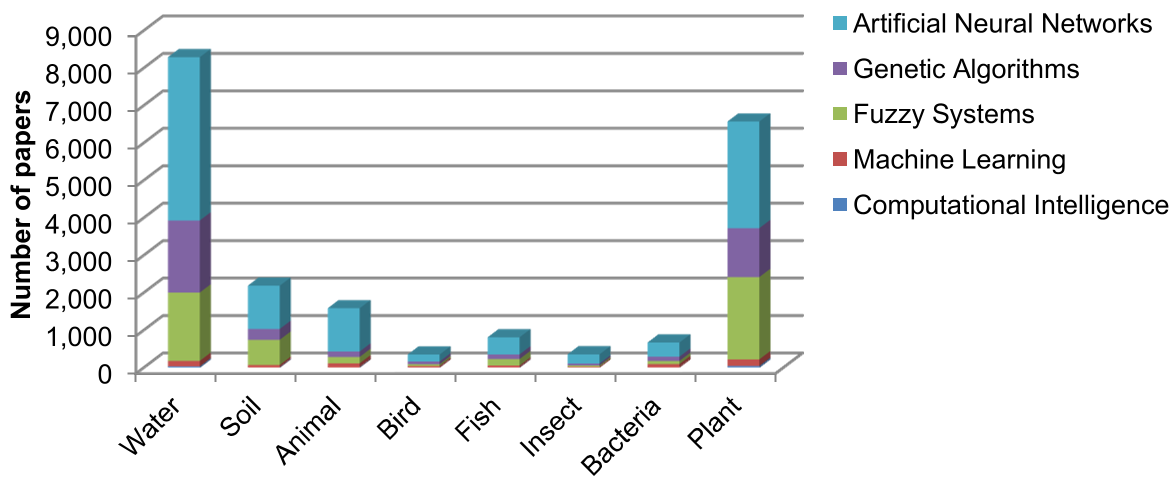 (Above: Trends highlighting the dominance of different CI/ML keywords across biological targets.)
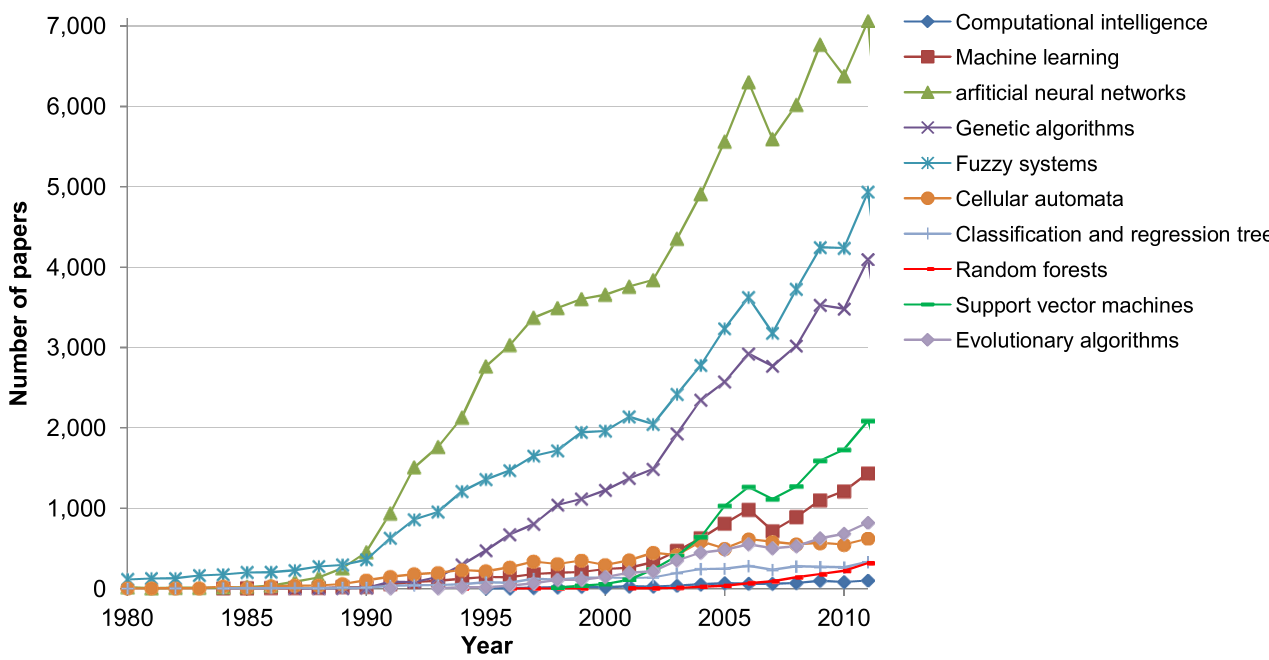 (Above: The exponential growth of publications in this field, particularly for Random Forests and SVMs.)
Critical Analysis & Conclusion
Takeaways
The transition toward Ecoinformatics is inevitable. The review highlights that we are moving into the "Big Science" realm of ecology, where transdisciplinary collaboration is the only way to process massive environmental datasets.
Limitations
While the review provides a strong historical overview up to 2012, it predates the "Deep Learning" revolution (CNNs, Transformers). Current practitioners would need to augment these findings with modern Deep Learning techniques for image-based plant phenotyping or remote sensing.
Future Outlook
The "Holy Grail" remains the Integrated Ecological-Environmental Management. By following a multi-step diagnostic process—from problem definition to recovery monitoring—advanced CI/ML methods will eventually allow for real-time, multiobjective optimization of our planet's natural resources.