
The Economics of Early Warning: Optimizing Canary-Based System Health Management
11199_Economic Analysis of Canary-Based Prognostics and Health Management.
Wang and Pecht present a quantitative cost-based decision model for Prognostics and Health Management (PHM) using "canary" devices—early-warning sensors designed to fail before the host system. The study develops analytical models to determine the economic feasibility of canary implementation and optimizes the replacement timing for Line Replaceable Units (LRUs) in both unscheduled and scheduled maintenance environments.
TL;DR
Is an early-warning sensor always worth its cost? This seminal paper by Wang and Pecht provides a mathematical "Yes, but..." through a rigorous economic framework. By applying renewal theory to "canary" devices—sensors that fail faster than the actual system—the authors demonstrate how to find the "sweet spot" between immediate replacement and waiting for scheduled maintenance to maximize ROI in high-stakes industries like aviation.
Background: Why "Canaries"?
In the coal mines of the 19th century, canaries warned miners of toxic gases because they were more sensitive than humans. In modern electronics, a canary is a sacrificial circuit or component designed to degrade and fail slightly faster than the main system under identical environmental stresses (vibration, heat, humidity).
While the engineering appeal is obvious, the business case is harder to prove. Canaries add weight, cost, and complexity. This paper provides the analytical tools to bridge the gap between "It works" and "It's profitable."
The Core Problem: The Risk of the "Prognostic Distance"
The time between a canary's failure () and the actual system's failure () is the Prognostic Distance ().
- If is too short: The warning is useless; the system fails before you can react.
- If is too long: Replacing the system immediately wastes precious remaining useful life (RUL).
The authors argue that we shouldn't always replace a part the second a warning light blinks. Instead, we should calculate an optimal delay () or wait for a scheduled Preventive Maintenance (PM) window to save on downtime costs.
Methodology: Renewal Theory and Decision Modeling
The authors treat the system's life as a series of "renewals." They define the Expected Total Cost over a system's life span () using the formula:
Where:
- is the initial canary setup cost.
- is the expected cost per replacement cycle.
- is the expected length of a replacement cycle.
Architecture of the Decision Model
The paper introduces a decision-making flow to handle cases where a system-level PM (scheduled maintenance) exists.
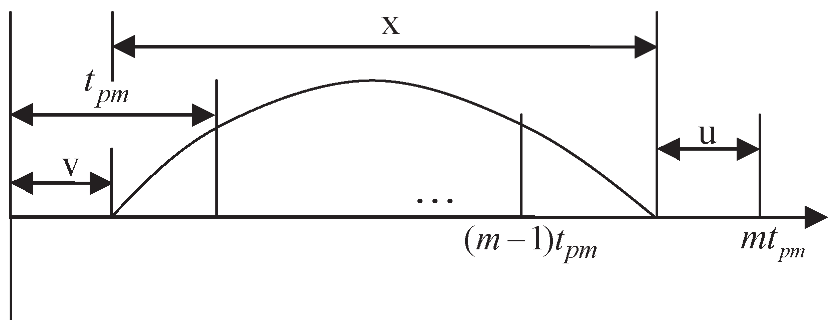 Fig 1: Relationship between Canary Failure (), System Failure (), and the threshold for scheduled maintenance.
Key Insights from Experiments
Using data from the aviation industry (where unplanned downtime costs can reach $70,000 compared to $2,350 for planned maintenance), the authors found several critical behaviors:
- The Threshold of Benefit: A canary remains beneficial even if it fails after the average system failure time (), provided some percentage of warnings still occur early enough to prevent a crash.
- Scheduled Maintenance Synergy: If the time to the next scheduled maintenance () is less than a certain threshold (), it is almost always cheaper to wait, even if the canary has already failed.
- Dependency Matters: "Dependent" canaries—those built on the same silicon or with the same materials as the host—are significantly more cost-effective because their failure distribution closely tracks the host, reducing the variance of the prognostic distance.
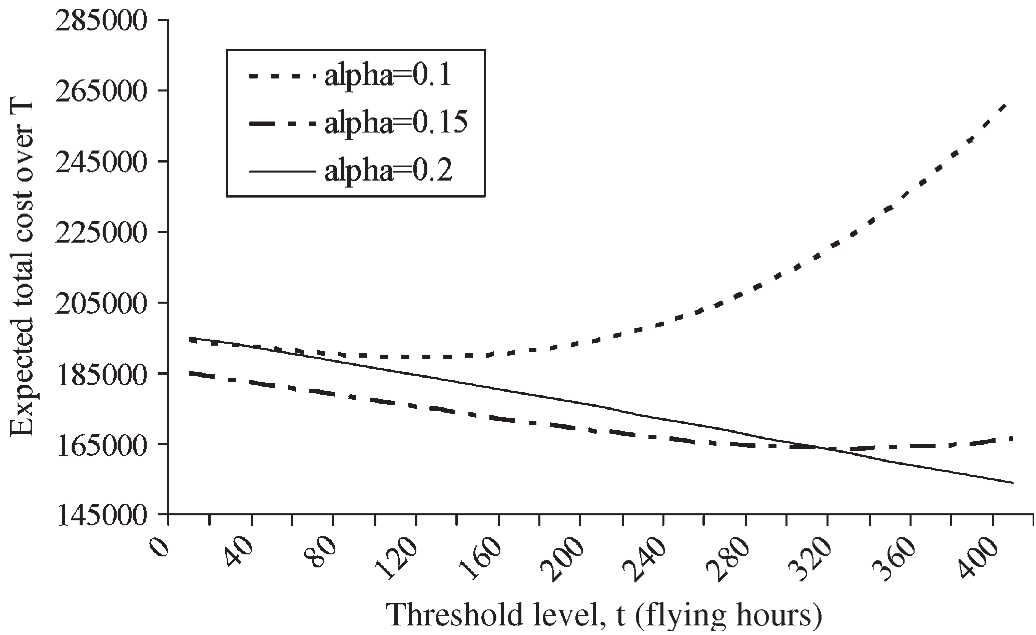 Fig 2: Total expected cost curves showing the "dip" where an optimal threshold exists for waiting until the next PM.
Critical Analysis & Conclusion
This paper is a masterclass in applying Stochastic Processes to Asset Management. Its biggest contribution is the realization that PHM effectiveness is not just a sensor problem-it's a logistics and maintenance scheduling problem.
Limitations:
- The model assumes a "binary" canary (it works or it doesn't). Modern PHM often uses continuous data-driven health indices.
- It assumes perfect observation of failure (no "dormant" failures).
Future Outlook: As we move toward "Digital Twins" and AI-driven maintenance, the logic established here—balancing the cost of early replacement vs. the risk of catastrophic failure—remains the fundamental economic law of the industry.