
Economic Design of LMCCS: Balancing Signal Loss, Reliability, and Cost
Economic Design of a Linear Consecutively Connected System Considering Cost and Signal Loss
This paper introduces a novel modeling approach for Linear Multistate Consecutively Connected Systems (LMCCS) that explicitly accounts for signal loss during transmission. By adapting the Universal Generating Function (UGF) technique, the authors co-optimize node construction and Connecting Element (CE) allocation to minimize total system cost while satisfying reliability and expected signal fraction constraints.
TL;DR
In the world of telecommunications, a connection isn't always "on" or "off"—it's often a gradient of signal quality. This paper shifts the paradigm of Linear Multistate Consecutively Connected Systems (LMCCS) by incorporating signal loss into reliability modeling. Using the Universal Generating Function (UGF), the authors provide a mathematical framework to decide where to build nodes and what hardware to use, proving that strategic gaps in a network (empty positions) can actually lead to lower costs without sacrificing critical signal integrity.
Background: Beyond the Binary "Connected" State
Standard reliability theory often treats a network path as a series of switches. If a node is within range, the connection exists; if not, it fails. However, in real-world scenarios like radio relay transmissions or GPS signal processing, signals fade over distance.
The authors identify a significant gap in prior work: while researchers have looked at "gap constraints" and "uncertain connection ranges," they have largely ignored the fractional reception of signals. In practice, a sink node might receive only 70% of a source signal due to environmental attenuation (weather, geography, or obstacles). If your system requires 80% to function, the "connected" logic fails to capture the true system state.
Methodology: The Power of UGF and Custom Operators
The core of this research lies in its use of the Universal Generating Function (UGF). UGF allows for the representation of discrete random variables as polynomials, making it easier to calculate the probability distributions of complex systems.
The "Combine" and "Leap" Operators
The authors propose an iterative approach to evaluate signal transmission across positions. They define two critical logic sets:
- The Combine Operator (): When a node is built at position , it receives signals from multiple previous channels (e.g., from the source and from the immediate predecessor). The model uses the inclusion-exclusion principle and equal-gain combining logic to determine the total signal fraction passed forward.
- The Leap Operator (): If the decision is made not to build a node at position , the signal must "jump" over that gap. The range effectively shortens, and signal loss increases.
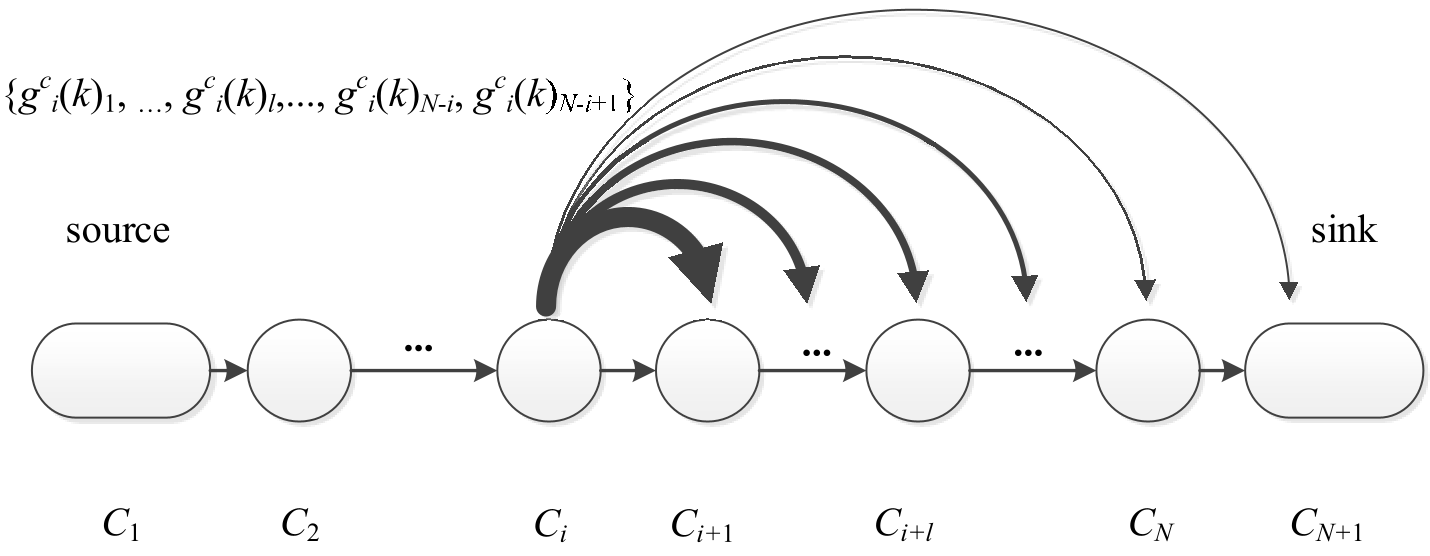 Fig 1: Signal transmission logic in a full-node LMCCS, illustrating how each node contributes to the forward-moving signal.
Experiments and Economic Insights
The study provides three numerical examples that yield intuitive but mathematically grounded insights:
1. Hardware Placement Strategy
The optimization results consistently show that high-performance (and expensive) Connecting Elements (CEs) should be placed at the beginning of the chain. Why? Because a strong signal at the source provides a "buffer" for attenuation across all subsequent nodes. Later nodes, having fewer successors to reach, can afford lower-cost, lower-range CEs.
2. The Case for "Empty Positions"
Example 3 is particularly enlightening. The authors compared a full-node design with a joint-optimization design (where nodes can be skipped).
- Full-node Cost: 24 units.
- Optimized (with gaps) Cost: 21 units.
Interestingly, the optimal design skipped building nodes at positions 5 and 8, opting instead to invest that saved capital into better CEs at other positions. This proves that a "dense" network isn't always the most reliable or the most economic.
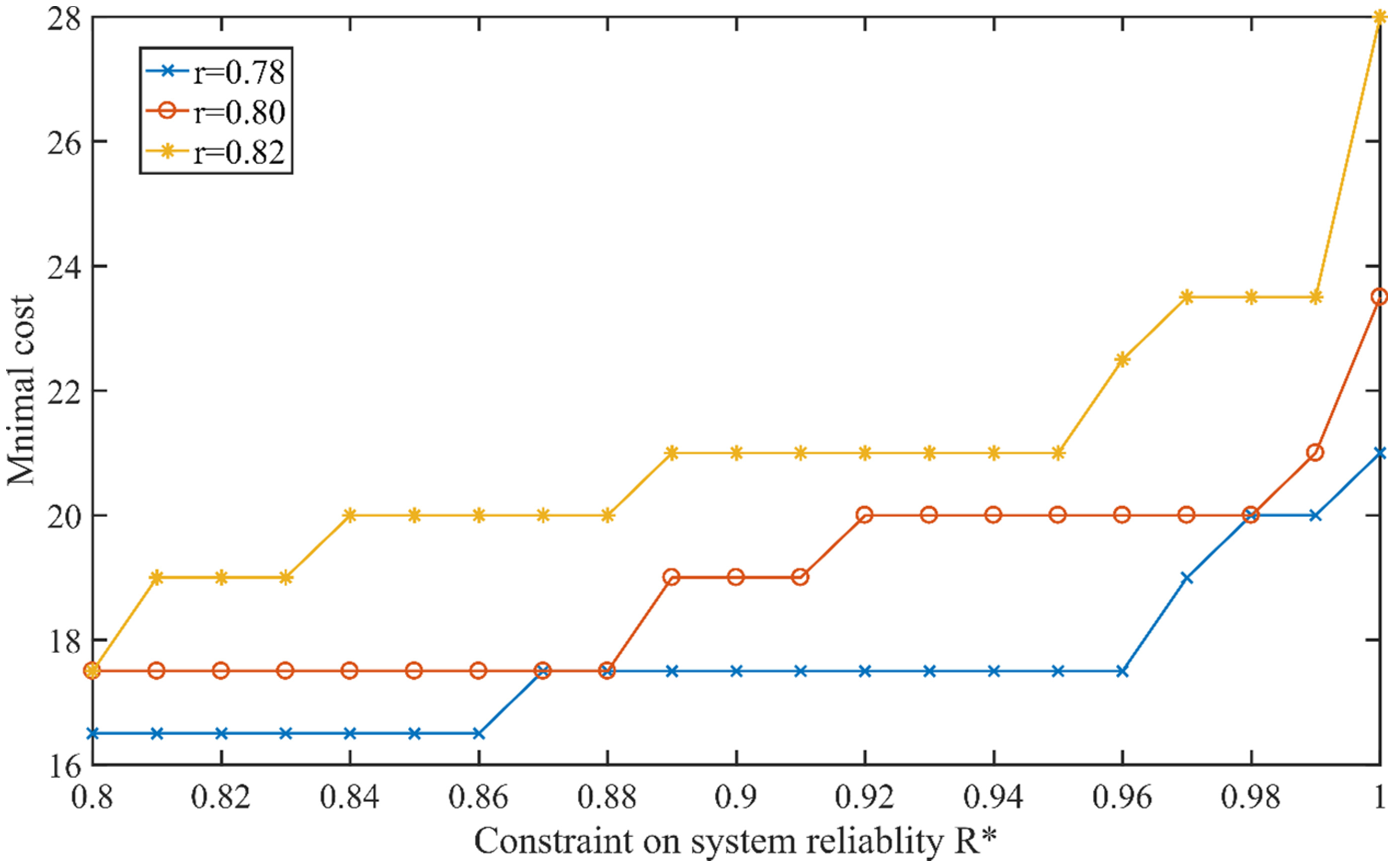 Fig 2: Minimal costs vs. reliability constraints. Note the sharp exponential increase in cost as required reliability approaches 1.0 (limit of perfection).
Critical Insight: The Cost of Perfection
As seen in the experimental data, the cost of increasing reliability from 0.95 to 0.99 is relatively linear, but pushing from 0.99 to 0.999 causes costs to spike. This reflects the Law of Diminishing Returns in infrastructure design. For engineers, this model provides a clear "bending point" on the curve to help stakeholders decide the optimal balance between budget and performance.
Conclusion & Future Work
This paper successfully bridges the gap between abstract reliability theory and the physical realities of signal transmission. By treating signal reception as a continuous spectrum (multistate) rather than a binary state, it offers a more robust tool for designing telecommunication relays and IoT sensor networks.
Future Directions:
- Phased-Missions: How does the optimal design change if the system requirements shift over time?
- Dependent Failures: Consideration of environmental impacts that hit multiple nodes simultaneously (e.g., a localized storm).
- External Impacts: Integrating protection strategies against external hardware damage alongside internal signal loss.
Academic Takeaway: Reliability in consecutively connected systems is a multi-objective optimization problem where spatial geometry (node building) and hardware performance (CE allocation) must be co-evolved.