
Sharing is Power: The Economic Blueprint for Femtocell Networks
The Economic Effects of Sharing Femtocells
This paper presents an analytical framework to evaluate the economic impact of sharing femtocells in a monopoly market. Using a two-stage sequential game model, it demonstrates that "open-femto" services (allowing guest access) significantly enhance operator revenue, user surplus, and social welfare compared to closed-femto or mobile-only services.
TL;DR
Femtocells—small, user-deployed base stations—are the key to handling the mobile data explosion. This research proves that making these private cells "open" to guest users creates a win-win-win scenario: operators make more money, users get better service via subsidies, and the network handles more traffic efficiently. Under flat pricing, operators only need to offer a 10-20% discount to flip users from "closed" to "open" access.
The Hidden Bottleneck: Economics, Not Tech
For years, engineers have optimized femtocell interference and power levels. However, the real hurdle is adoption. Why would a user buy a base station just to let strangers use their bandwidth?
Prior works often ignored the "openness" factor. This paper identifies that because femtocells are installed in private indoor environments, their capacity is often underutilized by the owner. By opening these "islands of connectivity" to guest users, the overall social welfare and network efficiency can be massively improved.
Methodology: Gaming the Market
The researchers modeled the interaction as a two-stage sequential game:
- Stage 1: The monopoly operator sets prices for three services: Mobile-only, Mobile+Open Femto, and Mobile+Closed Femto.
- Stage 2: Users (with varying willingness to pay) choose the service that maximizes their net utility.
They analyzed two core pricing strategies:
- Flat Pricing: A fixed monthly fee regardless of data usage.
- Partial Volume Pricing: A hybrid where macrocell usage is billed per-byte, while femtocell access remains fixed.
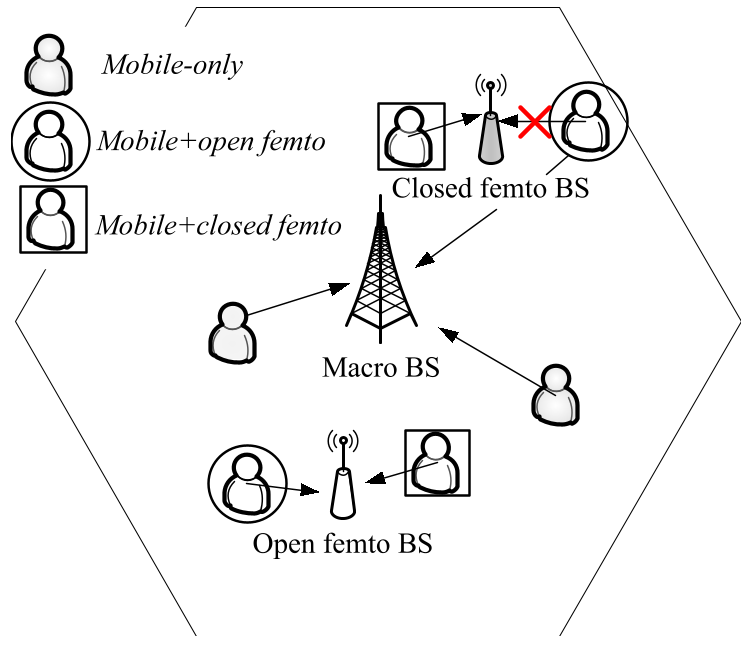 Figure 1: Comparison between mobile-only, closed-femto (private), and open-femto (shared) access models.
Key Insights: Why "Open" Wins
The study provides three major "takeaways" for the industry:
1. The Power of Open-Femto
Opening femtocells increases the "spatial reuse" of frequency. Even if guest users consume resources, the total system capacity grows so much that the operator can lower prices for everyone while still increasing total profit.
2. Pricing Sensitivity (Flat vs. Volume)
The paper makes a bold claim: Flat pricing is better for operators. When users are price-sensitive, volume pricing discourages usage, whereas flat pricing encourages users to stay within the ecosystem. The "negative externality" of heavy users in flat pricing is mitigated by the natural capacity of the femtocell.
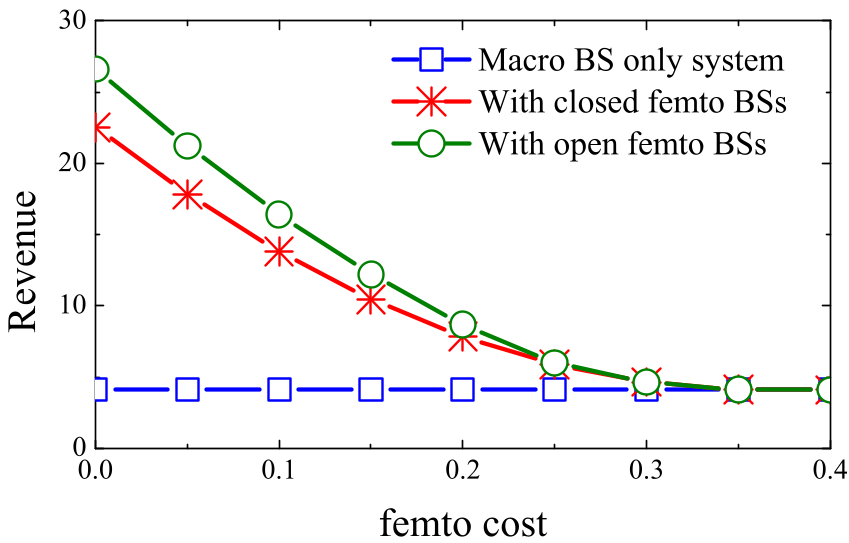 Figure 2: Performance metrics showing that Open-Femto (red/blue lines) consistently outperforms Closed-Femto and Mobile-only services.
3. The 10-20% Subsidy Rule
To convince a user to switch from a "closed" to an "open" femtocell, the operator doesn't need to give the service away for free. A price reduction (subsidy) of roughly 10% to 20% is sufficient to balance the slight utility loss of sharing the bandwidth.
Critical Analysis & Future Outlook
Contribution: This paper moves beyond pure physics/signal processing to provide a commercial roadmap for 4G/5G deployment. It characterizes the "Positive Externality" of open access mathematically.
Limitations: The model assumes a monopoly. In a real-world scenario with multiple providers (e.g., AT&T vs. Verizon), users might not want to share their femtocells with customers of a rival network. Furthermore, the model assumes backhaul (DSL/Fiber) is "free" or fixed-cost, which may not hold in data-capped residential markets.
Conclusion: As we move toward 6G and ultra-dense networks, the "Sharing Economy" for wireless spectrum isn't just a technical possibility—it is an economic necessity. Operators who master the "subsidize-to-share" model will dominate the landscape of high-density urban connectivity.