
From Silos to Synergy: An Economic Model for Standardizing Correlated Technologies
16598_Economic Evaluation Model for International Standardization of Correlated Technologies.
This paper proposes an economic evaluation model for the international standardization of correlated technologies, extending the traditional Cost-of-Ownership (COO) framework. It introduces a quantitative methodology to analyze the financial synergy and risk when multiple technologies are developed and standardized jointly rather than independently.
TL;DR
Technological standardization is a high-stakes gamble. This paper introduces a sophisticated Cost-of-Ownership (COO) evaluation model specifically designed for correlated technologies. By shifting from independent assessments to a joint-development framework, the authors demonstrate that fiscal synergy can more than double net profits, provided the "risk pooling" effect is managed.
The "Independence" Fallacy in R&D
In traditional technology management, companies often evaluate individual R&D projects as isolated silos. However, in the modern tech landscape (e.g., IoT, 5G, RFID), technologies are rarely independent. If Technology A and Technology B are functionally related, standardizing them separately is not only redundant but financially inefficient.
The authors argue that the degree of uncertainty increases with correlation, yet the potential for cost reduction—through shared equipment, joint labor, and unified international conference participation—presents a massive strategic advantage that current models fail to quantify.
Methodology: Quantifying the "Correlation"
The core innovation of this research lies in how it translates abstract technical synergy into cold, hard numbers using two primary levers:
1. The Cost Reduction Formula
The authors propose a non-linear relationship where cost reduction is a function of the correlation coefficient () and a sensitivity constant ():
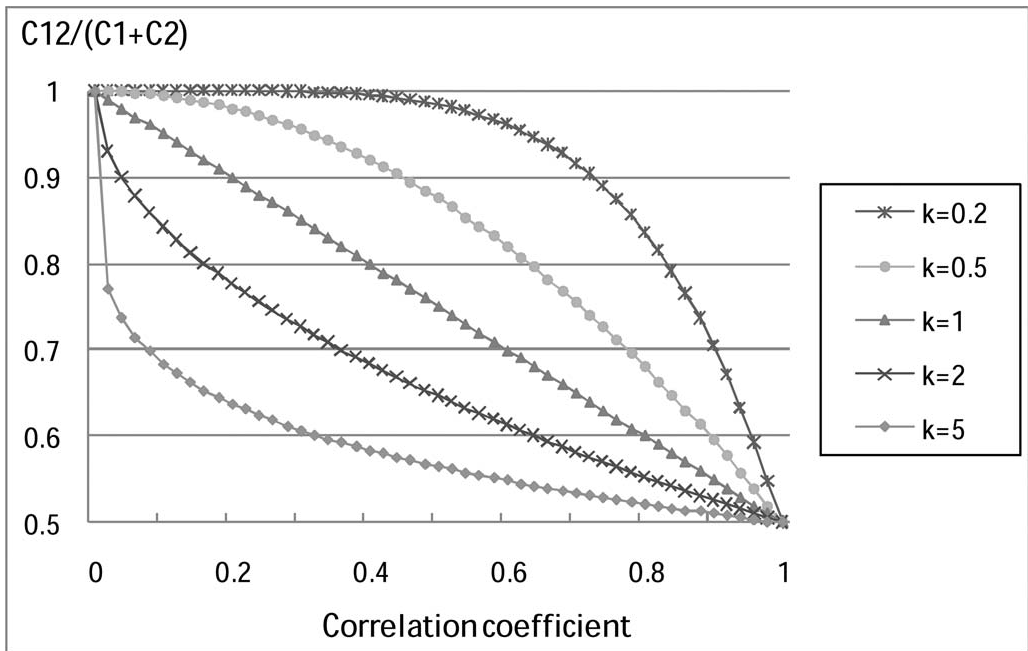 Figure 1: Relationship between the correlation coefficient and the relative level of reduced costs.
As approaches 1 (perfect correlation), the joint cost can be reduced to nearly half of the independent sum. The factor accounts for the "maturity" or field-specific characteristics of the technology.
2. Modeling Uncertainty with Beta Distributions
Standardization is inherently probabilistic. Instead of using static values, the model treats risk parameters (Probability of success, Market utilization, Sales growth) as random variables following a Beta Distribution. By using a bivariate beta distribution, they can simulate how the success of one technology influences the other.
Experimental Results: The RFID Case Study
The researchers applied this model to a realistic scenario involving Radio Frequency Identification (RFID) technologies. They compared Scenario 1 (Independent) against Scenario 2 (Joint Standardization).
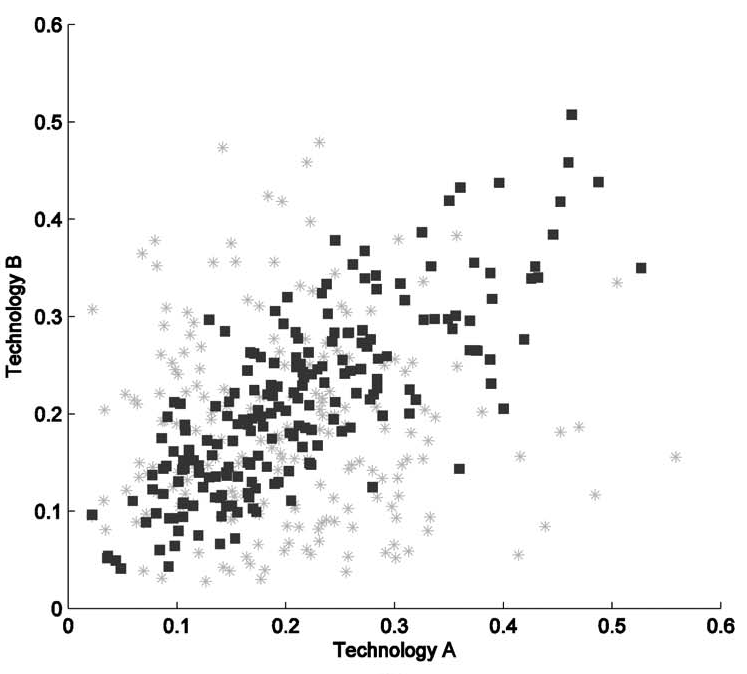 Figure 2: Scatter plot of randomly generated risk parameters showing higher success density in joint projects.
Key Findings:
- Profit Explosion: The mean net profit jumped from 63.74M when technologies were standardized jointly.
- The Variance Trap: While profits rose, the Standard Deviation also skyrocketed (from 35.52 to 83.18). This reveals the "double-edged sword" of correlation: joint projects are more profitable but carry higher systemic risk.
- Sensitivity Insight: Sensitivity analysis proved that increasing the probability of standardization success is far more critical than simple cost-cutting.
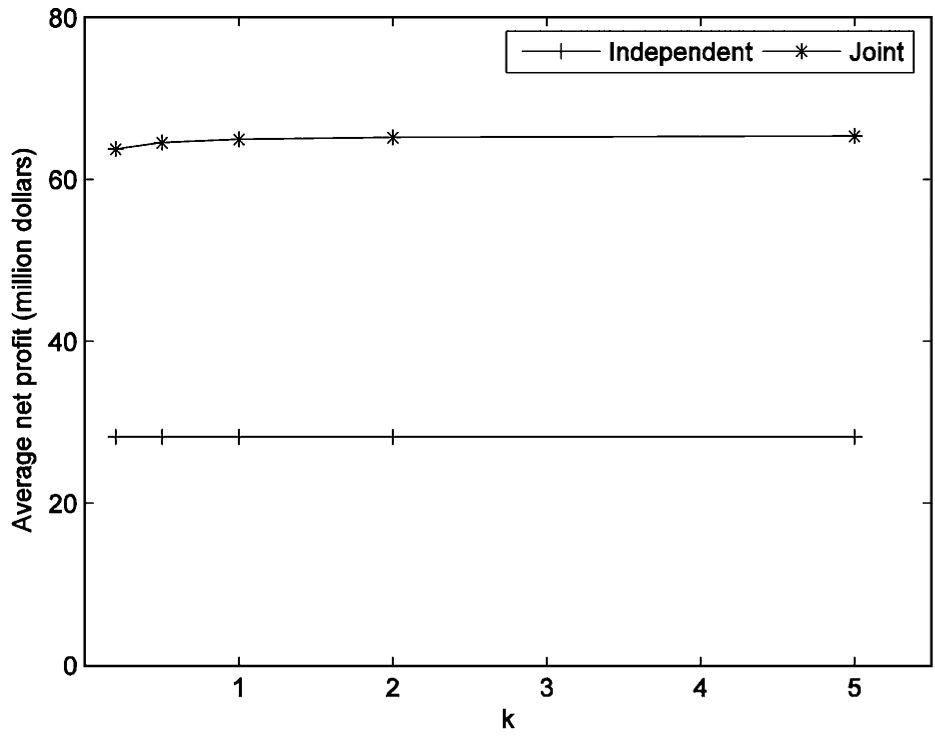 Figure 3: Histogram showing the distribution of net profits for independent vs. correlated scenarios.
Critical Insights & Future Outlook
This paper serves as a wake-up call for CTOs and policy makers. It proves that the "siloed" approach to international standardization is economically sub-optimal.
Takeaways for Industry:
- Identify Correlations Early: R&D managers must map technical dependencies during the brainstorming phase, not the standardization phase.
- Resource Pooling: Shared "Expert Manpower" and integrated standardization teams are the primary drivers of cost efficiency.
- Risk Management: Because joint projects increase variance, firms must have contingency plans (yield loss mitigation) for when a "correlated portfolio" fails to achieve standard status.
Limitations: The current model focuses on a two-technology pair. Future research must scale this to N-technology portfolios and account for aggressive competitors who may intentionally disrupt standardized "clusters."