
Profiting from Chaos: Quantitative Assessment of Topology Data Attacks via Virtual Bidding
17581_Economic Impact Assessment of Topology Data Attacks With Virtual Bids.
This paper proposes a mathematical framework to evaluate the financial impact of Topology Data Attacks in electricity markets. It specifically focuses on how an adversary can manipulate network topology (e.g., circuit breaker status) combined with Virtual Bids to generate significant profit, and introduces a closed-form metric called the Virtual Bidding Profit Signal (VBPS).
TL;DR
Power grids are not just engineering marvels; they are massive financial clearinghouses. This paper uncovers how cyber-adversaries can "hack" the market by faking the status of circuit breakers. By presenting a novel closed-form mathematical framework, the authors quantify the profit an attacker gains through virtual bidding during a topology attack, providing system operators with a vital tool to identify the most vulnerable points in the electricity market.
Background: The Hidden Vulnerability in the EMS/MMS Loop
In modern power systems, the Energy Management System (EMS) and Market Management System (MMS) work in a tight feedback loop. The Supervisory Control and Data Acquisition (SCADA) system feeds both analog data (voltage, flow) and discrete data (breaker status) into the State Estimator (SE). The SE then tells the Security Constrained Economic Dispatch (SCED) what the grid looks like.
The problem? If an attacker flips a "virtual switch" (topology attack), the SCED calculates the wrong Locational Marginal Prices (LMPs). By placing Virtual Bids (financial bets on price differences between Day-Ahead and Real-Time markets), an attacker can turn these miscalculated prices into a guaranteed payday.
Methodology: The Virtual Bidding Profit Signal (VBPS)
The core contribution of this paper is the derivation of the Virtual Bidding Profit Signal (VBPS). Instead of relying on "black-box" simulations, the authors provide a closed-form solution that links profit directly to:
- Marginal Costs of generators.
- Network Distribution Factors (the sensitivity of line flows to power injections).
The Attack Logic
The attacker uses a combination of an Increment Offer (INC) and a Decrement Bid (DEC) at two different buses. The profit () is defined as:
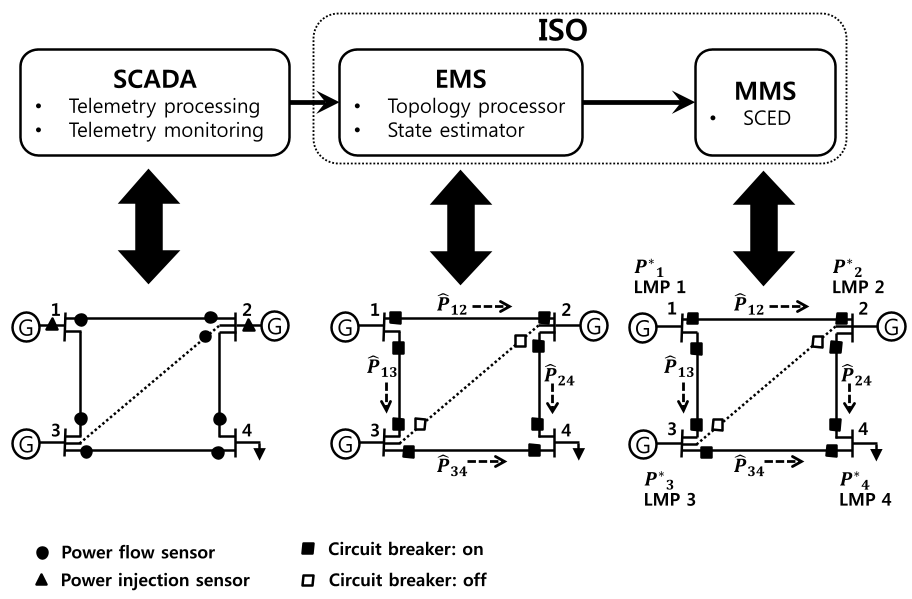 Fig 1: The coupling between SCADA, SE, and SCED that enables the attack.
The paper breaks down the impact into four scenarios (C1 through C4), mapping how changes in Marginal Units (MU) and Congested Lines (CL) affect the final profit signal.
Experimental Insights on IEEE 14-Bus System
The authors validated their framework on the standard IEEE 14-bus system. Key findings include:
- Strategic Placement: The most profitable buses for virtual bidding are usually the ones physically connected to the ends of the congested or victimized transmission lines.
- Sensitivity to Physical Parameters: Profit is highly sensitive to the "susceptance" of the line being attacked. As the susceptance approaches zero (simulating a line trip), the profit signal often spikes non-linearly.
- Attack Comparison: Topology attacks were found to be potentially more lucrative than simple "Continuous Data Attacks" (manipulating analog measurements) because they fundamentally change the constraint set of the optimization problem.
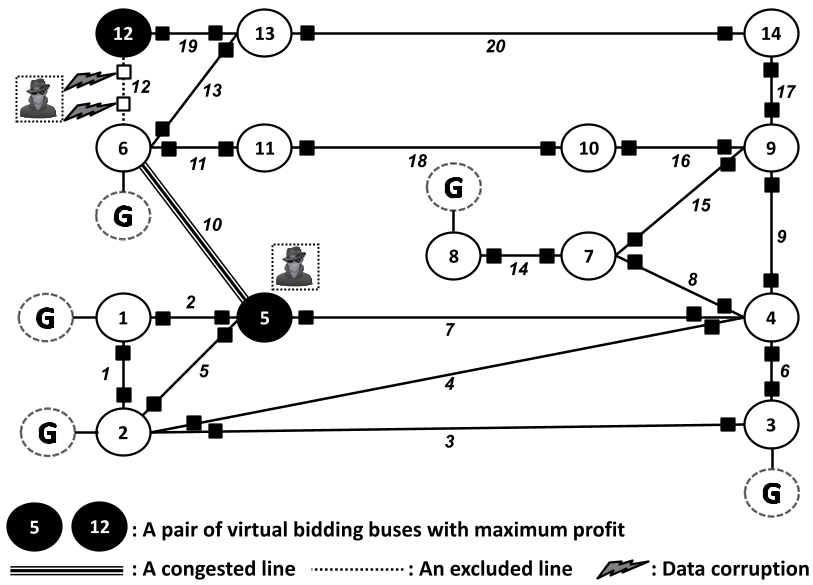 Fig 2: impact of varying line susceptance on the VBPS. Note how different lines yield drastically different profit potentials.
Deep Dive: Why This Matters for Grid Operators
This research moves the conversation from "can we detect the attack" to "what is the financial risk of the attack."
- Prioritized Protection: Operators can use this framework to identify "High-Value" lines—those whose exclusion creates the biggest price distortions—and harden the sensors (IEDs/PMUs) on those specific lines.
- Market Surveillance: By monitoring virtual bidding pairs that align with the "most profitable pairs" identified by the VBPS, regulators can flag potential market manipulation in real-time.
- Algorithmic Robustness: It provides a basis for creating "price-aware" state estimators that look for anomalies not just in physics, but in financial outcomes.
Conclusion
The paper successfully demonstrates that topology data attacks are not just a theoretical threat to grid reliability, but a practical threat to market integrity. The closed-form VBPS equations offer a computationally efficient way to screen for vulnerabilities, shifting the advantage back to the system operators in the ongoing cat-and-mouse game of power grid cybersecurity.
Title: Economic Impact Assessment of Topology Data Attacks With Virtual Bids Source: IEEE Transactions on Smart Grid, Vol. 7, No. 3, May 2016.