
Engineering the Bottom Line: The Economic Logic of Agility and Flexibility
17773_The Economic Impact of Learning and Flexibility on Process Decisions.
This paper establishes an economic framework for software process selection, comparing sequential (Waterfall) and iterative (Agile) models. It demonstrates that under high uncertainty, iterative processes create superior economic value by leveraging "learning power" and "embedded flexibility" through real options like the exit option.
TL;DR
Why is Agile often better than Waterfall? While developers argue for "culture," Hakan Erdogmus argues for Economics. By modeling software processes as a series of financial options, this paper proves that iterative development generates higher net value under uncertainty by allowing projects to "learn" and "exit" before losses spiral—effectively pruning the "dark branches" of a project's decision tree.
Background Positioning
This work moves software process debate from "dogma" to "data." Positioned in the lineage of Value-Based Software Engineering (VBSE), it provides a mathematical bridge between the qualitative intuition of the Agile Manifesto and the quantitative rigor of Financial Engineering.
Motivation: The Fallacy of Predictability
In traditional engineering, "on time and on budget" are the primary metrics of success. However, software is a "soft artifact"—it obeys no natural physical laws and is subject to constant pressure to change. The author argues that:
- Rigid processes (Sequential/Waterfall) work only when uncertainty is low.
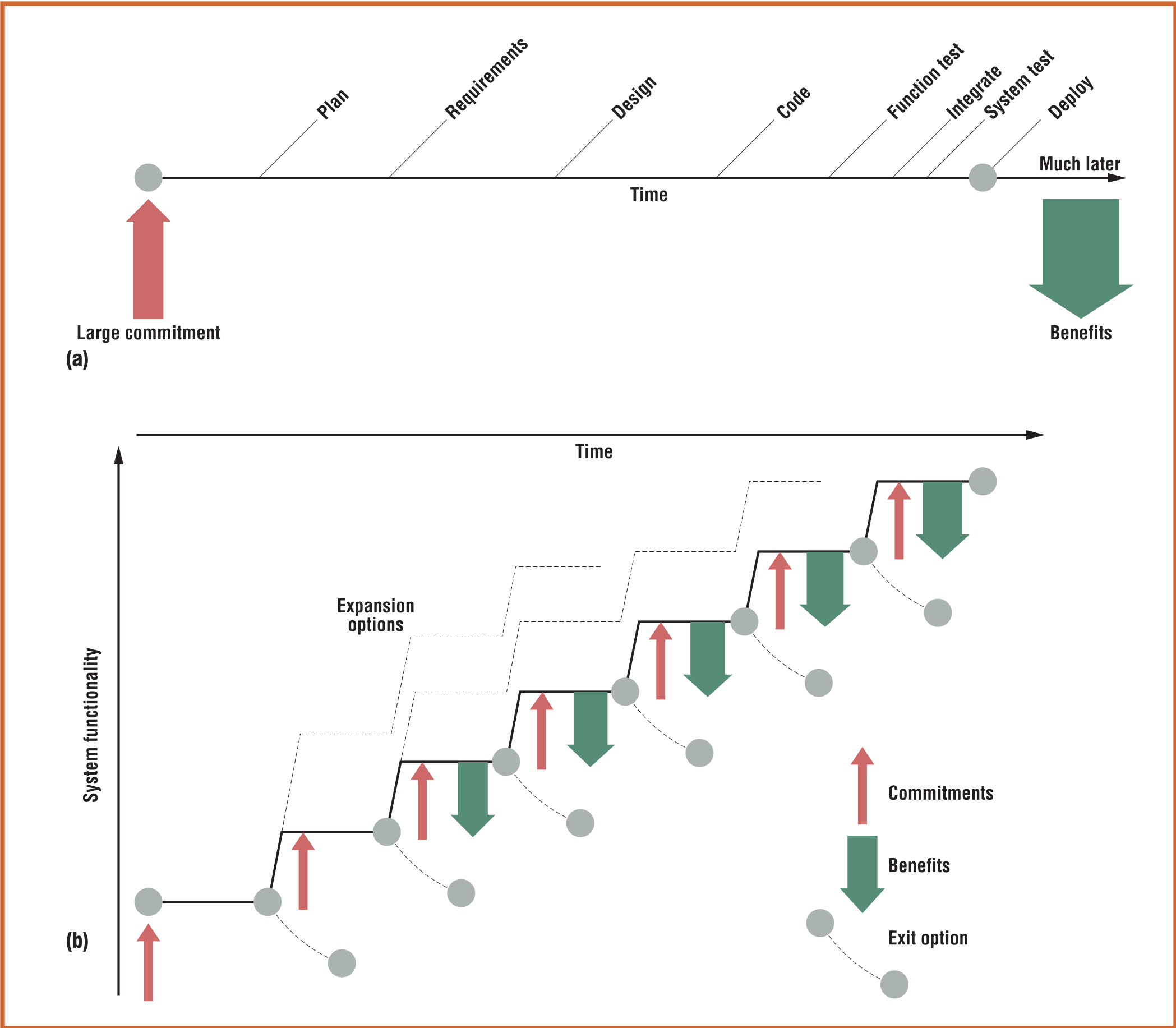
- Flexible processes (Iterative/Agile) are mandatory when market needs are ambiguous. The core problem is that sequential projects require a massive upfront resource commitment, delaying benefits and hiding risks until the very end.
Methodology: The Power of Real Options
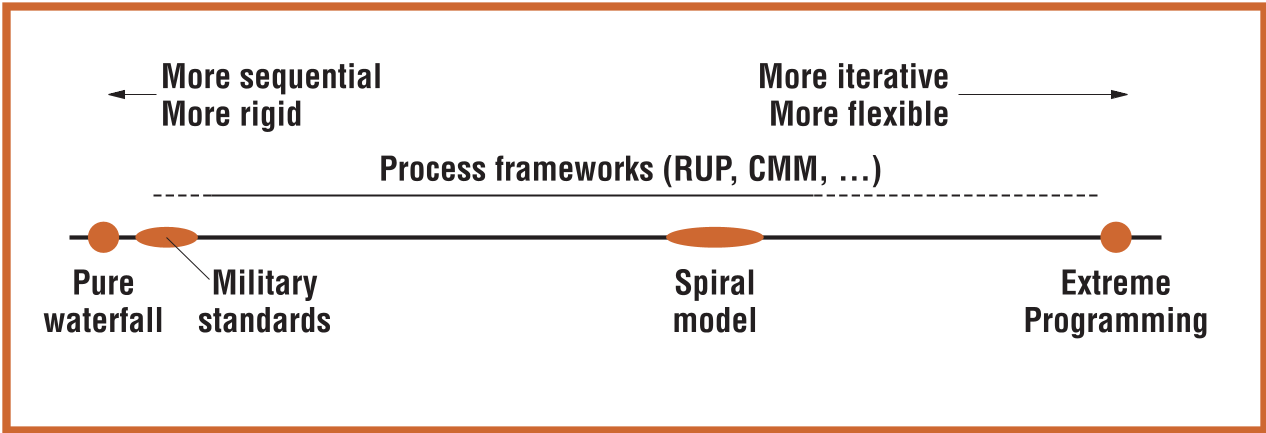
The author views iterations as a Process Flexibility Continuum. By breaking a large project into smaller increments, we embed "Real Options" into the development lifecycle.
Two Engines of Value:
- Learning Power (): The ability of an iteration to resolve uncertainty. If , one iteration resolves 50% of the project's unknown variables.
- Process Granularity: The frequency of delivery. More iterations mean more "gates" where stakeholders can decide to continue, pivot, or exit.
The Decision Tree Logic
The paper uses a "yesterday's weather" principle. If iteration yields a pessimistic outcome, the estimates for are adjusted downward. If the future cost exceeds the expected residual benefit, the "Exit Option" is triggered.
Experiments: Breaking Even vs. Going Broke
The author compares a 3-iteration project against an equivalent sequential one with the same $900K cost and similar risk profiles.
- The Sequential Result: A net value of -$113K. Since there is no way to stop mid-stream, the project must absorb all "pessimistic" outcomes.
- The Iterative Result: A net value of +$4K. By exercising the exit option on unprofitable paths (nodes where expected gain < cost), the "downside" is effectively capped.
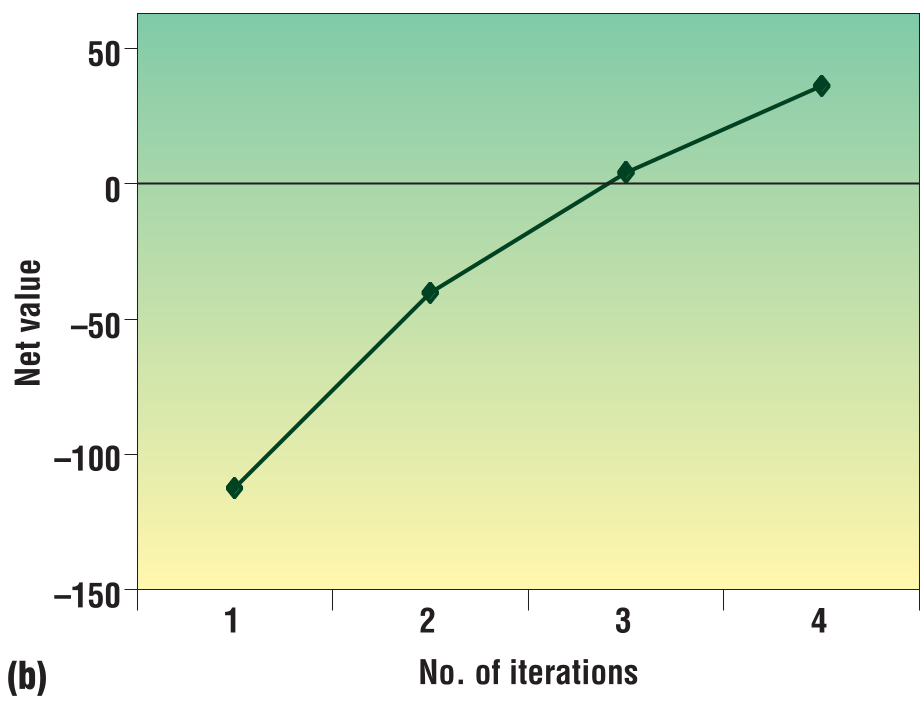
The results (Figure 4) show that as Learning Power increases, the iterative advantage grows linearly. Interestingly, Process Granularity shows diminishing returns: while more iterations add value, the benefit levels off as cumulative uncertainty reduction approaches its limit.
Critical Insight: When Agility Fails
The paper gracefully admits a caveat: Incremental delivery must be feasible. If a system is "all-or-nothing" (like a rocket launch or a nuclear control system), the customer cannot derive value from partial features, and the economic advantage of iteration is significantly diminished (though the learning/exit value remains).
Conclusion: A Rational Basis for Choice
Agile isn't just about "developer happiness"; it's a risk-management strategy.
- High Certainty? Stick to sequential plans to avoid the overhead (transaction costs) of frequent iterations.
- High Uncertainty? Use small iterations to "buy" information and maintain the right to quit early.
By framing software as a financial asset, Erdogmus provides a language that both CTOs and CFOs can understand: Agility is the price we pay for the option to not fail catastrophically.