
Beyond Efficiency: Detecting Appliance Aging with Hellinger Distance in EMIS
Economic Load Demand Response in Energy Management Information Systems: Data Mining Methods in the Safety and Quality of Building Systems
This paper introduces a data mining approach for Energy Management Information Systems (EMIS) utilizing the Hellinger distance to classify electrical load events. The method focuses on detecting "state transitions" and "load aging" across household appliances by analyzing standardized steady-state power signatures (P, Q, VTHD, ITHD).
TL;DR
Energy Management Information Systems (EMIS) are evolving beyond simple electricity tracking. This research proposes a novel data mining framework that uses the Hellinger distance to identify load state transitions and, more importantly, load aging. By analyzing steady-state power signatures, the system can provide early warnings for potential fire hazards caused by degrading appliance components.
Context: The Hidden Dangers of Aging Infrastructure
In the context of Smart Buildings and Economic Load Demand Response (ELDR), simply knowing how much power is consumed is no longer enough. The real value lies in understanding the quality and state of the loads.
The authors highlight a critical gap: while many systems focus on energy saving, few address the safety aspects of load aging. As appliances age, their internal resistance changes, often leading to increased real power consumption and heat—a primary cause of electrical fires. Traditional data mining methods are often too memory-intensive for real-time edge deployment in EMIS.
Methodology: Statistical Precision via Hellinger Distance
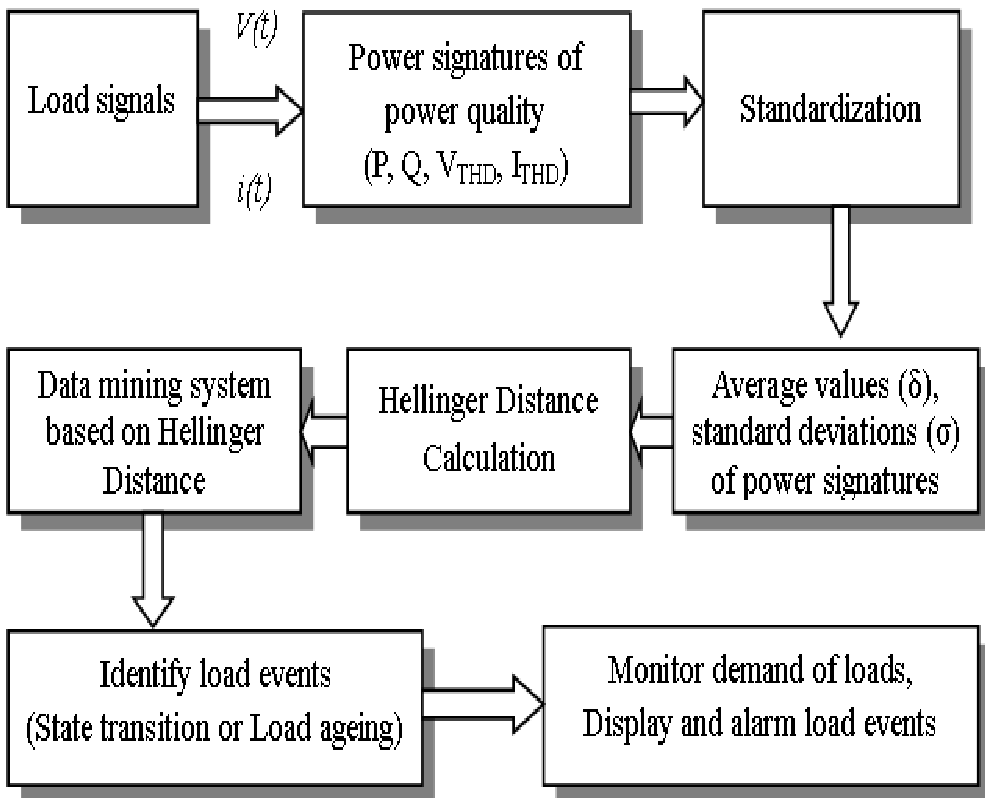
The core innovation lies in treating power signatures not as static points, but as probability distributions. The workflow is split into two distinct phases:
- Feature Extraction & Standardization: The system extracts four primary power signatures: Real Power (), Reactive Power (), Voltage Total Harmonic Distortion (), and Current Total Harmonic Distortion (). These are standardized to have zero mean and unity standard deviation to ensure feature parity.
- Hellinger Distance Classification: Unlike Euclidean distance, the Hellinger distance is specifically designed to quantify the similarity between two normal probability distributions. It is defined as: This metric is highly sensitive to shifts in both the mean () and variance (), making it ideal for detecting the subtle drift in power signatures that signifies an aging component.
Experimental Insights: State Transitions vs. Aging
The researchers tested their model using common household appliances: a refrigerator and two rice cookers (one new, one manufactured in 1998).
1. State Transition Detection
For appliances like refrigerators, the transition between "Compressor On" and "Compressor Off" is drastic. The Hellinger distance achieved a score of 1.0 (maximum divergence) for P and Q signatures, indicating perfect classification of operational states.
2. The Aging Signature (The "Smoking Gun")
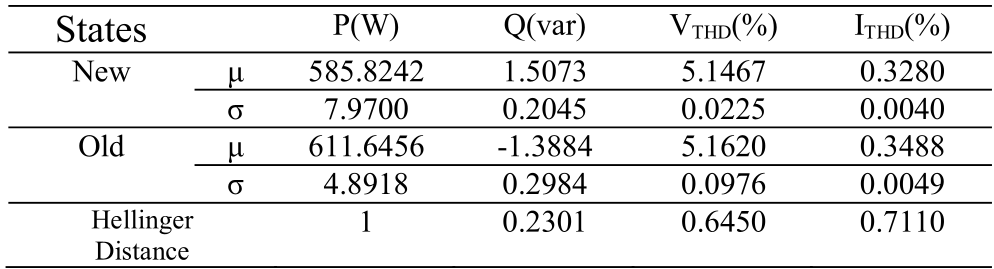
The most compelling result came from comparing the old and new rice cookers. During the "Steaming" state:
- New Rice Cooker: Mean Real Power
- Old Rice Cooker (1998): Mean Real Power
The Hellinger distance for Real Power () was 1.0, clearly distinguishing the aged appliance. The study confirms that internal resistance decreases as the heater ages, causing the appliance to draw more current and potentially exceed its rated safety limits.
Deep Insight: Why Harmonics Aren't Enough
Interestingly, the study found that and (harmonics) were less effective at identifying state transitions in simple resistive loads like rice cookers. This suggests that while harmonics are vital for identifying types of non-linear loads (like computers), Real Power () remains the most reliable indicator of physical component degradation.
Conclusion and Future Outlook
This paper successfully demonstrates that the Hellinger distance is a computationally efficient and statistically robust tool for EMIS. By embedding these algorithms into non-intrusive energy monitoring systems, we can:
- Prevent Fires: Identify appliances acting as "ticking time bombs" due to aging.
- Optimize ELDR: Better predict demand response capacity by knowing the exact state of building loads.
- E-Business Integration: Enable service providers to offer "Predictive Maintenance as a Service" to building managers.
Future work will likely focus on integrating these statistical methods into Non-Intrusive Load Monitoring (NILM) hardware to provide a truly "plug-and-play" safety diagnostic tool.