
Accelerating the Grid: Solving Economic Load Dispatch via Radial Basis Neural Networks
Economic Load Dispatch with Short-Term Wind Power: Machine Learning through Radial Basis Neural Network
This paper proposes a Machine Learning (ML) approach using Radial Basis Neural Networks (RBN) to solve the Economic Load Dispatch (ELD) problem integrated with volatile wind power. By treating ELD as a function approximation task, the RBN model achieves near-instantaneous power allocation, outperforming traditional iterative solvers and standard Multilayer Perceptrons (MPN).
TL;DR
Integrating wind power into the electrical grid introduces high volatility that traditional optimization solvers struggle to handle in real-time. This paper demonstrates that Radial Basis Neural Networks (RBN) can learn the mapping between wind fluctuations and optimal generator setpoints, reducing computation time from tens of milliseconds to mere fractions of a millisecond—a speedup of over 600x compared to standard iterative solvers like fmincon.
The Bottleneck: Why Iteration Fails the Smart Grid
The Economic Load Dispatch (ELD) problem is the heartbeat of power systems engineering: how do we meet demand at the lowest cost while staying within generator limits? When wind power is added, the equation becomes a moving target.
Mathematically, wind power follows a Beta distribution, making the supply-demand constraint stochastic. Traditional "Wait-and-See" or "Here-and-Now" optimization approaches require complex integrations of hypergeometric functions that become intractable as the number of turbines grows. In short: by the time a classical solver finds the "optimal" solution, the wind has already changed.
Methodology: Mapping Instead of Searching
The author's core insight is to treat the optimization problem not as a search, but as a functional mapping. If the Karush–Kuhn–Tucker (KKT) conditions define an optimal solution for any parameter , then there exists an unknown function .
Instead of solving the KKT equations every time, we can train a neural network to approximate . The paper specifically selects the Radial Basis Neural Network (RBN) for several reasons:
- Architecture: A single hidden layer makes it more compact and faster to train than deep Multilayer Perceptrons (MPN).
- Activation: It uses Gaussian functions based on the Euclidean distance between inputs and weights, allowing for excellent local approximation.
- Efficiency: It avoids the vanishing gradient issues of deeper networks while maintaining "universal approximator" status.
 The RBN approximates the transformation from random wind input to optimal thermal generation.
Experimental Results: Breaking the Speed Limit
The study compared RBN performance across two systems:
- System A: 15 generators, 100 wind turbines.
- System B: 40 generators, 250 wind turbines.
Performance Mastery
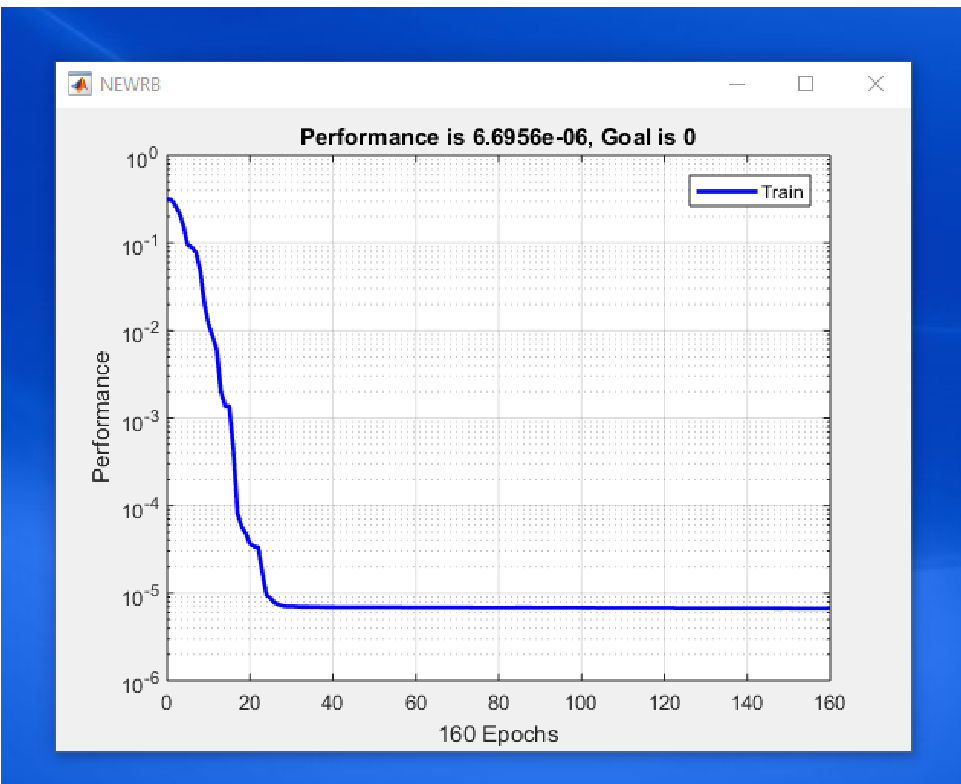
The RBN didn't just match the accuracy of the iterative fmincon solver (achieving Mean Squared Errors as low as ); it obliterated it in terms of speed.
 In Figure 4, the RBN (dots) perfectly tracks the reference solvers (line) across shifting wind power scenarios.
The Efficiency Gap
The results in System B (40 generators) were particularly striking. While a standard MPN was roughly 10x faster than the conventional solver, the RBN was nearly 100x faster than the MPN and 700x faster than the classical solver.
| Method | Computation Time (ms) | Speed Ratio () |
|---|---|---|
| Fmincon | 76.3 | 100% |
| MPN | 6.76 | 8.86% |
| RBN | 0.109 | 0.14% |
Critical Analysis & Conclusion
This work highlights a significant shift in power systems: moving away from online optimization toward offline training with online inference.
Takeaway: RBNs are exceptionally well-suited for mid-scale ELD problems because their single-layer Gaussian kernels can capture the non-linear "cost-to-generation" curves more efficiently than deep sigmoidal networks.
Limitations: While the speed is impressive, the paper omits the "feasibility" check. In real-world deployment, a neural network might occasionally predict a value that slightly violates a hard constraint. Future work should explore constrained neural networks or "projection layers" that guarantee 100% adherence to physical grid limits.
Future Outlook: As we move toward grids with thousands of distributed energy resources, the RBN's ability to provide sub-millisecond dispatch instructions will be a cornerstone of stable, renewable-heavy energy markets.