
Maximizing Gains in the Mobile Cloud: An SMDP-Based Economic Approach
On Economic Mobile Cloud Computing Model
This paper proposes an Economic Mobile Cloud Computing Model based on the Semi-Markov Decision Process (SMDP). It aims to optimize resource allocation by balancing system gains for cloud providers and operational expenses for mobile users, specifically addressing offloading decisions in capacity-constrained environments.
TL;DR
Mobile Cloud Computing (MCC) allows power-hungry apps to run on resource-constrained devices by offloading "weblets" to the cloud. This paper introduces the first economic service provisioning scheme using a Semi-Markov Decision Process (SMDP). It doesn't just manage traffic; it calculates the most profitable way to allocate CPU virtual images while considering the mobile user's battery life and the cloud provider's revenue.
Problem & Motivation
The rise of 4G/LTE has made cloud-mobile communication seamless, but the cloud isn't an infinite resource. Cloud providers face a tripartite challenge:
- Limited Capacity: Hardware has a fixed number of virtual images (CPUs).
- Economic Leakage: When a local cloud is full, it must transfer tasks to another domain (Inter-domain transfer), resulting in lost revenue.
- User Sensitivity: Mobile users care about battery savings versus the cost of using the service.
Previous works like CloneCloud focused on execution speed but ignored the provider's economic ecosystem. The authors recognized that a "pay-as-you-go" model needs a sophisticated decision engine to decide if a task should be accepted or moved elsewhere to maximize long-term gains.
Methodology: The SMDP Core
The authors model the cloud as a system with CPUs, reserving units for internal transfers to minimize service disruption.
1. The State Space
The system state is defined by the number of new weblets (), intra-domain transfers (), and the current event (Arrival of new/transfer requests or a Leave event).
2. The Reward Function: Why "Economic"?
The reward isn't just money; it’s a weighted formula: By using weight factors (), the model can prioritize either the provider's profit or the user's energy efficiency, creating a tunable "Economic" balance.
3. Architecture Overview
The model operates within the MobiCloud framework, using "weblets" as portable application components.
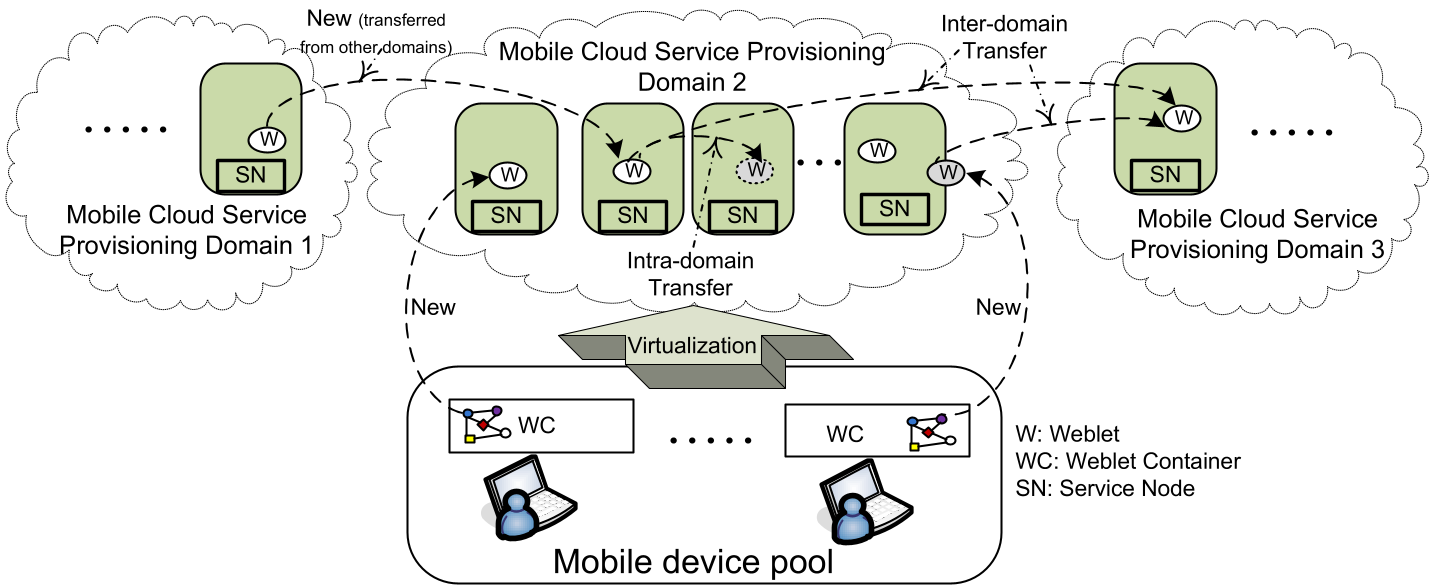 Figure 1: The logic of weblet migration between Mobile Devices and Cloud Service Nodes.
Experiments & Results
The researchers compared their SMDP-based model against the traditional Guard Occupation Model.
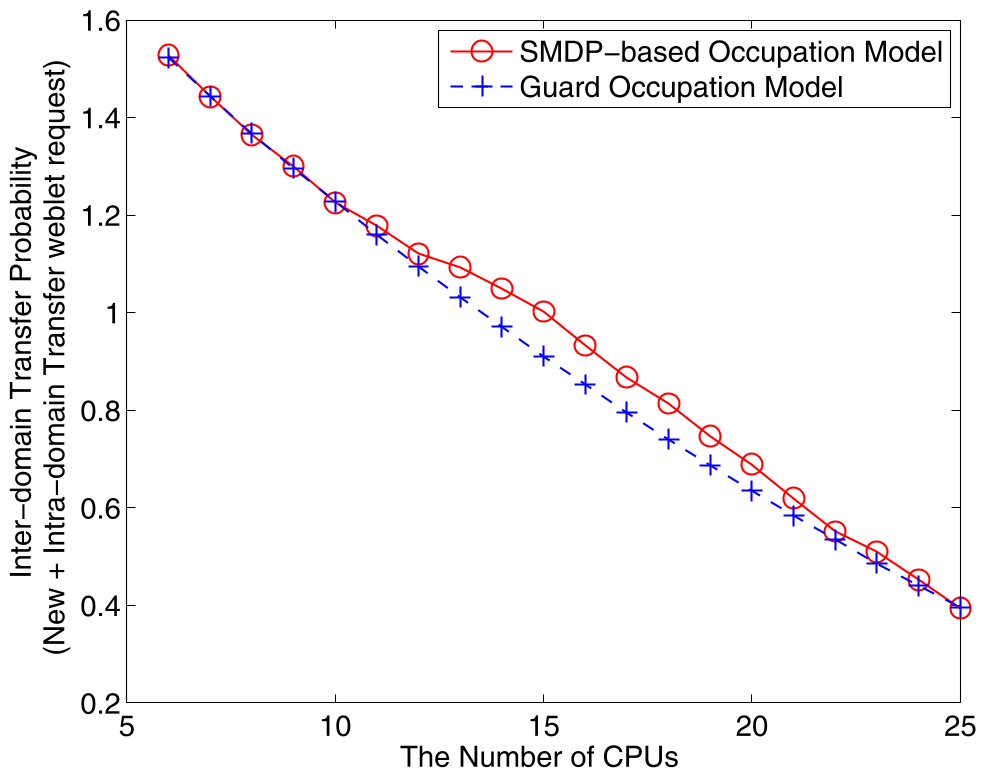 Figure 3: Inter-domain transfer probability vs. Number of CPUs.
Key Observations:
- Extreme Scenarios: When CPUs are very scarce (<10) or very abundant (>22), both models perform similarly because the environment dictates the outcome.
- The "Economic" Trade-off: In the moderate range (10-22 CPUs), the SMDP model actually shows a higher transfer probability. While this might seem like a disadvantage, it is a deliberate choice: the model chooses to transfer less "profitable" tasks to maintain resource availability for higher-gain tasks, optimizing total system reward rather than just minimizing transfer rates.
Critical Analysis & Conclusion
Takeaway
This work marks a shift from "Cloud as a Utility" (purely technical) to "Cloud as an Economy" (value-driven). It provides a mathematical framework to ensure that offloading remains beneficial for both the provider's bottom line and the user's hardware longevity.
Limitations
- Simplicity of Tasks: The current model assumes single-threaded weblets. In reality, modern applications are multi-threaded and require varying levels of security and priority.
- Static Coefficients: The weight factors for energy vs. income are assumed to be fixed, but in real-world scenarios, these might change dynamically (e.g., a user might pay more when their battery is at 5%).
Future Outlook
The next frontier is extending this SMDP logic to multi-core CPUs and incorporating task-specific constraints like latency sensitivity for AR/VR applications, where a transfer doesn't just mean a loss of revenue, but a catastrophic failure in user experience.