
Beyond Zero: The Calculus of Negative Pricing in Digital Economies
An Economic Model for Pricing Digital Products
This paper develops a novel economic model for domesticating digital products by shifting the focus from quantity-based neoclassical models to price-controlled frameworks. It investigates how low marginal costs and advertising subsidies enable "negative pricing" (customer subsidies) and provides a quantitative "Lerner condition" variant for digital services like search engines and social networks.
TL;DR
Why is Google free? Why did Microsoft once pay users to use "Live Search"? This paper by Gerald V. Post moves beyond traditional supply-and-demand to build a digital-first economic model. It proves that when marginal costs approach zero and advertising revenue flows in, the mathematically "optimal" price isn't just zero—it's often negative.
Context: The Death of Scarcity
In the physical world, making the 1,000,000th car costs roughly the same as the 1,000th. In the digital world, the marginal cost (MC) of the 1,000,000th song download is essentially the cost of a few megabytes of bandwidth. Traditional economics, which focuses on firms adjusting quantity to market price, breaks down here. In the digital realm, firms set the price (often $0) and let the "infinite" quantity take care of itself.
The "Adway" to Negative Prices
The core of the paper’s methodology is the integration of advertising revenue () as a per-unit subsidy. The author derives a modified profit-maximization equation that looks like a twist on the classic Lerner Index:
Why this matters:
- The Ad-Sharing Rule: If demand is linear, the firm should give half of its ad revenue back to the user. If demand is exponential, it should give all of it back to stay optimal.
- The Breaking Point: When (ad revenue per unit) exceeds (marginal cost), the numerator becomes negative. If the market is elastic enough, the firm should pay the user to consume the product.
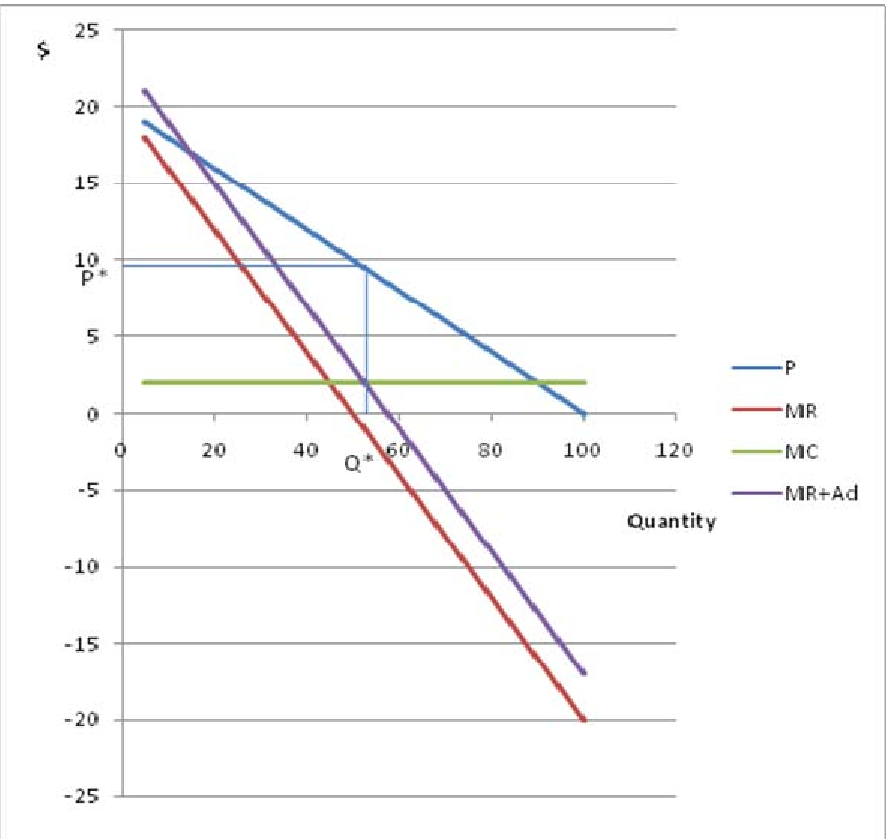 In this figure, the advertising revenue shifts the Marginal Revenue curve, allowing the optimal price (P) to drop significantly while increasing quantity (Q*).*
The Consumer’s Perspective: It’s Not Just About Money
The paper doesn't just look at the firm; it looks at the "Utility" of the user. Why do people pay for iTunes (or Spotify) when "free" (pirated) music exists?
The author introduces Time (T) as a cost.
- The Intuition: A "free" service that is hard to use or slow is actually more expensive than a paid service that is seamless.
- The Formula for Success: A user will switch to a new service if the Money Saved > Value of Time Lost.
Numerical Breakdown: When do we get paid?
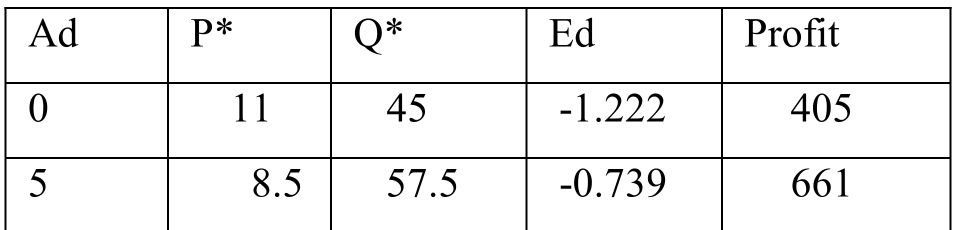
Using a sample linear demand curve (), the paper simulates how prices drop as ad revenue grows:
| Ad Revenue | Optimal Price () | Note |
|---|---|---|
| $0 | $11.0 | Standard Monopoly pricing |
| $5 | $8.5 | Sharing the wealth |
| $25 | -$1.5 | The Subsidy Zone |
Critical Insight: The "Infinite Demand" Fallacy
One might worry that if you pay people to use a service, they will use it infinitely, crashing the system. Post argues this won't happen for two reasons:
- Time Constraints: Humans only have 24 hours a day to consume content.
- Bandwidth Caps: Physical infrastructure still limits the "byte-flow."
- The "Gaming" Protection: Smart firms place a cap () on the maximum subsidy a single user can collect.
Conclusion
This paper provides a rigorous mathematical backbone for what we intuitively see in the App Store and Search markets. It suggests that as AI lowers the marginal cost of content generation even further, the competition for user attention (as measured by ) will inevitably push more products into the realm of negative pricing. The winner won't be the one with the lowest cost, but the one with the most efficient user experience (the lowest "Time Cost").